Choosing treatment and surgery
What does a total knee replacement replace?
It reconstructs damaged joint surfaces rather than removing the whole knee.
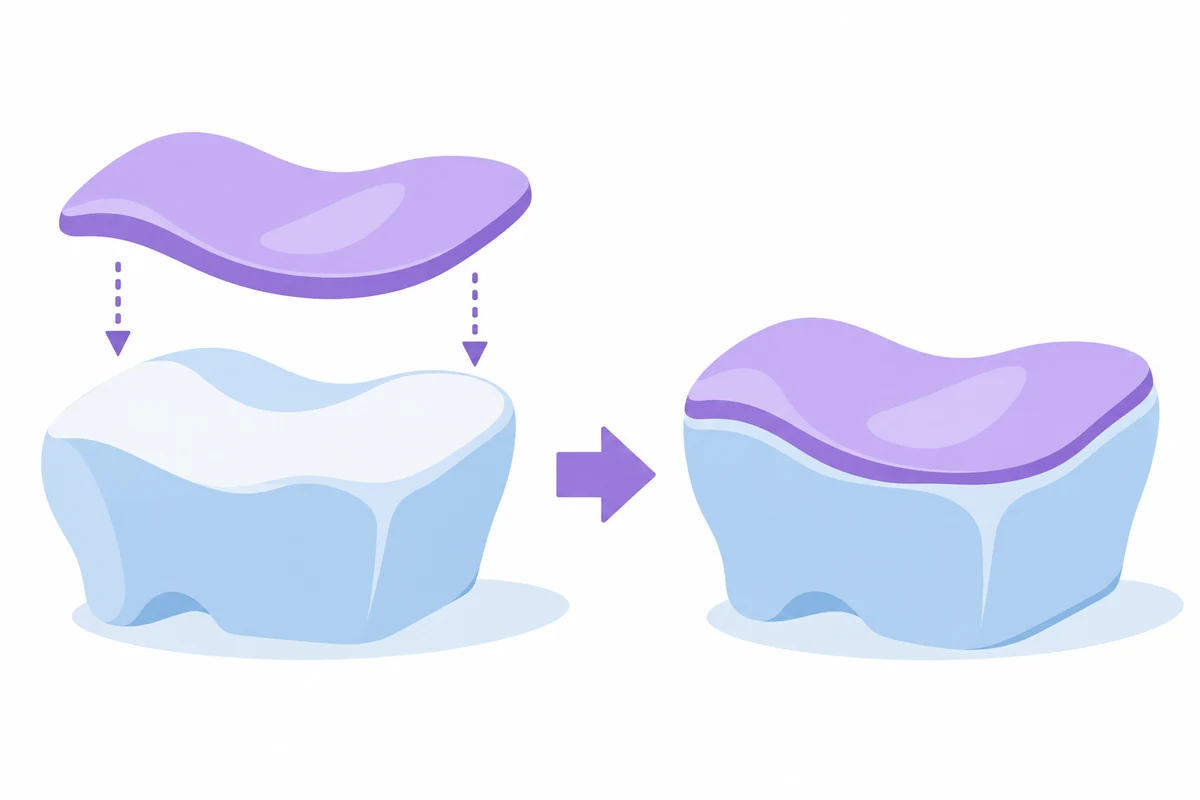
At a glance
- Replacement reconstructs surfaces, not the entire leg bones.
- Patellar, ligament and fixation choices depend on the knee.
- Strength and walking still need rehabilitation.
The phrase a new knee can suggest that the entire joint is exchanged. Total replacement prepares damaged cartilage and some underlying bone, then reconstructs surfaces with metal and medical-grade plastic. Remaining bone, ligaments and muscles still have important roles.
What replacement changes and rehabilitation restores
- 01
Prepare
Damaged femoral and tibial surfaces
- 02
Reconstruct
Metal, plastic and ligament balance
- 03
Recover
Movement, strength and safe walking
Surface preparation, implants and balance, functional recovery
The thighbone and shinbone surfaces
The worn end of the femur and top of the tibia are prepared and components fixed in place. A plastic spacer forms the contacting surface between components during movement.
Partial replacement may be considered when damage is limited. Selection depends on other compartments, ligament function and alignment, not pain location alone.
The kneecap is assessed separately
The patella moves along the thighbone groove as the knee bends and straightens. Its back surface may be resurfaced or retained.
The term total replacement does not mean every patella is treated identically. Ask how cartilage, bone thickness and tracking affect the choice.
Alignment, ligaments and fixation matter
Placing metal is not the whole operation. Bone cuts, component size and position, and ligament balance are checked together to support stable movement at different angles.
Cemented and cementless fixation and different ligament-related designs are available. Understanding why a design fits your bone and ligaments is more useful than its name alone.
Strength still needs recovery
Changing joint surfaces does not instantly restore weak muscles or walking habits. Pain and swelling management, movement, strengthening and gait recovery remain necessary.
The aim is improved pain and daily function. Sensations may differ from the original knee and some limits can remain. Discuss likely activities and rehabilitation before surgery.
Common Questions
Is all the knee bone removed?
Damaged surfaces and some underlying femoral and tibial bone are prepared, not the whole leg bones.
What is the plastic inside?
Medical-grade polyethylene contributes to the joint surface and stability between components.
Will I immediately walk well once implants are inserted?
Movement, strength and balance need rehabilitation, with individual variation in recovery.
Evidence and references
01When to seek medical care
Each warning sign is a separate reason to seek care. Follow the action below if any one applies.
Emergency department · call 119 in Korea
- Call 119 for sudden breathlessness or chest pain, severe faintness or loss of consciousness. Do not wait for calf swelling to appear.
- Go to an emergency department if you suddenly cannot bear any weight, or if an injured knee swells rapidly or looks deformed. A cold or numb foot after injury also needs immediate assessment.
- Seek emergency care for a hot, swollen and severely painful joint with high fever, shaking chills, confusion or inability to bear weight.
- With back or leg pain, go immediately to an emergency department for new difficulty passing urine, loss of bladder or bowel control, or numbness around the genitals or anus. Severe or rapidly worsening weakness or numbness in both legs also needs immediate assessment.
Same-day assessment
- Arrange assessment today for a newly hot, swollen joint, sudden severe pain, or a knee locked so that it cannot fully straighten. Joint infection can occur without fever.
- Have new swelling or pain in one calf assessed today for a possible blood clot. Call 119 immediately if breathlessness or chest pain develops.
- Severe knee pain or a new limp in a growing adolescent may come from a hip condition such as slipped capital femoral epiphysis. Stop walking and sport and arrange assessment today. Go directly to emergency care if they cannot bear weight.
- Stop running and seek assessment today for new recurring groin pain, pain with walking or at night, or a limp. A femoral neck stress fracture needs to be considered. Keep weight off the painful leg until assessed. Go to emergency care if you cannot bear weight.
Book an outpatient appointment
- If none of the warning signs above is present, book an appointment for pain lasting a few weeks, repeated swelling or reduced daily activity and exercise.