Injuries, tendons and menisci
How should partial and total knee replacement be compared?
The extent of arthritis and ligament function matter before incision size.
At a glance
- Assess compartments and ligament function first.
- Compare preservation benefits with possible further surgery.
- Early recovery and long-term outcomes are distinct.
It is tempting to assume that the smaller operation is always better. Partial and total replacement resurface different amounts of the joint and suit different patients. First understand which compartments are damaged and how the remaining surfaces and ligaments function.
Compare preservation and reconstruction
- 01
Partial
Resurface one area and preserve others
- 02
Total
Reconstruct broader joint surfaces
- 03
Selection
Compartments, ligaments, deformity, function and goals
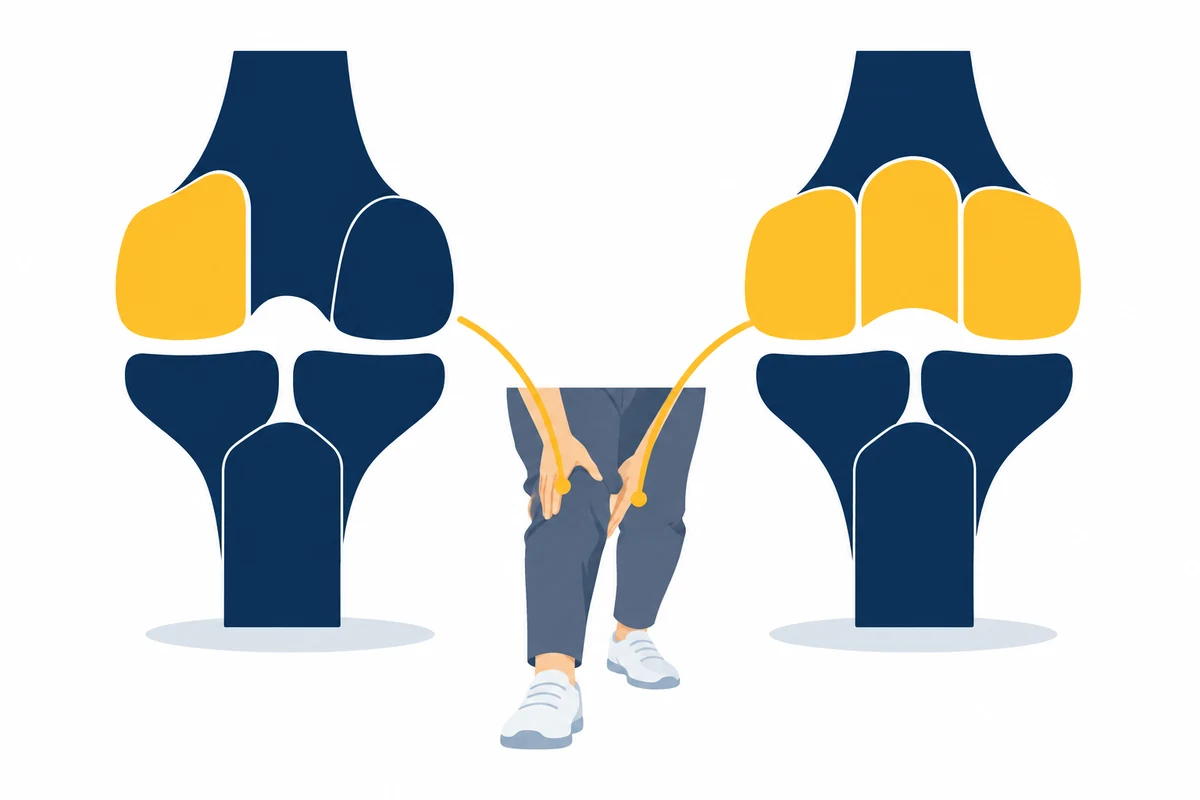
Panels comparing one-compartment resurfacing, broader reconstruction and selection factors
The knee has several compartments
The medial and lateral thighbone–shinbone compartments and the joint behind the kneecap are assessed separately. Partial replacement resurfaces one affected area. Total replacement reconstructs broader femoral and tibial surfaces; treatment of the patella varies.
Medial pain alone does not establish that other compartments are healthy. Standing and other X-ray views, movement and ligament examination are needed. Previous operations and desired activities also matter.
Partial replacement depends on appropriate selection
It may be considered when arthritis is concentrated in one compartment and other surfaces and ligament function are suitable. Marked stiffness, ligament problems and wider damage affect eligibility. Pain location or age alone cannot determine it.
Suitable patients may benefit from tissue preservation and aspects of early recovery. However, arthritis or another problem in the remaining joint can require further surgery. Discuss preservation benefits alongside possible revision.
Total replacement has recovery needs and limitations
Wider arthritis, deformity and ligament or functional problems may support considering total replacement. It does not remove the entire knee; damaged joint surfaces are reconstructed with metal and plastic components. Planning and rehabilitation both matter.
Total replacement cannot guarantee freedom from all pain or every activity. Discuss infection, clots, persistent pain and daily-life goals. If partial replacement appears possible but total replacement is recommended, ask for the specific reasons.
Compare the same outcomes
Early recovery, pain and function, and long-term revision are different outcomes. AAOS guidance discusses short-term functional benefits and potentially higher longer-term revision risk for partial replacement in suitable medial arthritis. Individual outcomes depend on the knee and clinical context.
Do not compare only hospital stay or incision length. Ask why the recommendation fits your joint, what alternatives offer, what support recovery needs and which future options remain. The goal is an appropriate operation, not simply the smallest one.
How long can a knee replacement last?
Long-term registry data estimated that about 82% of total knee replacements and 70% of partial knee replacements were still in place without revision surgery at 25 years. The precise estimates in the 2019 Lancet review were 82.3% and 69.8%, respectively.
These figures come from historical surgical cohorts in Finland. The life of an individual knee replacement varies with age at surgery, the implant, its fixation, and activity level. Total and partial replacement are also used in different patients and knee conditions, so these percentages alone do not determine which operation to choose. Continue to monitor pain and walking ability. If new pain or swelling persists, seek assessment before your next routine appointment.
Common Questions
Does medial pain mean partial replacement?
No. Other compartments, ligaments, movement and images must be assessed.
Does older age require total replacement?
Age alone does not decide. Joint extent, function, health and goals matter.
Can partial replacement later become total replacement?
Conversion may be considered if needed, but complexity and outcomes depend on the problem. It is not a simple scheduled next step.
Evidence and references
01When to seek medical care
Each warning sign is a separate reason to seek care. Follow the action below if any one applies.
Emergency department · call 119 in Korea
- Call 119 for sudden breathlessness or chest pain, severe faintness or loss of consciousness. Do not wait for calf swelling to appear.
- Go to an emergency department if you suddenly cannot bear any weight, or if an injured knee swells rapidly or looks deformed. A cold or numb foot after injury also needs immediate assessment.
- Seek emergency care for a hot, swollen and severely painful joint with high fever, shaking chills, confusion or inability to bear weight.
- With back or leg pain, go immediately to an emergency department for new difficulty passing urine, loss of bladder or bowel control, or numbness around the genitals or anus. Severe or rapidly worsening weakness or numbness in both legs also needs immediate assessment.
Same-day assessment
- Arrange assessment today for a newly hot, swollen joint, sudden severe pain, or a knee locked so that it cannot fully straighten. Joint infection can occur without fever.
- Have new swelling or pain in one calf assessed today for a possible blood clot. Call 119 immediately if breathlessness or chest pain develops.
- Severe knee pain or a new limp in a growing adolescent may come from a hip condition such as slipped capital femoral epiphysis. Stop walking and sport and arrange assessment today. Go directly to emergency care if they cannot bear weight.
- Stop running and seek assessment today for new recurring groin pain, pain with walking or at night, or a limp. A femoral neck stress fracture needs to be considered. Keep weight off the painful leg until assessed. Go to emergency care if you cannot bear weight.
Book an outpatient appointment
- If none of the warning signs above is present, book an appointment for pain lasting a few weeks, repeated swelling or reduced daily activity and exercise.