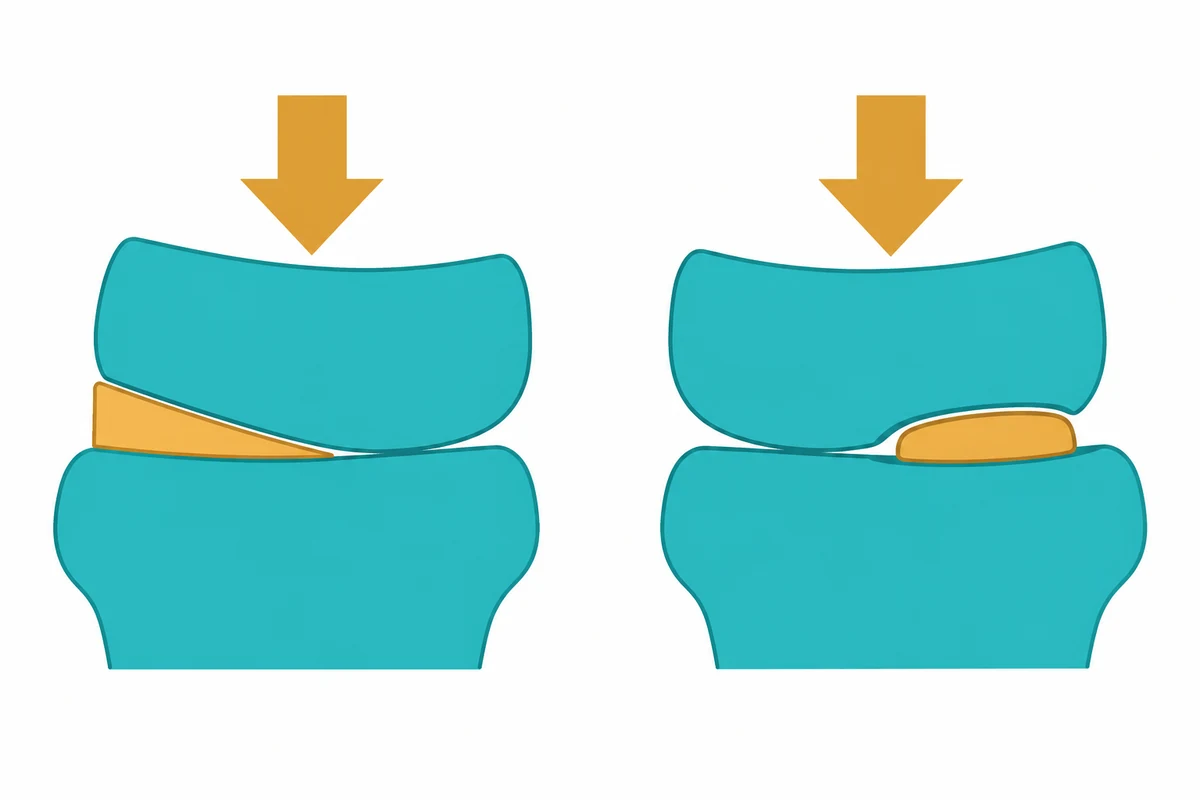
One person with medial knee wear may receive osteotomy, another partial replacement. Both may address medial pain, but differently: osteotomy changes the path of weight-bearing, while partial replacement replaces one damaged compartment’s surface. Start by asking which problem in your knee the procedure is intended to solve.
Does the knee have separate compartments?
Assess the medial and lateral femur–tibia compartments and the joint behind the patella separately. Arthritis may be widespread or concentrated in one area; medial pain does not prove the rest is healthy. Weight-bearing and other X-rays, movement, and ligament condition matter. Tell the clinician about prior substantial meniscus removal, which helps explain the current joint.
Does osteotomy create new cartilage?
Osteotomy changes bone shape and angle to redirect load, for example away from an overloaded medial compartment toward a healthier region. It does not directly replace worn cartilage. The decision is whether preserving the joint can improve pain and function; correction location and amount are planned from whole-leg alignment and deformity.
What does partial knee replacement change?
Partial replacement replaces the damaged surface of one arthritic compartment with metal and plastic, preserving other joint surfaces and ligaments in suitable patients. Suitability depends on OA extent, ligament function and stiffness, not incision size. Remaining compartments matter; later progression may require further treatment or total replacement.
Can age alone determine the operation?
Age and activity alone do not choose an operation. Consider the extent of arthritis, which bone contains the deformity, ligament stability, and real activity goals. Similar medial pain may require total replacement if multiple compartments are damaged. Ask why an option fits the examination and your life instead of assigning an operation solely by age.
How does recovery differ?
After osteotomy, bone healing must be checked; weight-bearing depends on procedure, fixation and union. Partial replacement also needs wound, strength and gait rehabilitation. Internet timelines are not personal schedules. Work and sport require different movements, so discuss walking, driving and squatting separately.
What should be explained before choosing?
Ask about alternative operations, benefits and drawbacks, expected pain relief and recovery. For osteotomy, identify the deformity being corrected; for partial replacement, the preserved compartments and ligament condition. Discuss future options if OA progresses and your work, sport and caregiving needs. Suitability matters more than calling it a “small operation.” Plan family support and workplace adjustments alongside the procedure choice.
How long can a knee replacement last?
Long-term registry data estimated that about 82% of total knee replacements and 70% of partial knee replacements were still in place without revision surgery at 25 years. The precise estimates in the 2019 Lancet review were 82.3% and 69.8%, respectively.
These figures come from historical surgical cohorts in Finland. The life of an individual knee replacement varies with age at surgery, the implant, its fixation, and activity level. Total and partial replacement are also used in different patients and knee conditions, so these percentages alone do not determine which operation to choose. Continue to monitor pain and walking ability. If new pain or swelling persists, seek assessment before your next routine appointment.