R.Du Hyun RoOrthopedics & Research
Text
← The Story of Research

knee shape and change · 2026

Can Knee Alignment Tell Us Who Will Develop Osteoarthritis?

In knees without OA followed for 5 years, joint-line obliquity, rather than the type number, was associated with OA onset.

The Bone & Joint Journal · J-S. Kim, S. J. MacDessi, D. W. Lee, D. H. Ro

Results explained with study numbers

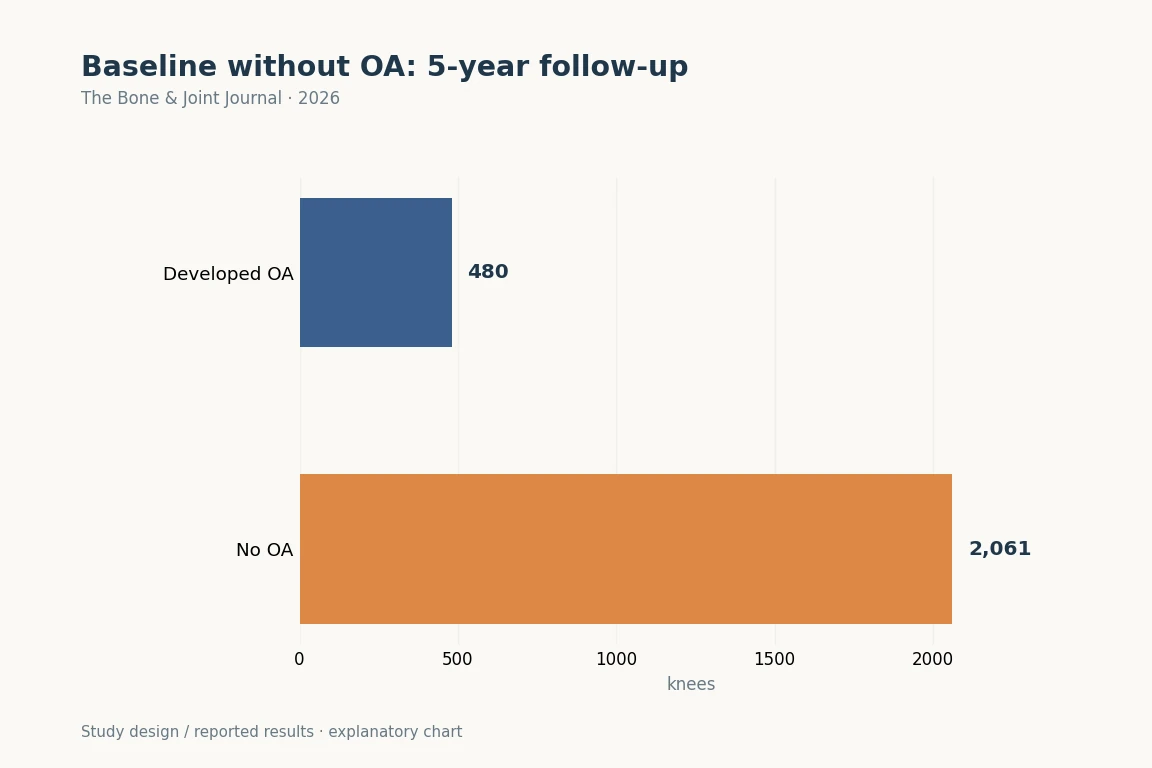
Among 2,541 knees without baseline OA, 480 developed OA over five years. The study examined continuous JLO measures and OA onset, beyond categorical alignment types.Enlarge Figure

Among 2,541 knees without baseline OA, 480 developed OA over five years. The study examined continuous JLO measures and OA onset, beyond categorical alignment types.

The Bone & Joint Journal (2026). DOI: 10.1302/0301-620X.108B7.BJJ-2025-0687.R2 · Original explanatory chart based on reported data

Evidence & Original SourceImage use terms
01

So the angle itself is more than the type number.

Bowlegs or knock-knees alone do not fully describe knee shape. Femoral and tibial angles and joint-line obliquity also differ. CPAK groups these features into nine types. We asked whether category names or continuous angles better explain later arthritis onset.

02

2,541 knees without OA were reassessed after 5 years

MOST knees initially below X-ray KL 2 were analyzed. Over 5 years, 480 reached KL ≥2. This defines radiographic onset, not severe pain or surgical need in every case. Alignment change was separately analyzed in knees with follow-up images.

03

Why do red and blue dots overlap?

The figure shows baseline shapes in knees that did and did not develop OA. The distributions overlap substantially, and CPAK type itself was not significantly associated with onset. Lower JLO, indicating a more oblique joint line, was associated. Recording continuous angles may therefore be more informative for research than type numbers alone.

04

So 1.36 times the number reads like this.

The group below the data-derived JLO cutoff of 171.6° had 1.36 times the odds of onset compared with the group above it. An odds ratio is not the same as multiplying the probability by 1.36. The number cannot determine from one individual’s X-ray that arthritis will occur. The cutoff needs validation in other populations.

05

It's not the end of the line that we need to fix the bridge.

An association between shape and OA onset does not prove that surgery on an asymptomatic leg prevents arthritis. Care considers pain, function, previous injury and daily life. The paper identifies more precise candidate markers; research on alignment and actual treatment effects must continue.

Look at the study numbers again.

2,541Knees without OA at baseline
5 yearsFollow-up period
18.9%Proportion developing osteoarthritis
RESEARCH FINDINGknee

Composition of the study sample

Onset within 5 years
480
No onset
2,061
01,1852,370
Counts of data included in the study. These do not show treatment effects or an individual’s risk.

Common Questions

Can we apply these results directly to individual therapies?

An association between shape and OA onset does not prove that surgery on an asymptomatic leg prevents arthritis. Care considers pain, function, previous injury and daily life. The paper identifies more precise candidate markers; research on alignment and actual treatment effects must continue.

Methods and Numbers in Detail

Coronal alignment parameters of the knee predict osteoarthritis development: A Coronal Plane Alignment of the Knee classification-based analysis using the Multicenter Osteoarthritis Study data

Participants and Methods

2,541 MOST knees with KL <2 at baseline, followed for 5 years. Alignment-change analysis included 2,314 knees with follow-up full-length radiographs.

CPAK types and continuous aHKA and JLO values were compared. Covariate-adjusted logistic regression assessed associations with the development of KL ≥2, and linear regression was used for changes in JLCA.

Results Reported in the Paper

  1. Over 5 years, 480 knees (18.9%) developed KL ≥2. CPAK type itself was not significantly associated with onset.
  2. Decreased JLO was associated with onset (OR 1.048 per 1° decrease; 95% CI 1.001–1.098). With JLO <171.6°, the odds of onset were 1.36 times those at or above that threshold (95% CI 1.053–1.770).
  3. The regression coefficient relating aHKA to change in JLCA was −0.139 (95% CI −0.241 to −0.036).

Scope of Interpretation

This observational association does not prove alignment correction prevents OA. The 171.6° cutoff was derived from these data, not a universal surgical target or diagnostic risk threshold. Consider 5-year observation, MOST’s high-risk population and image selection/attrition.

Keywords

Abstract · Original text

Ji-Sahn Kim, Samuel J MacDessi, Do Weon Lee, Du Hyun Ro. Coronal alignment parameters of the knee predict osteoarthritis development : a Coronal Plane Alignment of the Knee classification-based analysis using the Multicenter Osteoarthritis Study data. The bone & joint journal. 2026;108-B(7):889-897. doi:10.1302/0301-620X.108B7.BJJ-2025-0687.R2.

AIMS

Mechanical varus or valgus alignment measures have been demonstrated to be closely related to knee osteoarthritis (KOA) development, but few attempts have been made to correlate the Coronal Plane Alignment of the Knee (CPAK) classification and disease development. This study hypothesized that certain CPAK types or deviations in CPAK parameters might enhance the risk of KOA development.

METHODS

KOA was defined as a Kellgren-Lawrence grade of 2 or higher. Data from 2,541 knees without KOA at baseline from the Multicenter Osteoarthritis Study (MOST) over five years of follow-up were examined. Differences in baseline CPAK types and parameters were analyzed between knees that developed KOA and those that did not. The association of CPAK type, arithmetic hip-knee-ankle angle (aHKA), and joint line obliquity (JLO) with the risk of disease development and joint line convergence angle (JLCA) changes were assessed.

RESULTS

Knees that developed KOA (480 knees; 18.9%) had significantly lower JLO (p = 0.022) and aHKA (p = 0.008) values than those that did not (2,061 knees; 81.1%). JLO was significantly associated with KOA development (odds ratio 1.048 (95% CI 1.001 to 1.098)). For knees with JLO values under the cut-off value of 171.6°, the risk of KOA development was 1.36 times higher than for those with values over the cut-off value (95% CI 1.053 to 1.770). aHKA showed a significant negative correlation with JLCA change (regression coefficient -0.139 (95% CI -0.241 to -0.036); p = 0.008). However, CPAK type itself showed no significant correlation with KOA development.

CONCLUSION

CPAK parameters, rather than types, were significantly associated with KOA development. Importantly, significant obliquity to the constitutional joint line might be as impactful as lower limb alignment. By potentially adjusting cut-off values, CPAK classification might be applied for predicting KOA development and investigating alignment-related aspects of KOA pathophysiology.