It's not like both knees are exactly the same shape.
If one knee hurts, you may wonder whether the other will change similarly. A less painful or less affected opposite knee can seem like a useful template. First, however, we need to ask whether the two knees of the same person always share an alignment type.
The study examined agreement in left–right knee shape and how one side’s imaging measures related to later alignment on the other. Its key approach was comparing analyses of each knee separately with analyses of both knees together.
3,045 Korean participants followed for an average of 4 years
Full-length X-rays of both legs assessed alignment at baseline and follow-up. FKP classifies femoral and tibial morphology; CPAK combines leg alignment and joint-line obliquity. We calculated the proportion of left and right knees sharing a category.
Groups were defined by baseline varus, neutral and valgus combinations. Measures associated with follow-up HKAA were analyzed, including both ipsilateral and contralateral measures to compare association strength.
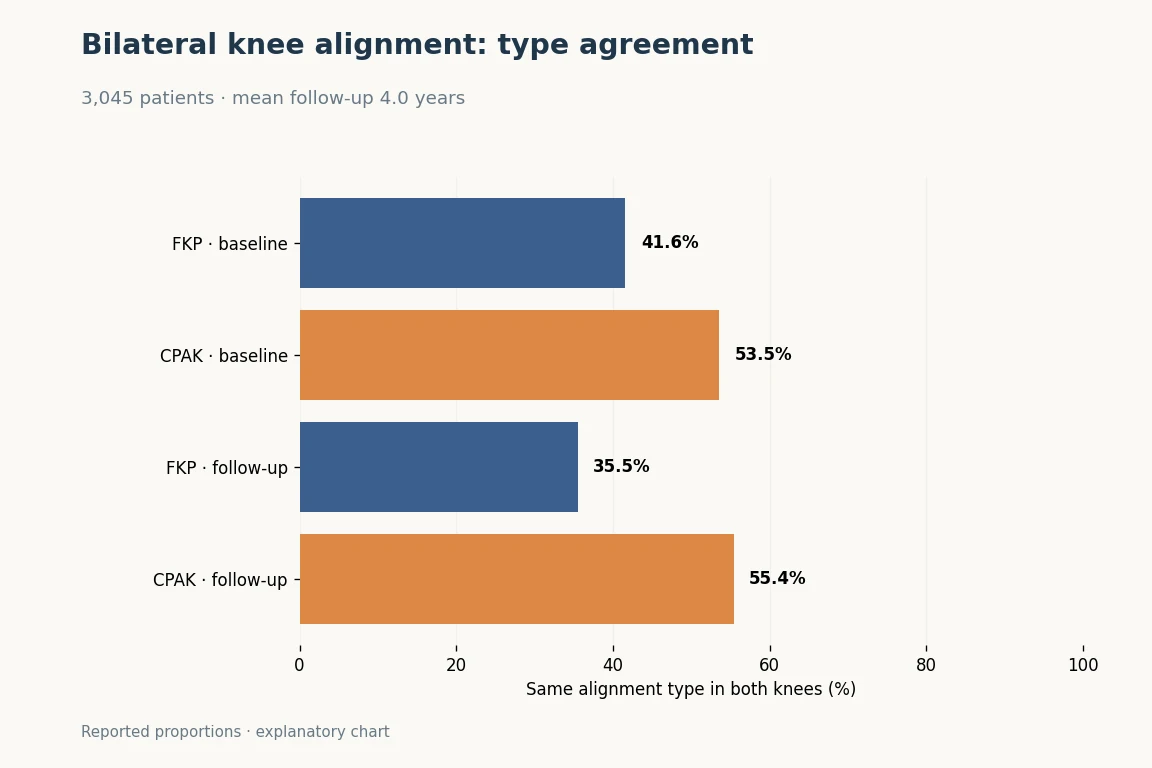
The initial rate of the same CPAK type was 53.5%.
Baseline bilateral agreement was 41.6% for FKP and 53.5% for CPAK; after a mean 4.0 years, 35.5% and 55.4%. Depending on classification, only around half of a person’s knees shared a type. “Same type” means the same category, not identical angles.
Some opposite-knee measures were also associated with follow-up alignment. Their standardized regression coefficients, however, were smaller than those of the knee being assessed. This is different from concluding that opposite-knee information is irrelevant.
The rise in CPAK agreement from 53.5% to 55.4% does not prove that the knees became more symmetric. The original paper notes that a limited number of categories can group different angle changes within the same type.
The other side is, you have to look at knee separately.
And this shows that it's hard to replace the shape of the other side as a straight answer. Because the alignment type of the coordinates can be different, and subsequent changes are more strongly related to how knee was at first.
It's not necessarily better that they are different. The differences in the way we classify them in our studies and the problems that need to be treated are not the same questions. We can use this research to talk about how uncomfortable each of these is in the clinic, and what changes we see in each video.
It's not a study that tested the effects of one surgery on another.
“Contralateral influence” in the title should not be read as a treatment effect. This study analyzed statistical associations between imaging measures in both knees and later alignment. It did not compare contralateral outcomes in patients with versus without surgery.
These numbers alone cannot set target arthroplasty angles or show that surgery on one knee reduces OA progression in the other. The study asks how similar the information from the two knees is and how it relates to alignment change.
The participants were Korean hospital patients, with many varus knees. Applicability to valgus knees or people without OA needs further study. Imaging position and leg rotation can also affect measured angles.