Choosing treatment and surgery
What happens to the kneecap during replacement?
Removing the whole patella is different from resurfacing its back surface.
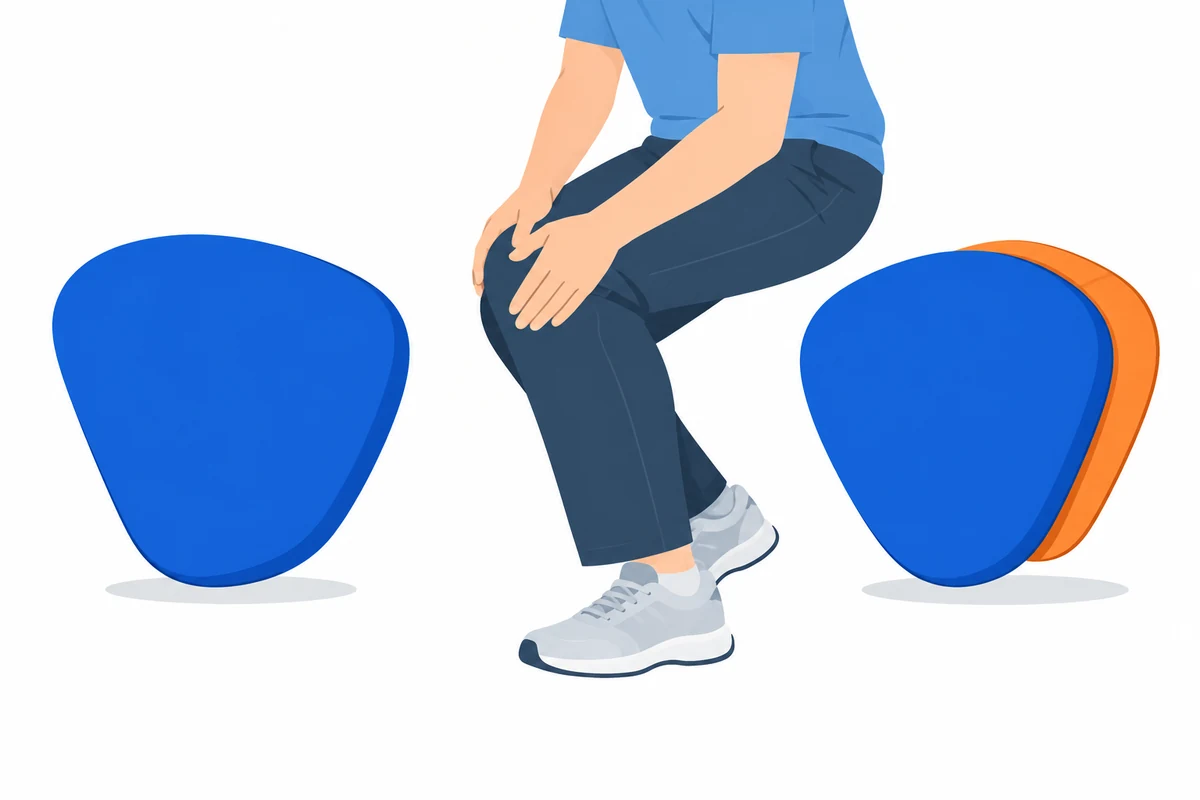
At a glance
- Distinguish whole-patella removal from resurfacing.
- Assess the surface, bone and tracking together.
- Evaluate strength and other causes of anterior pain.
The patella transfers thigh-muscle force to help straighten the knee. In total knee replacement, the kneecap and surrounding tissues are generally retained, while its back surface may be resurfaced or left in place.
Three considerations for the patella
Surface
Damage and resurfacing versus retention
Bone
Thickness, quality and fixation risk
Movement
Component position, strength and tracking
Surface, bone condition and movement
Assess its path of movement
The patella moves along the groove at the front of the femur. Cartilage, bone shape, alignment, muscles, tendons and ligaments all influence that path.
Femoral and tibial component position and rotation are assessed together with tracking. Front-of-knee pain cannot always be explained by patellar cartilage alone.
The surface may be replaced or retained
Resurfacing prepares the damaged back surface and fixes a plastic component. Retaining the original surface is also an option; neither approach is automatically best for everyone.
Consider cartilage, bone thickness and quality, previous surgery and implant design. Insufficient remaining bone raises concerns about fracture and fixation.
Understand the evidence and individual choice
The 2022 AAOS guideline did not find consistent overall outcome differences between resurfacing and nonresurfacing in the evidence reviewed. Both approaches can be considered in context.
Similar average outcomes do not mean every method is equivalent for your knee. Ask about the rationale, expected benefit, fracture or fixation risk and potential later treatment.
Reassess anterior pain by its cause
Pain at the front during stairs or standing up should prompt review of strength, movement, swelling, components and tissues. Do not assume that an unresurfaced patella is automatically the cause.
Report new pain, swelling or instability. Rehabilitation needs to restore thigh strength and safe movement as well as knee range of motion.
Common Questions
Is the kneecap removed?
Ordinary total replacement retains it and considers whether to resurface its back.
Does resurfacing eliminate anterior pain?
Multiple causes exist, so complete pain relief cannot be guaranteed by resurfacing alone.
Will a retained surface need surgery later?
Not necessarily. Further treatment depends on symptoms and the identified cause.
Evidence and references
01When to seek medical care
Each warning sign is a separate reason to seek care. Follow the action below if any one applies.
Emergency department · call 119 in Korea
- Call 119 for sudden breathlessness or chest pain, severe faintness or loss of consciousness. Do not wait for calf swelling to appear.
- Go to an emergency department if you suddenly cannot bear any weight, or if an injured knee swells rapidly or looks deformed. A cold or numb foot after injury also needs immediate assessment.
- Seek emergency care for a hot, swollen and severely painful joint with high fever, shaking chills, confusion or inability to bear weight.
- With back or leg pain, go immediately to an emergency department for new difficulty passing urine, loss of bladder or bowel control, or numbness around the genitals or anus. Severe or rapidly worsening weakness or numbness in both legs also needs immediate assessment.
Same-day assessment
- Arrange assessment today for a newly hot, swollen joint, sudden severe pain, or a knee locked so that it cannot fully straighten. Joint infection can occur without fever.
- Have new swelling or pain in one calf assessed today for a possible blood clot. Call 119 immediately if breathlessness or chest pain develops.
- Severe knee pain or a new limp in a growing adolescent may come from a hip condition such as slipped capital femoral epiphysis. Stop walking and sport and arrange assessment today. Go directly to emergency care if they cannot bear weight.
- Stop running and seek assessment today for new recurring groin pain, pain with walking or at night, or a limp. A femoral neck stress fracture needs to be considered. Keep weight off the painful leg until assessed. Go to emergency care if you cannot bear weight.
Book an outpatient appointment
- If none of the warning signs above is present, book an appointment for pain lasting a few weeks, repeated swelling or reduced daily activity and exercise.