In ACL reconstruction, careful graft harvesting is followed by an assessment of whether the harvested graft can support a safe reconstruction. Premature amputation during harvesting can leave insufficient length, while a small diameter raises questions about graft preparation and augmentation. This presentation addresses both prevention during harvesting and intraoperative alternatives. The key points are organized to support fellows in preoperative planning and intraoperative assessment.
Key points to remember
- If resistance occurs during harvesting, reassess accessory bands and adhesions. Forcing the stripper forward can lead to premature graft amputation.
- Assess diameter and length together. Even when additional strands increase diameter, sufficient length must remain for reconstruction and fixation.
- Each augmentation addresses a different problem. A 5-strand construct aims to increase diameter, suture tape provides mechanical load sharing, and LET addresses rotational instability.
- Evaluate a small hamstring graft alongside the patient's age, activity level, and rotational instability. An 8 mm threshold alone cannot classify risk for every patient.
Reducing injury during graft harvesting
The presentation covered hamstring, quadriceps tendon, partial rectus femoris, peroneal tendon, and BPTB grafts. Although harvesting techniques differ, they share the goals of obtaining sufficient length and minimizing donor-site and graft injury. The following points summarize the preventive measures emphasized in the presentation.
Identify accessory bands before harvesting the hamstrings
When harvesting the semitendinosus (ST) and gracilis (GR), release the accessory bands and soft-tissue connections that tether the tendons. The presentation emphasized checking connections and anomalous attachments within the proximal 10–12 cm. If the stripper does not advance smoothly, first reassess the source of resistance.
Pay attention to bone plug dimensions and extraction in BPTB harvesting
Patellar fracture and anterior knee pain are important concerns when harvesting a bone–patellar tendon–bone (BPTB) graft. The presentation highlighted a bone plug length of 20–25 mm, a trapezoidal shape no more than 1 cm deep, harvesting below the patellar equator, and avoiding excessive levering during bone plug extraction. The actual bone plug design should account for the patient's anatomy and the fixation method.
Assess quadriceps tendon length and bone plug position separately
For a quadriceps tendon (QT) graft, first confirm the tendon length needed for the planned construct. The considerations differ between soft-tissue harvesting and harvesting with a patellar bone plug. Avoid positioning the bone plug too far laterally, and assess both the tendon harvesting direction needed to obtain adequate length and a safe bone plug location in the patella.
Combine preoperative diameter prediction with intraoperative measurement
Final hamstring graft size varies between patients. Anthropometric measurements such as height, weight, and BMI, together with MRI measurements of tendon size, can help anticipate an insufficient diameter. The study by Ro et al. discussed in the presentation examined graft constructs for double-bundle reconstruction. When applying its prediction equations to other constructs, consider differences in measurement methods and study populations. Even after preoperative prediction, measure the actual length and diameter of the fully prepared graft. [1]
Several studies have reported an association between small hamstring graft diameter and revision surgery. In the registry study by Spragg et al., each 0.5 mm increase in diameter within the 7.0–9.0 mm range was associated with an odds ratio for revision of 0.82 (95% CI 0.68–0.98). This is an observed association; it does not mean that increasing diameter reduces revision surgery by the same proportion in every patient. [2]
An 8 mm threshold is commonly used when assessing a small hamstring graft. The presentation also proposed aiming for at least 8 mm when possible. However, this value is not a standalone safety threshold. Consider patient risk factors, including young age, a planned return to pivoting sports, and marked rotational instability, and prepare alternatives.
Compare options when graft diameter is insufficient
If the graft is small, assess the remaining tendon length and condition before considering a change in construct. Methods for increasing diameter and methods for reducing graft load can be considered together, but they address different problems.
Scroll the table horizontally to read the evidence notes.
| Option | Goal and requirements | Considerations when interpreting the evidence |
|---|---|---|
| 5-strand or 6-strand construct | Increase diameter by adding autograft strands. Confirm both the final length and the length available for fixation. | There are data showing increased diameter with 5-strand constructs. This should not be interpreted as proof that every construct prevents rerupture. [3] |
| Hybrid graft with added allograft | Add tissue to a small autograft to increase diameter. Consider allograft processing and the patient population. | An adolescent study reported unfavorable outcomes, while pooled studies found no significant difference. A larger diameter does not guarantee clinical benefit. [4],[5] |
| Suture tape augmentation | Mechanical augmentation that shares load with the graft. | Distinguish biomechanical experiments from clinical studies. The case series with 5-year follow-up is promising, but it does not provide randomized controlled trial evidence. [6],[7] |
| Addition of LET | Use lateral extra-articular tenodesis to control rotational instability and share graft load. | A 2-year randomized trial provides evidence in high-risk young patients. LET does not resolve inadequate length, tissue damage, or fixation problems. [8] |
| Braiding or an alternative graft | Braiding changes the construct; consider an alternative graft when reconstruction with the harvested tendon is difficult. | Braiding alone cannot be assumed to improve strength. Before changing grafts, review donor-site morbidity, the fixation plan, and preoperative consent. |
In a 5-strand construct, verify length as diameter increases
A typical 5-strand construct combines 3 semitendinosus strands with 2 gracilis strands. The presentation described obtaining approximately 22–23 cm of semitendinosus tendon to produce a final construct of approximately 7 cm. In a randomized study of 64 patients, Krishna et al. reported a mean diameter increase of 1.4 ± 0.3 mm after conversion to a 5-strand construct. This was the mean measured in that study; the increase and available length may differ between patients. [3]
Evaluate hybrid grafts beyond the increase in diameter
In the adolescent cohort reported by Pennock et al., among the 20 patients with follow-up in each group, failure occurred in 6 patients (30%) in the hybrid group and 1 patient (5%) in the small-autograft-only group. By contrast, the 2024 meta-analysis by Fan et al., including 14 studies and 1,411 patients, found no significant difference in failure rates between the two constructs. Age, initial graft diameter, and allograft processing varied across studies, making it difficult to conclude that all hybrid grafts are more or less safe. [4],[5]
Distinguish suture tape studies of reconstruction from studies of primary repair
Biomechanical studies of suture tape have reported less elongation under cyclic loading and higher failure loads. In the reconstruction augmentation case series by Wilson et al., 1 of the 90 patients (1.1%) available for final contact had a rerupture at a mean follow-up of 5 years. This was a single-center case series with a mean age of 34.7 years and no concurrent randomized control group. The same benefit therefore cannot be assumed for small grafts in high-risk adolescents. Studies of ACL primary repair should also be considered separately from studies of augmentation in ACL reconstruction. [6],[7]
Interpret the effects of LET within the population studied
The STABILITY study included patients aged 25 years or younger who met at least two of three criteria: grade 2 or greater pivot shift, a planned return to high-risk pivoting sports, or generalized ligamentous laxity. At 2 years, graft rupture occurred in 34/298 patients (approximately 11%) in the ACLR-only group and 11/291 patients (approximately 4%) in the ACLR+LET group. This study demonstrates a benefit of LET in a selected high-risk population. It should not be interpreted as evidence that every small graft can be used without modification. [8]
Protect the graft during passage
Even after harvesting and preparation, a bone plug may catch within the joint or at a tunnel entrance. The presentation cautioned against long bone plugs, particularly along a nonlinear passage route, and suggested preparing the femoral bone plug at no more than 25 mm, preferably 18–20 mm. Inspect the tunnel entrance and adjust bone plug orientation so that resistance is not addressed with stronger traction.
With a poor-quality allograft bone plug, the passing suture may cut through or fragment the bone. The presentation proposed distributing the traction load with an additional passing suture that grasps 1–1.5 cm of tendon tissue proximal to the bone plug. Assessing both bone plug condition and the passage route is essential.
Intraoperative assessment sequence for fellows
Identify the problem
Determine whether the issue is insufficient length, insufficient diameter, tissue injury, or a problem involving the bone plug, tunnel, or fixation.
Measure the remaining tissue
Assess the current length, diameter, extent of injury, and the length available for the planned fixation.
Reassess the autograft construct
Determine whether a 5-strand or 6-strand construct is feasible, then remeasure length and diameter after preparation.
Match patient risk to the purpose of augmentation
Consider age, the sport to which the patient plans to return, and rotational instability. Distinguish the problems addressed by suture tape and LET.
Review the graft conversion plan if reconstruction is difficult
Confirm donor-site morbidity for the alternative graft, the required instruments and fixation method, and the scope of preoperative discussion and consent.
Before surgery, discuss how to configure a small-diameter graft, which graft to use if premature amputation leaves insufficient length, and which augmentation to consider for marked rotational instability.
Presentation slides and symposium materials
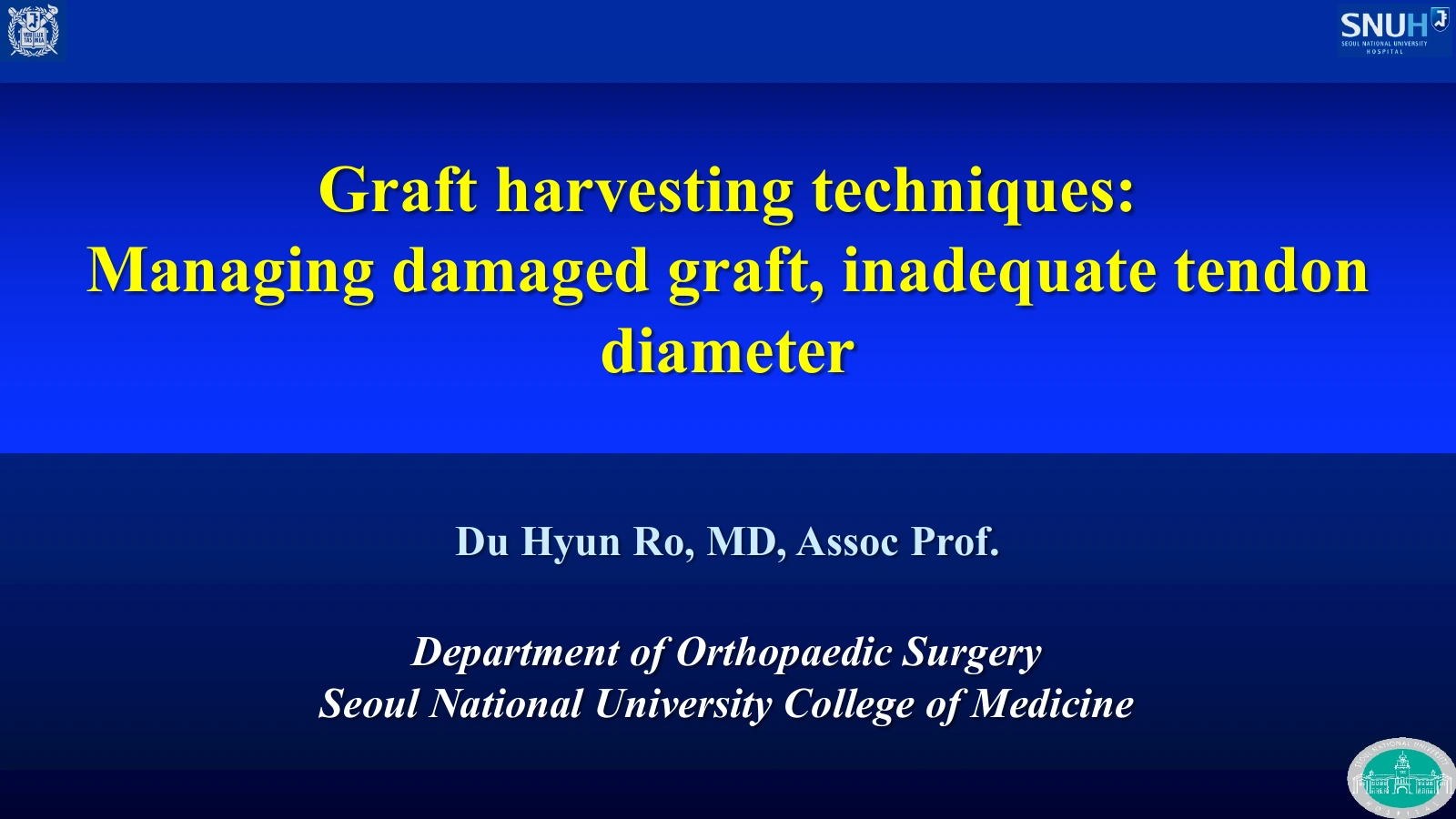
The harvesting demonstrations in the PDF are still images. Demonstration sources credited in the presentation: Prof. Thore Zantop (hamstring), Prof. Doo-Han Kim (partial rectus femoris graft), and Prof. Wolf Petersen (peroneal tendon).
Related papers
Increasing diameter, biomechanical effects, and preventing clinical rerupture are different outcomes. Interpret the findings alongside study design and patient population.
- Ro et al. 2020 · Anthropometry and prediction of graft size
Factors that Predicts the Size of Autologous Hamstring Tendon Graft for Double-Bundle ACL Reconstruction
Indian Journal of Orthopaedics. 2020;54:444–453.
Consider the graft construct and measurement methods used for double-bundle ACLR.
- Spragg et al. 2016 · Association between diameter and revision surgery
The Effect of Autologous Hamstring Graft Diameter on the Likelihood for Revision of Anterior Cruciate Ligament Reconstruction
American Journal of Sports Medicine. 2016;44:1475–1481.
This is a registry-based case-control study. It does not directly establish a causal effect of increasing diameter.
- Krishna et al. 2018 · 5-strand graft
Use of the 5-Strand Hamstring Autograft Technique in Increasing Graft Size in Anterior Cruciate Ligament Reconstruction
Arthroscopy. 2018;34:2633–2640.
A randomized study of 64 patients assessed the increase in diameter. Distinguish obtaining a larger diameter from preventing rerupture over the long term.
- Pennock et al. 2017 · Hybrid grafts in adolescents
Does Allograft Augmentation of Small-Diameter Hamstring Autograft ACL Grafts Reduce the Incidence of Graft Retear?
American Journal of Sports Medicine. 2017;45:334–338.
This is a small retrospective adolescent cohort. Its findings should not be generalized to all hybrid grafts.
- Fan et al. 2024 · Meta-analysis comparing hybrid grafts
Comparison of clinical outcomes between hamstring tendon autografts and hybrid grafts in ACL reconstruction: a systematic review and meta-analysis
Journal of Orthopaedic Surgery and Research. 2024;19:809.
The analysis pooled 14 studies and 1,411 patients. The search ended in July 2022, and patient populations and allograft processing varied across studies.
- Bachmaier et al. 2018 · Biomechanics of suture tape
Independent Suture Tape Reinforcement of Small and Standard Diameter Grafts for Anterior Cruciate Ligament Reconstruction: A Biomechanical Full Construct Model
Arthroscopy. 2018;34:490–499.
This is a laboratory biomechanical study. Distinguish it from studies assessing clinical rerupture rates in patients.
- Wilson et al. 2023 · 5-year follow-up of suture tape augmentation
Outcomes of Anterior Cruciate Ligament Reconstruction With Independently Tensioned Suture Tape Augmentation at 5-Year Follow-up
American Journal of Sports Medicine. 2023;51:3658–3664.
This is a single-center, single-surgeon case series with no concurrent randomized control group. The mean age was 34.7 years.
- Getgood et al. 2020 · STABILITY randomized trial
Lateral Extra-articular Tenodesis Reduces Failure of Hamstring Tendon Autograft Anterior Cruciate Ligament Reconstruction: 2-Year Outcomes From the STABILITY Study Randomized Clinical Trial
American Journal of Sports Medicine. 2020;48:285–297.
The population was aged 25 years or younger and met at least 2 criteria involving rotational instability, return to pivoting sports, or generalized ligamentous laxity.