knee doesn't have just one average.
When I describe the knee alignment, I use familiar words like O- and X-step. In the actual video, you can see the alignment of the entire bridge divided by the slope of knee and joint line. Even a bridge that looks similar on the outside can be a combination of both.
This study compared hospital visitors in Korea and the UAE. It asked whether common alignment types were the same, and whether differences remained after accounting for age and sex—a starting point for studying individual knee variation.
I compared the X-rays to age and sex.
Before analysis, the data included 7,138 Korean and 1,098 UAE participants, comprising 16,472 knees in total. These were historical images from people attending hospitals with knee symptoms. AI software measured alignment angles and OA grades and classified CPAK types.
A simple comparison of group proportions may mix in differences in age and sex composition. The study therefore used 1:2 propensity-score matching for age and sex. Matching reduces differences in specified factors; it does not make every condition identical.
There were different patterns seen in men and women.
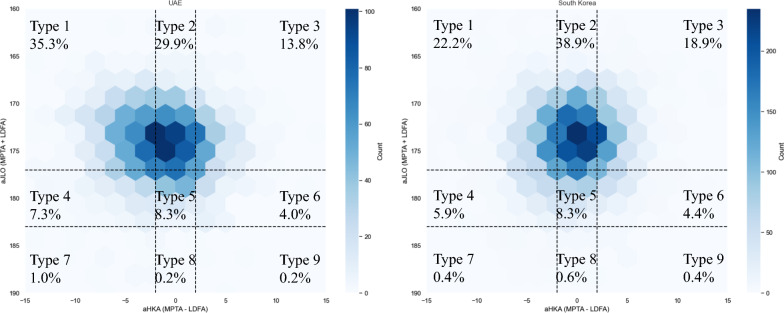
After matching, the most common male type was CPAK 1 in the UAE (42.4%) and CPAK 2 in Korea (30.6%). Women most often had type 2 in both populations: UAE 30.6%, Korea 35.3%. Breaking down sex and type explains the result more accurately than simply saying the countries differ.
The original plots show where individual knees fall within the classification. Many angles occur even within one named type. The most common type does not represent every knee in that population.
It's the basic data for studying individual surgery plans.
The results of the differing distributions in different groups show that it's difficult to describe all knee with just one average shape. In order to study the knee form and develop a surgery plan, we need to consider group characteristics together with individual video information.
But you can't just sort out a person from any country. We need to distinguish between group differences and individual conditions. Also, this study is not a clinical trial comparing which surgery angle is better for specific types of CPAK.
Even when the most common type differs by country, many types coexist within each country. Read the dense regions and the wider spread together to avoid confusing averages with individuals. Surgical planning requires information from that person’s own knee.
It's not a comparison of the entire population of the country.
Participants attended hospitals with symptoms. They were not a random sample of either country’s healthy general population, so the findings should not be generalized to national knee shapes or arthritis incidence.
BMI differences remained after matching for age and sex. Lifestyle and environmental factors may also contribute. This comparison cannot separate genetic background from body build or other explanations for the observed differences.
AI repeatedly measured the same variables across a large set of radiographs. The country comparison does not show that AI can recommend a particular treatment or determine a patient’s future course.