Daily life and exercise
How can water exercise help the knee?
Use buoyancy and resistance while preparing safe entry, exit and movement.
At a glance
- Buoyancy shares body weight; resistance changes with movement.
- Choose between strokes and water walking according to comfort.
- Check access, wet flooring, wounds and health too.
Water partly supports body weight and may make movement more comfortable than walking on land. Swimming skill is not essential for supervised shallow-water walking. Water does not replace treatment or make every movement safe, however.
Prepare, move and review in the pool
- 01
Prepare
Check entry, rails, depth and wound status.
- 02
Move
Use support and resistance at a comfortable range and speed.
- 03
Review
Check walking, swelling and fatigue on land before adjusting the next session.
Three panels show access safety, buoyancy and resistance, and function afterwards
Separate buoyancy from resistance
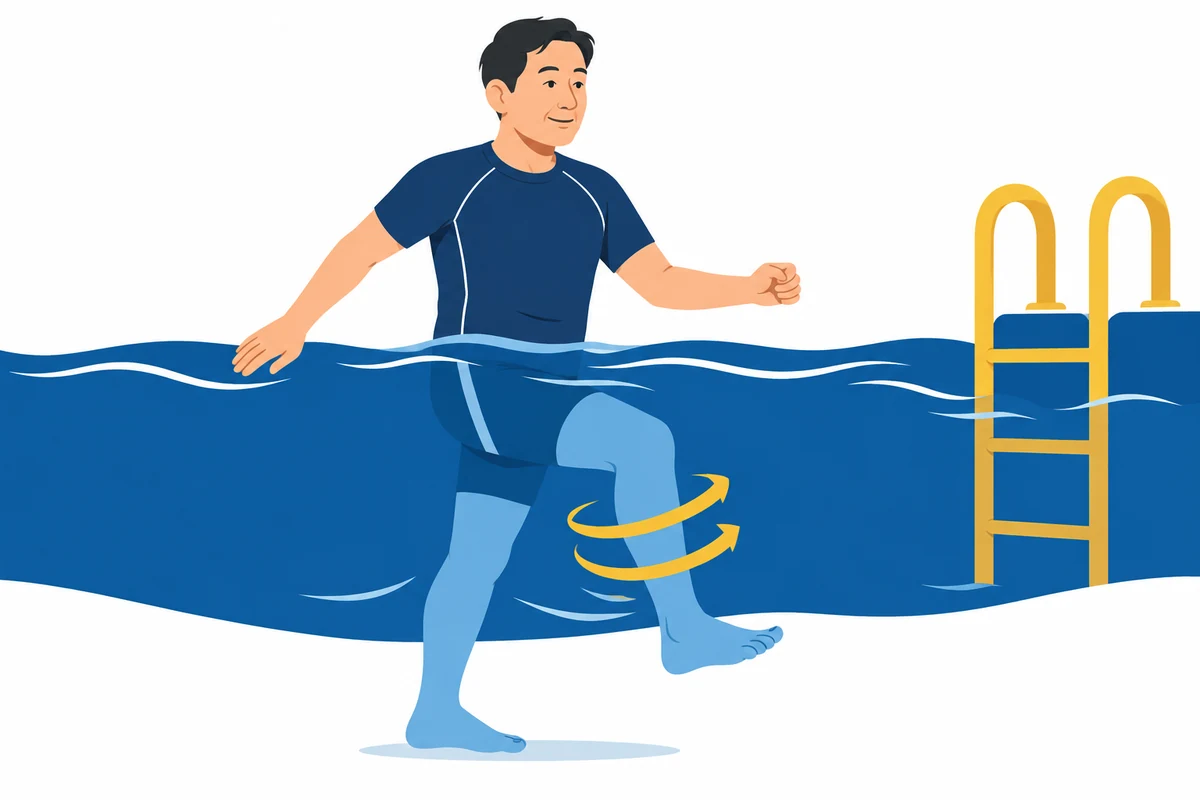
Support from water can reduce the burden of bearing weight on land. Water also resists movement according to direction and speed. Faster movement is not automatically better; begin at a speed that preserves balance and control.
Depth and posture affect the load. At first, choose instruction where your feet reach the floor and support is available. Deep bending or forceful kicking should not be recommended for everyone. Begin in a comfortable range.
Swimming and water walking differ
Swimming strokes use the knees and back differently. If a particular kick hurts, adjust the stroke or activity rather than repeating it forcibly. Slow walking forwards or sideways in water may provide another option when swimming skills are limited.
Check depth, entry and exit, instructor assistance and places to rest when choosing a programme. You need not match a group’s pace. AAOS describes walking, swimming and cycling as aerobic options for arthritis, but the type and amount should suit the individual.
Safety outside the pool also matters
Check slippery flooring, steps and ladders. With difficult land walking or balance, getting out can be harder than getting in. Arrange rails and help in advance, and do not hurry alone when tired.
Check permission to use the pool if you have wounds, a recent incision or a skin infection. Some heart or breathing conditions also require special consideration. Support from water does not remove the need to assess health and follow facility rules.
Connect the dose to the next activity
Rather than completing a long class at the outset, include easy movements and rest. Check pain and breathing during activity and swelling and walking afterwards. If movement feels comfortable in water but is followed by swelling or difficulty on land, adjust time and movements.
Water exercise can support strength, fitness and movement but does not guarantee cartilage regrowth. Connect it with goals on land. Comparing rising at home and walking helps assess benefits in everyday life.
Common Questions
Can I exercise in water if I cannot swim?
Supervised water walking with feet on the floor may be an option. Do not begin alone in deep water.
Which stroke is always best?
Knee and back responses differ. Avoid repeatedly using a painful kick and seek instruction.
Can I enter after surgery if the incision is small?
Check wound healing, infection risk and procedure-specific restrictions. Size alone does not decide.
Evidence and references
01When to seek medical care
Each warning sign is a separate reason to seek care. Follow the action below if any one applies.
Emergency department · call 119 in Korea
- Call 119 for sudden breathlessness or chest pain, severe faintness or loss of consciousness. Do not wait for calf swelling to appear.
- Go to an emergency department if you suddenly cannot bear any weight, or if an injured knee swells rapidly or looks deformed. A cold or numb foot after injury also needs immediate assessment.
- Seek emergency care for a hot, swollen and severely painful joint with high fever, shaking chills, confusion or inability to bear weight.
- With back or leg pain, go immediately to an emergency department for new difficulty passing urine, loss of bladder or bowel control, or numbness around the genitals or anus. Severe or rapidly worsening weakness or numbness in both legs also needs immediate assessment.
Same-day assessment
- Arrange assessment today for a newly hot, swollen joint, sudden severe pain, or a knee locked so that it cannot fully straighten. Joint infection can occur without fever.
- Have new swelling or pain in one calf assessed today for a possible blood clot. Call 119 immediately if breathlessness or chest pain develops.
- Severe knee pain or a new limp in a growing adolescent may come from a hip condition such as slipped capital femoral epiphysis. Stop walking and sport and arrange assessment today. Go directly to emergency care if they cannot bear weight.
- Stop running and seek assessment today for new recurring groin pain, pain with walking or at night, or a limp. A femoral neck stress fracture needs to be considered. Keep weight off the painful leg until assessed. Go to emergency care if you cannot bear weight.
Book an outpatient appointment
- If none of the warning signs above is present, book an appointment for pain lasting a few weeks, repeated swelling or reduced daily activity and exercise.