Daily life and exercise
How do I start sit-to-stand and squats?
Build everyday strength with a stable chair and a manageable range.
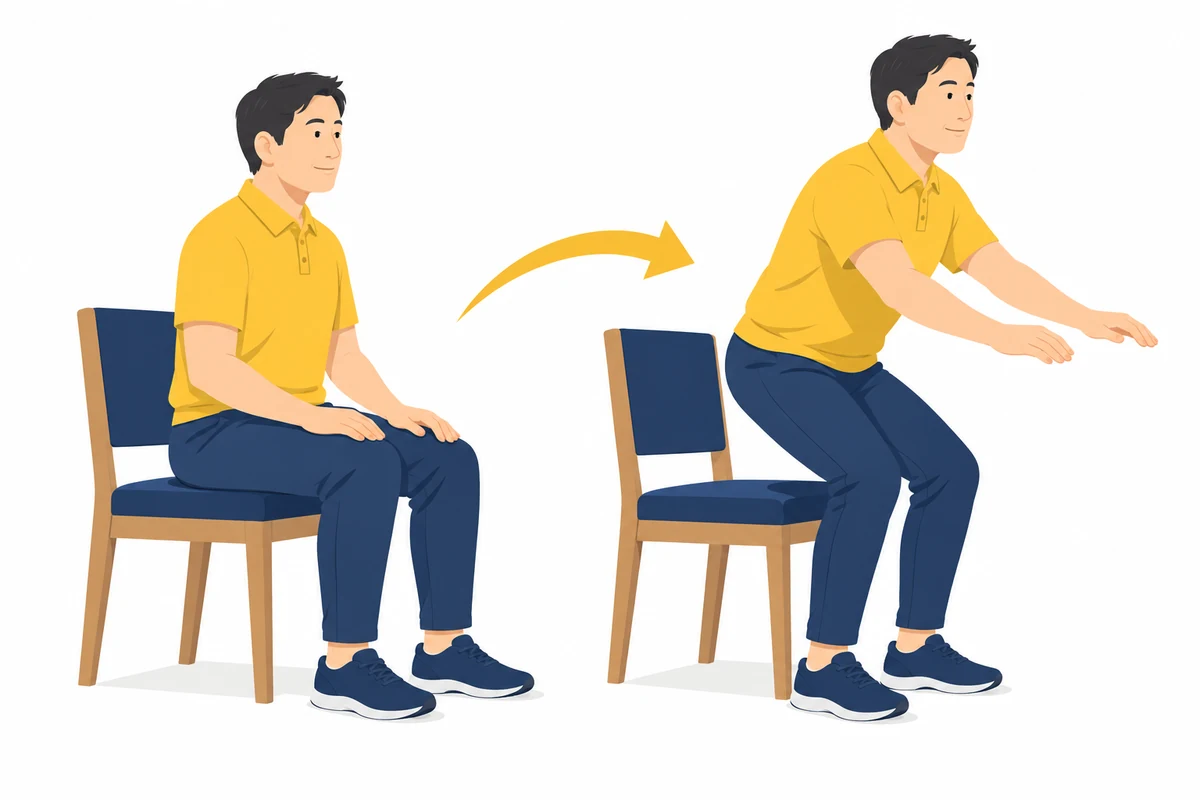
At a glance
- Start with a stable chair and the support needed for safety.
- The NHS five-repetition example is a general starting point, not an individual prescription.
- Do not change depth, repetitions and assistance all at once.
Rising from a chair is a daily task and a way to assess thigh and hip strength. Deep bending or many repetitions need not be the first exercise goal for osteoarthritis. Begin by finding a manageable movement in a stable environment.
Three stages of sit-to-stand
- 01
Prepare
Check a fixed chair, supported feet and any arm help needed.
- 02
Stand
Lean slightly forward and rise slowly using the legs.
- 03
Return
Find balance, then sit slowly. Five repetitions are a starting example.
Three panels show preparation, standing and controlled sitting
Prepare the chair and foot position
Use a sturdy chair without wheels on a non-slip surface; placing it against a wall can limit movement. Keep the feet around hip-width apart on the floor and check room to lean slightly forward. If a low seat is difficult, discuss a higher seat or suitable support.
Do not insist on using no hands at all. Armrests or appropriate support may help you stand safely at first. Remove trip hazards and check that the chair will not slide backwards as you sit.
Rise slowly and sit slowly
Look ahead, lean the trunk slightly forward and rise using the legs. Establish balance, then bring the hips back towards the chair and lower slowly. Control the final part rather than dropping onto the seat. Light hand support can be used if needed.
The NHS general strength guide offers five sit-to-stand repetitions as a starting example. This is not a prescription for every person with arthritis. If one is difficult, adjust height and assistance. If easy, do not increase repetitions and depth together immediately.
Control matters more than squat depth
A standing squat can be learned in a shallow range near a chair or support. Avoid twisting the knee relative to the foot and maintain foot contact. The knee moving past the toes is not automatically an incorrect movement for everyone.
Comfortable technique depends on joint range, body proportions, pain and balance. Choose depth for the purpose and response. After procedures such as meniscal repair or osteotomy, follow the specific restrictions rather than adopting a general squat programme.
Match repetitions to the response
Stop and check the technique if there is sharp joint pain, buckling or new swelling. Mild initial discomfort and next-day muscle soreness do not all mean damage, but worse walking or function warrants adjustment.
As the task becomes familiar, change one feature at a time: height, hand assistance, repetitions or sets. Having the movement assessed by a clinician or physiotherapist helps identify useful adjustments. The goal is easier and safer rising in daily life, not a repetition contest.
Common Questions
Must I avoid using my hands?
No. Use the help needed for safe standing and adjust it gradually.
Must my knees never pass my toes?
That is not an absolute rule for everyone. Balance, foot support, pain and body proportions matter.
How deep should I squat?
Match the range to current ability and purpose. Check specific restrictions after surgery first.
Evidence and references
01When to seek medical care
Each warning sign is a separate reason to seek care. Follow the action below if any one applies.
Emergency department · call 119 in Korea
- Call 119 for sudden breathlessness or chest pain, severe faintness or loss of consciousness. Do not wait for calf swelling to appear.
- Go to an emergency department if you suddenly cannot bear any weight, or if an injured knee swells rapidly or looks deformed. A cold or numb foot after injury also needs immediate assessment.
- Seek emergency care for a hot, swollen and severely painful joint with high fever, shaking chills, confusion or inability to bear weight.
- With back or leg pain, go immediately to an emergency department for new difficulty passing urine, loss of bladder or bowel control, or numbness around the genitals or anus. Severe or rapidly worsening weakness or numbness in both legs also needs immediate assessment.
Same-day assessment
- Arrange assessment today for a newly hot, swollen joint, sudden severe pain, or a knee locked so that it cannot fully straighten. Joint infection can occur without fever.
- Have new swelling or pain in one calf assessed today for a possible blood clot. Call 119 immediately if breathlessness or chest pain develops.
- Severe knee pain or a new limp in a growing adolescent may come from a hip condition such as slipped capital femoral epiphysis. Stop walking and sport and arrange assessment today. Go directly to emergency care if they cannot bear weight.
- Stop running and seek assessment today for new recurring groin pain, pain with walking or at night, or a limp. A femoral neck stress fracture needs to be considered. Keep weight off the painful leg until assessed. Go to emergency care if you cannot bear weight.
Book an outpatient appointment
- If none of the warning signs above is present, book an appointment for pain lasting a few weeks, repeated swelling or reduced daily activity and exercise.