2025 · Knee Surgery & Related Research
CPAK distributions in symptomatic Korean and UAE cohorts
The most common CPAK type among men was type I in the UAE (42.4%) and type II in Korea (30.6%). Type II was most common among women in both populations (UAE 30.6%, Korea 35.3%).
Original Figure 2 · We examined both country means and the spread of the distributions
 Enlarge Figure
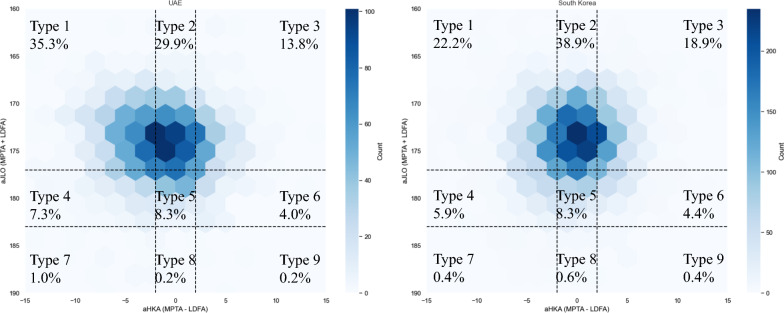
Left is the UAE, right is the knee alignment distribution in Korea. The transverse axis is aHKA, which combines the alignment of bone, and the triangle axis JLO is the slope of joint line, where as the color gets deeper there's a lot more knee in that position. The dot zone in the dotted line represents CPAK type. The two diagrams show that instead of setting a country's knee as a single standard, we need to look at the diversity within and between groups together. It's the data of patients who were hospitalized with symptoms, so it doesn't make sense as a normal population distribution across the country.
Jisoon Park, Oussama Chaar, Jayakrishnan Narayanakurup, Alamedin Sobhe Abdelsamea Abdelhamead, Du Hyun Ro, Sung Eun Kim. Do knee alignment patterns differ between Middle Eastern and East Asian populations? A propensity-matched analysis using artificial intelligence. Knee Surgery & Related Research (2025). https://doi.org/10.1186/s43019-025-00261-w · Figure 2.
Original Figure Legend
Hexbin plots of CPAK classification of the UAE and South Korea
The research question
Participants and Methods
Main Findings
Implications for clinical and surgical practice
Limitations
Let's put it briefly.
Which clinical question does this address?
The findings support considering population differences in alignment distributions in surgical-planning research. They do not support estimating an individual’s target alignment from nationality.
Keywords
- Knee alignment
- Middle East
- Osteoarthritis
- Populations
- Propensity score-matched
- South Korea
- CPAK
- alignment
Abstract · Original text
Jisoon Park, Oussama Chaar, Jayakrishnan Narayanakurup, Alamedin Sobhe Abdelsamea Abdelhamead, Du Hyun Ro, Sung Eun Kim. Do knee alignment patterns differ between Middle Eastern and East Asian populations? A propensity-matched analysis using artificial intelligence. Knee surgery & related research. 2025;37(1):11. doi:10.1186/s43019-025-00261-w.
INTRODUCTION
Population-based differences in knee alignment patterns may impact osteoarthritis (OA) progression. This study compares lower extremity alignment in knee OA between Middle Eastern (UAE) and East Asian (South Korean) populations using artificial intelligence (AI)-assisted analysis.
METHODS
A retrospective review included patients with knee symptoms from South Korea (2009-2019) and the United Arab Emirates (UAE) (2015-2024). Exclusion criteria comprised prior knee surgeries, significant bony attrition, and low-quality radiographs. Propensity score matching controlled for age and sex differences between populations. Alignment parameters (hip-knee-ankle angle (HKA), medial proximal tibial angle (MPTA), lateral distal femoral angle (LDFA), and joint line convergence angle (JLCA)) and OA severity (Kellgren-Lawrence (KL) grade) were measured using artificial intelligence (AI) software, along with the analysis of coronal plane alignment of the knee (CPAK) classification. Subanalyses by sex and age group (under 40, 40-60, and over 60 years) were also conducted.
RESULTS
A total of 1098 UAE and 7138 South Korean patients (2196 and 14,276 knees, respectively) were evaluated in this study. Post-matching (1:2), body mass index was significantly higher in UAE patients (p < 0.001). CPAK type 1 was predominant in UAE male patients (42.4%), whereas type 2 was more common in South Korean male patients (30.6%). Female patients in both populations predominantly exhibited CPAK type 2 (UAE 30.6%; South Korea 35.3%). UAE patients showed a lower MPTA with increasing age, indicating a trend toward more varus alignment in older individuals.
CONCLUSIONS
A propensity score-matched analysis revealed significant alignment differences between Middle Eastern and East Asian populations, underscoring the importance of population-specific considerations in OA management.
© The Author(s) 2025
The original paper.
Do knee alignment patterns differ between Middle Eastern and East Asian populations? A propensity-matched analysis using artificial intelligence
Jisoon Park, Oussama Chaar, Jayakrishnan Narayanakurup, Alamedin Sobhe Abdelsamea Abdelhamead, Du Hyun Ro, Sung Eun Kim
Knee Surgery & Related Research · 2025