2025 · Knee Surgery & Related Research
韓国・UAEの有症状コホートにおけるCPAK分布の比較
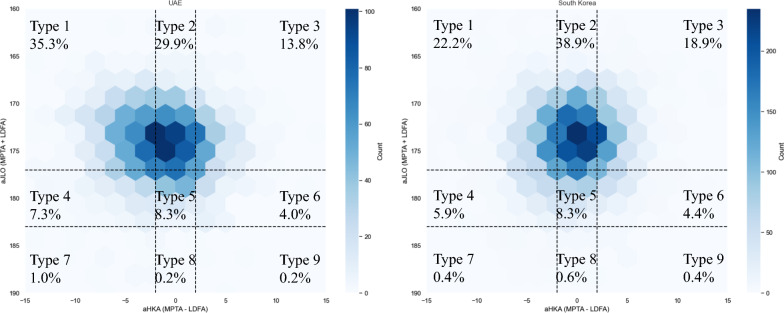
男性で最も多いCPAKはUAEでI型(42.4%)、韓国でII型(30.6%)でした。女性では両集団ともII型が最多でした(UAE 30.6%、韓国35.3%)。
原著 Figure 2 · 国別の平均だけでなく分布の広がりも確認しました
 図を拡大する
左はアラブ首長国連邦右は韓国における膝の配線分布です 横軸は aHKAで,骨の配列を組み合わせます. 三角軸 JLOは関節線の傾きです. 色が深くなるとその位置に膝が多くなります. ポイントゾーンは CPAK型を表します. 2つの図は,一つの国の膝を単一の基準として設定する代わりに,グループ内の多様性や集団間の多様性を一緒に検討する必要があることを示しています. 症状で入院した患者のデータなので全国の正常な人口分布では意味がありません
Jisoon Park, Oussama Chaar, Jayakrishnan Narayanakurup, Alamedin Sobhe Abdelsamea Abdelhamead, Du Hyun Ro, Sung Eun Kim. Do knee alignment patterns differ between Middle Eastern and East Asian populations? A propensity-matched analysis using artificial intelligence. Knee Surgery & Related Research (2025). https://doi.org/10.1186/s43019-025-00261-w · Figure 2.
原著の図の説明
Hexbin plots of CPAK classification of the UAE and South Korea
研究で問うこと
対象と方法
主な結果
診療・手術で考える点
解釈の限界
簡単に説明しましょう
どの診療上の問いにつながりますか?
集団ごとのアライメント分布の違いを手術計画の研究に反映する根拠です。国籍から個人の目標アライメントを推定する研究ではありません。
Keywords・キーワード
- Knee alignment
- Middle East
- Osteoarthritis
- Populations
- Propensity score-matched
- South Korea
- CPAK
- alignment
Abstract・原文の抄録
Jisoon Park, Oussama Chaar, Jayakrishnan Narayanakurup, Alamedin Sobhe Abdelsamea Abdelhamead, Du Hyun Ro, Sung Eun Kim. Do knee alignment patterns differ between Middle Eastern and East Asian populations? A propensity-matched analysis using artificial intelligence. Knee surgery & related research. 2025;37(1):11. doi:10.1186/s43019-025-00261-w.
INTRODUCTION
Population-based differences in knee alignment patterns may impact osteoarthritis (OA) progression. This study compares lower extremity alignment in knee OA between Middle Eastern (UAE) and East Asian (South Korean) populations using artificial intelligence (AI)-assisted analysis.
METHODS
A retrospective review included patients with knee symptoms from South Korea (2009-2019) and the United Arab Emirates (UAE) (2015-2024). Exclusion criteria comprised prior knee surgeries, significant bony attrition, and low-quality radiographs. Propensity score matching controlled for age and sex differences between populations. Alignment parameters (hip-knee-ankle angle (HKA), medial proximal tibial angle (MPTA), lateral distal femoral angle (LDFA), and joint line convergence angle (JLCA)) and OA severity (Kellgren-Lawrence (KL) grade) were measured using artificial intelligence (AI) software, along with the analysis of coronal plane alignment of the knee (CPAK) classification. Subanalyses by sex and age group (under 40, 40-60, and over 60 years) were also conducted.
RESULTS
A total of 1098 UAE and 7138 South Korean patients (2196 and 14,276 knees, respectively) were evaluated in this study. Post-matching (1:2), body mass index was significantly higher in UAE patients (p < 0.001). CPAK type 1 was predominant in UAE male patients (42.4%), whereas type 2 was more common in South Korean male patients (30.6%). Female patients in both populations predominantly exhibited CPAK type 2 (UAE 30.6%; South Korea 35.3%). UAE patients showed a lower MPTA with increasing age, indicating a trend toward more varus alignment in older individuals.
CONCLUSIONS
A propensity score-matched analysis revealed significant alignment differences between Middle Eastern and East Asian populations, underscoring the importance of population-specific considerations in OA management.
© The Author(s) 2025
オリジナル紙だ
Do knee alignment patterns differ between Middle Eastern and East Asian populations? A propensity-matched analysis using artificial intelligence
Jisoon Park, Oussama Chaar, Jayakrishnan Narayanakurup, Alamedin Sobhe Abdelsamea Abdelhamead, Du Hyun Ro, Sung Eun Kim
Knee Surgery & Related Research · 2025