2025 · Knee Surgery & Related Research
한국·UAE 증상성 코호트의 CPAK 분포 비교
남성의 최빈 CPAK은 UAE에서 I형(42.4%), 한국에서 II형(30.6%)이었습니다. 여성은 두 집단 모두 II형이 가장 많았습니다(UAE 30.6%, 한국 35.3%).
원문 Figure 2 · 나라별 평균뿐 아니라 분포의 폭을 보았습니다
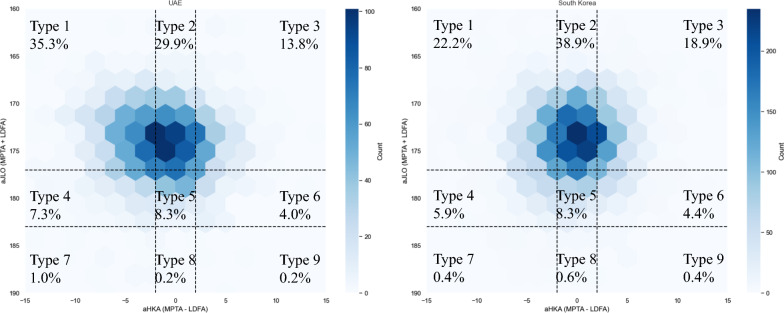 그림 크게 보기
왼쪽은 UAE, 오른쪽은 한국의 무릎 정렬 분포입니다. 가로축은 뼈의 정렬을 조합한 aHKA, 세로축은 관절선의 기울기 JLO이고, 색이 진할수록 그 위치에 무릎이 많이 모여 있습니다. 점선으로 나뉜 구역은 CPAK 유형을 뜻합니다. 두 그림은 한 나라의 무릎을 하나의 표준형으로 정하기보다, 집단 안의 다양성과 집단 사이의 차이를 함께 살펴야 한다는 점을 보여줍니다. 증상으로 병원을 찾은 환자의 자료이므로 국가 전체의 정상 인구 분포로 해석하지는 않습니다.
Jisoon Park, Oussama Chaar, Jayakrishnan Narayanakurup, Alamedin Sobhe Abdelsamea Abdelhamead, Du Hyun Ro, Sung Eun Kim. Do knee alignment patterns differ between Middle Eastern and East Asian populations? A propensity-matched analysis using artificial intelligence. Knee Surgery & Related Research (2025). https://doi.org/10.1186/s43019-025-00261-w · Figure 2.
원문 캡션
Hexbin plots of CPAK classification of the UAE and South Korea
연구에서 묻는 질문
대상과 방법
주요 결과
진료와 수술에서 읽을 지점
해석의 제한
짧게 정리하면
어떤 진료 질문과 연결되나요?
집단별 정렬 분포 차이를 수술 계획 연구에 반영할 근거입니다. 국적으로 개인의 목표 정렬을 추정하는 연구는 아닙니다.
Keywords · 주제어
- Knee alignment
- Middle East
- Osteoarthritis
- Populations
- Propensity score-matched
- South Korea
- CPAK
- alignment
Abstract · 원문 초록
Jisoon Park, Oussama Chaar, Jayakrishnan Narayanakurup, Alamedin Sobhe Abdelsamea Abdelhamead, Du Hyun Ro, Sung Eun Kim. Do knee alignment patterns differ between Middle Eastern and East Asian populations? A propensity-matched analysis using artificial intelligence. Knee surgery & related research. 2025;37(1):11. doi:10.1186/s43019-025-00261-w.
INTRODUCTION
Population-based differences in knee alignment patterns may impact osteoarthritis (OA) progression. This study compares lower extremity alignment in knee OA between Middle Eastern (UAE) and East Asian (South Korean) populations using artificial intelligence (AI)-assisted analysis.
METHODS
A retrospective review included patients with knee symptoms from South Korea (2009-2019) and the United Arab Emirates (UAE) (2015-2024). Exclusion criteria comprised prior knee surgeries, significant bony attrition, and low-quality radiographs. Propensity score matching controlled for age and sex differences between populations. Alignment parameters (hip-knee-ankle angle (HKA), medial proximal tibial angle (MPTA), lateral distal femoral angle (LDFA), and joint line convergence angle (JLCA)) and OA severity (Kellgren-Lawrence (KL) grade) were measured using artificial intelligence (AI) software, along with the analysis of coronal plane alignment of the knee (CPAK) classification. Subanalyses by sex and age group (under 40, 40-60, and over 60 years) were also conducted.
RESULTS
A total of 1098 UAE and 7138 South Korean patients (2196 and 14,276 knees, respectively) were evaluated in this study. Post-matching (1:2), body mass index was significantly higher in UAE patients (p < 0.001). CPAK type 1 was predominant in UAE male patients (42.4%), whereas type 2 was more common in South Korean male patients (30.6%). Female patients in both populations predominantly exhibited CPAK type 2 (UAE 30.6%; South Korea 35.3%). UAE patients showed a lower MPTA with increasing age, indicating a trend toward more varus alignment in older individuals.
CONCLUSIONS
A propensity score-matched analysis revealed significant alignment differences between Middle Eastern and East Asian populations, underscoring the importance of population-specific considerations in OA management.
© The Author(s) 2025
원래 논문
Do knee alignment patterns differ between Middle Eastern and East Asian populations? A propensity-matched analysis using artificial intelligence
Jisoon Park, Oussama Chaar, Jayakrishnan Narayanakurup, Alamedin Sobhe Abdelsamea Abdelhamead, Du Hyun Ro, Sung Eun Kim
Knee Surgery & Related Research · 2025