2024 · Knee Surgery & Related Research
Are the Final Postoperative Score and the Amount of Improvement the Same Question?
Adjusted R² values for 1-year WOMAC pain, stiffness and function scores were 0.017, 0.036 and 0.078. For change-score models, they were 0.881, 0.755 and 0.761, respectively.
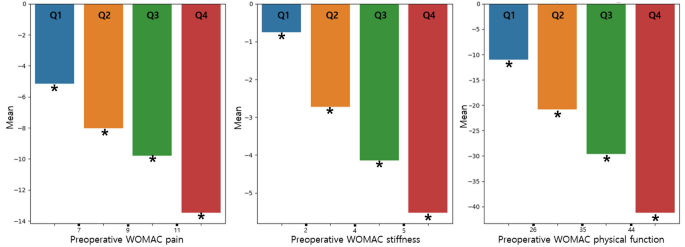
Original Figure 5
 Enlarge Figure
Original Figure 5 compares improvement by quartile of preoperative WOMAC. The model includes postoperative joint motion, so it is not a validated predictor using preoperative information alone.
Sung Eun Kim, Du Hyun Ro, Myung Chul Lee, Hyuk-Soo Han. Can individual functional improvements be predicted in osteoarthritic patients after total knee arthroplasty?. Knee Surgery & Related Research (2024). https://doi.org/10.1186/s43019-024-00238-1
Participants and Methods
Main Findings
The point of reading on surgery
Limitations
Let's put it briefly.
What did this study confirm?
Adjusted R² values for 1-year WOMAC pain, stiffness and function scores were 0.017, 0.036 and 0.078. For change-score models, they were 0.881, 0.755 and 0.761, respectively.
Can it be applied directly to individual patients' treatment decisions?
This single-center study had 1-year follow-up and no MCID analysis. Postoperative ROM was included in the model, so it is not a predictor with all inputs available before surgery. High change-score R² must be distinguished from low final-score R².
Keywords
- Functional improvement
- Knee arthroplasty
- Predictive model
- WOMAC
- TKA
- PROMs
- prediction
- range of motion
Abstract · Original text
Sung Eun Kim, Du Hyun Ro, Myung Chul Lee, Hyuk-Soo Han. Can individual functional improvements be predicted in osteoarthritic patients after total knee arthroplasty? Knee surgery & related research. 2024;36(1):31. doi:10.1186/s43019-024-00238-1.
PURPOSE
Total knee arthroplasty (TKA) is an effective treatment for advanced osteoarthritis, and achieving optimal outcomes can be challenging due to various influencing factors. Previous research has focused on identifying factors that affect postoperative functional outcomes. However, there is a paucity of studies predicting individual postoperative improvement following TKA. Therefore, a quantitative prediction model for individual patient outcomes is necessary.
MATERIALS AND METHODS
Demographic data, radiologic variables, intraoperative variables, and physical examination findings were collected from 976 patients undergoing TKA. Preoperative and 1-year postoperative Western Ontario and McMaster Universities Osteoarthritis Index (WOMAC) scores were assessed, and multivariate regression analysis was conducted to identify significant factors influencing one-year WOMAC scores and changes in WOMAC scores. A predictive model was developed on the basis of the findings.
RESULTS
The predictive accuracy of the model for 1-year WOMAC scores was poor (all adjusted R2 < 0.08), whereas the model for changes in WOMAC scores demonstrated strong predictability (all adjusted R2 > 0.75). Preoperative WOMAC scores, sex, and postoperative knee range of motion significantly affected all pain, stiffness, and physical function aspects of the WOMAC scores (all P < 0.05). Age, cerebrovascular disease, and patellar resurfacing were associated with changes in physical function (all P < 0.05).
CONCLUSIONS
The developed quantitative model demonstrated high accuracy in predicting changes in WOMAC scores after TKA. The identified factors influencing postoperative improvement in WOMAC scores can assist in optimizing patient outcomes after TKA.
© The Author(s) 2024
The original paper.
Can individual functional improvements be predicted in osteoarthritic patients after total knee arthroplasty?
Sung Eun Kim, Du Hyun Ro, Myung Chul Lee, Hyuk-Soo Han
Knee Surgery & Related Research · 2024