2024 · Knee Surgery & Related Research
수술 뒤 최종 점수와 좋아진 정도는 같은 질문일까?
1년 WOMAC 통증·강직·기능 점수의 adjusted R²는 0.017, 0.036, 0.078이었습니다. 변화량 모델은 각각 0.881, 0.755, 0.761이었습니다.
원문 Figure 5
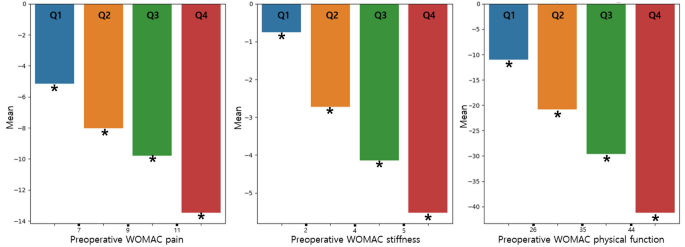 그림 크게 보기
수술 전 WOMAC 점수의 사분위별 변화량을 비교한 원문 Figure 5. 수술 후 관절운동이 모델에 포함되어, 수술 전 정보만으로 검증된 예측기를 의미하지 않습니다.
Sung Eun Kim, Du Hyun Ro, Myung Chul Lee, Hyuk-Soo Han. Can individual functional improvements be predicted in osteoarthritic patients after total knee arthroplasty?. Knee Surgery & Related Research (2024). https://doi.org/10.1186/s43019-024-00238-1
대상과 방법
주요 결과
진료·수술에서 읽을 지점
해석의 제한
짧게 정리하면
이 연구가 확인한 것은 무엇인가요?
1년 WOMAC 통증·강직·기능 점수의 adjusted R²는 0.017, 0.036, 0.078이었습니다. 변화량 모델은 각각 0.881, 0.755, 0.761이었습니다.
개별 환자의 치료 결정에 바로 적용할 수 있나요?
단일 기관·1년 추적이며 MCID 분석이 없습니다. 모형에 수술 후 ROM이 포함되므로 모든 입력을 수술 전에 알 수 있는 예측기로 볼 수 없습니다. 높은 변화량 R²와 낮은 최종 점수 R²를 구분해야 합니다.
Keywords · 주제어
- Functional improvement
- Knee arthroplasty
- Predictive model
- WOMAC
- TKA
- PROMs
- prediction
- range of motion
Abstract · 원문 초록
Sung Eun Kim, Du Hyun Ro, Myung Chul Lee, Hyuk-Soo Han. Can individual functional improvements be predicted in osteoarthritic patients after total knee arthroplasty? Knee surgery & related research. 2024;36(1):31. doi:10.1186/s43019-024-00238-1.
PURPOSE
Total knee arthroplasty (TKA) is an effective treatment for advanced osteoarthritis, and achieving optimal outcomes can be challenging due to various influencing factors. Previous research has focused on identifying factors that affect postoperative functional outcomes. However, there is a paucity of studies predicting individual postoperative improvement following TKA. Therefore, a quantitative prediction model for individual patient outcomes is necessary.
MATERIALS AND METHODS
Demographic data, radiologic variables, intraoperative variables, and physical examination findings were collected from 976 patients undergoing TKA. Preoperative and 1-year postoperative Western Ontario and McMaster Universities Osteoarthritis Index (WOMAC) scores were assessed, and multivariate regression analysis was conducted to identify significant factors influencing one-year WOMAC scores and changes in WOMAC scores. A predictive model was developed on the basis of the findings.
RESULTS
The predictive accuracy of the model for 1-year WOMAC scores was poor (all adjusted R2 < 0.08), whereas the model for changes in WOMAC scores demonstrated strong predictability (all adjusted R2 > 0.75). Preoperative WOMAC scores, sex, and postoperative knee range of motion significantly affected all pain, stiffness, and physical function aspects of the WOMAC scores (all P < 0.05). Age, cerebrovascular disease, and patellar resurfacing were associated with changes in physical function (all P < 0.05).
CONCLUSIONS
The developed quantitative model demonstrated high accuracy in predicting changes in WOMAC scores after TKA. The identified factors influencing postoperative improvement in WOMAC scores can assist in optimizing patient outcomes after TKA.
© The Author(s) 2024
원래 논문
Can individual functional improvements be predicted in osteoarthritic patients after total knee arthroplasty?
Sung Eun Kim, Du Hyun Ro, Myung Chul Lee, Hyuk-Soo Han
Knee Surgery & Related Research · 2024