2024 · Knee Surgery & Related Research
手術後の最終スコアと改善量は、同じことを示すか?
1年WOMACの痛み・こわばり・機能スコアの調整済みR²は0.017、0.036、0.078でした。変化量モデルでは順に0.881、0.755、0.761でした。
原図Figure 5
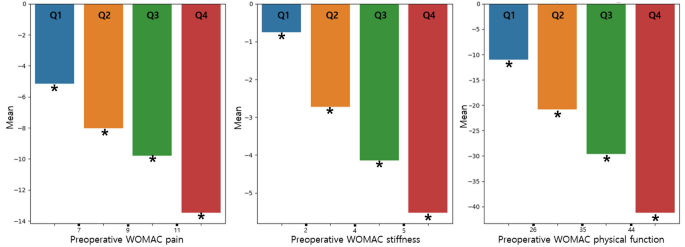 図を拡大する
術前WOMACの四分位別改善量を比較した原著 Figure 5です。モデルに術後可動域を含むため、術前情報だけの検証済み予測器ではありません。
Sung Eun Kim, Du Hyun Ro, Myung Chul Lee, Hyuk-Soo Han. Can individual functional improvements be predicted in osteoarthritic patients after total knee arthroplasty?. Knee Surgery & Related Research (2024). https://doi.org/10.1186/s43019-024-00238-1
対象と方法
主な結果
手術に関する読書のポイント
解釈の限界
簡単に説明しましょう
この研究で何が確認されましたか?
1年WOMACの痛み・こわばり・機能スコアの調整済みR²は0.017、0.036、0.078でした。変化量モデルでは順に0.881、0.755、0.761でした。
治療決定に直接適用できるか?
単施設・1年追跡でMCID解析はありません。術後ROMをモデルに含むため、すべての入力が術前に分かる予測器ではありません。高い変化量R²と低い最終スコアR²を区別する必要があります。
Keywords・キーワード
- Functional improvement
- Knee arthroplasty
- Predictive model
- WOMAC
- TKA
- PROMs
- prediction
- range of motion
Abstract・原文の抄録
Sung Eun Kim, Du Hyun Ro, Myung Chul Lee, Hyuk-Soo Han. Can individual functional improvements be predicted in osteoarthritic patients after total knee arthroplasty? Knee surgery & related research. 2024;36(1):31. doi:10.1186/s43019-024-00238-1.
PURPOSE
Total knee arthroplasty (TKA) is an effective treatment for advanced osteoarthritis, and achieving optimal outcomes can be challenging due to various influencing factors. Previous research has focused on identifying factors that affect postoperative functional outcomes. However, there is a paucity of studies predicting individual postoperative improvement following TKA. Therefore, a quantitative prediction model for individual patient outcomes is necessary.
MATERIALS AND METHODS
Demographic data, radiologic variables, intraoperative variables, and physical examination findings were collected from 976 patients undergoing TKA. Preoperative and 1-year postoperative Western Ontario and McMaster Universities Osteoarthritis Index (WOMAC) scores were assessed, and multivariate regression analysis was conducted to identify significant factors influencing one-year WOMAC scores and changes in WOMAC scores. A predictive model was developed on the basis of the findings.
RESULTS
The predictive accuracy of the model for 1-year WOMAC scores was poor (all adjusted R2 < 0.08), whereas the model for changes in WOMAC scores demonstrated strong predictability (all adjusted R2 > 0.75). Preoperative WOMAC scores, sex, and postoperative knee range of motion significantly affected all pain, stiffness, and physical function aspects of the WOMAC scores (all P < 0.05). Age, cerebrovascular disease, and patellar resurfacing were associated with changes in physical function (all P < 0.05).
CONCLUSIONS
The developed quantitative model demonstrated high accuracy in predicting changes in WOMAC scores after TKA. The identified factors influencing postoperative improvement in WOMAC scores can assist in optimizing patient outcomes after TKA.
© The Author(s) 2024
オリジナル紙だ
Can individual functional improvements be predicted in osteoarthritic patients after total knee arthroplasty?
Sung Eun Kim, Du Hyun Ro, Myung Chul Lee, Hyuk-Soo Han
Knee Surgery & Related Research · 2024