2023 · Journal of Clinical Medicine
Is Robot Use Associated with Transfusion Rates in Staged Bilateral TKA Performed One Week Apart?
The first surgery bleeding: 2/53 of the conventional troops, 3.8 percent; 1/53 in the robotic army, 1.9 percent; P=0.558.
Original Figure 1
 Enlarge Figure
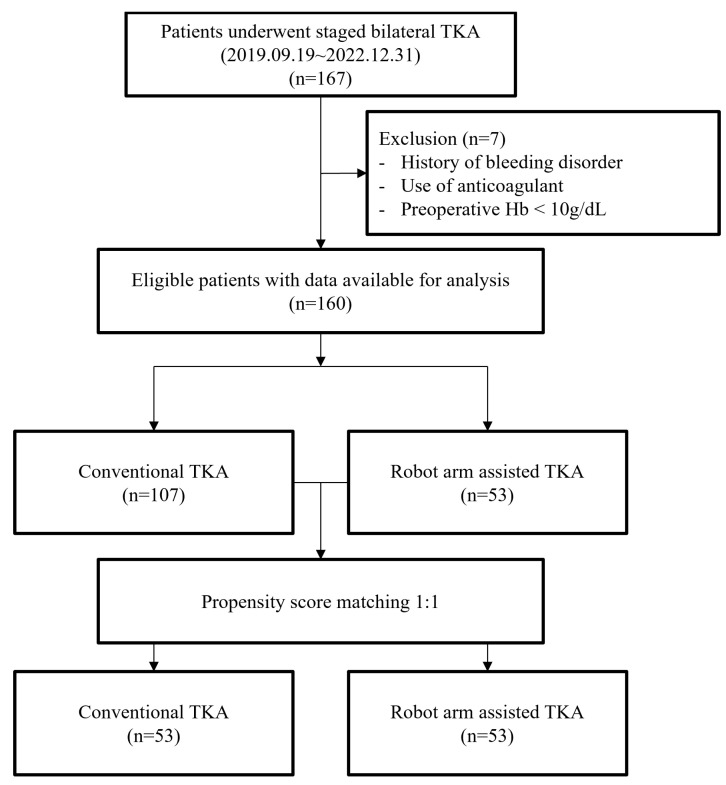
The original flowchart shows selection and propensity-score matching for bilateral TKA performed 1 week apart. Each comparison group contained 53 patients.
Jong Hwa Lee, Ho Jung Jung, Byung Sun Choi, Du Hyun Ro, Joong Il Kim. Effectiveness of Robotic Arm-Assisted Total Knee Arthroplasty on Transfusion Rate in Staged Bilateral Surgery. Journal of Clinical Medicine (2023). DOI: 10.3390/jcm12144570. © 2023 by the authors.
Original Figure Legend
Flow diagram for the patients’ enrollment.
Participants and Methods
The order in which you read the painting.
Main Findings
The point of reading on surgery
Limitations
Let's put it briefly.
What did this study confirm?
The first surgery bleeding: 2/53 of the conventional troops, 3.8 percent; 1/53 in the robotic army, 1.9 percent; P=0.558.
Can it be applied directly to individual patients' treatment decisions?
This was a nonrandomized retrospective study. The second-operation rates used different denominators. The text reports 7.6% and the table 7.7%, which should be read alongside the actual count of 4/52 in Table 3. Generalization to unilateral surgery or different intervals between operations is limited.
Keywords
- perioperative blood management
- robotic arm-assisted total knee arthroplasty
- staged bilateral total knee arthroplasty
- total knee arthroplasty
- transfusion
- TKA
- robotics
- blood management
Abstract · Original text
Jong Hwa Lee, Ho Jung Jung, Byung Sun Choi, Du Hyun Ro, Joong Il Kim. Effectiveness of Robotic Arm-Assisted Total Knee Arthroplasty on Transfusion Rate in Staged Bilateral Surgery. Journal of clinical medicine. 2023;12(14):4570. doi:10.3390/jcm12144570.
The transfusion rate in staged bilateral total knee arthroplasty (TKA) remains high despite the application of blood management techniques. The potential of robotic arm-assisted TKA (R-TKA) in reducing the transfusion rate in staged bilateral surgery has not yet been investigated. Therefore, we aimed to evaluate the effectiveness of R-TKA on transfusion reduction compared with conventional TKA (C-TKA) in staged bilateral surgery. This retrospective study involved two groups of patients who underwent 1-week interval staged bilateral TKA-the C-TKA group and the R-TKA group-using MAKO SmartRobotics (Stryker, Kalamazoo, MI, USA). Each group comprised 53 patients after propensity score matching and was compared in terms of nadir hemoglobin (Hb) level and transfusion rate after each stage of surgery. Both groups showed no significant differences in the propensity-matched variables of age, sex, body mass index, American Society of Anesthesiologists physical status score, and preoperative Hb level. The R-TKA group showed a significantly higher nadir Hb level than the C-TKA group after the second TKA (p = 0.002). The transfusion rate was not significantly different between the two groups after the first TKA (p = 0.558). However, the R-TKA group showed a significantly lower transfusion rate in the TKA (p = 0.030) and overall period (p = 0.023) than the C-TKA group. Patients who undergo staged bilateral R-TKA have lower transfusion rate than those who undergo C-TKA. R-TKA may be effective in minimizing unnecessary allogeneic transfusions in staged bilateral surgery.
© 2023 by the authors.
The original paper.
Effectiveness of Robotic Arm-Assisted Total Knee Arthroplasty on Transfusion Rate in Staged Bilateral Surgery
Jong Hwa Lee, Ho Jung Jung, Byung Sun Choi, Du Hyun Ro, Joong Il Kim
Journal of Clinical Medicine · 2023