2023 · Journal of Clinical Medicine
1주 간격의 staged bilateral TKA에서 로봇 사용은 수혈률과 관련될까?
첫 수술 수혈: 기존군 2/53명(3.8%), 로봇군 1/53명(1.9%); P=0.558.
원문 Figure 1
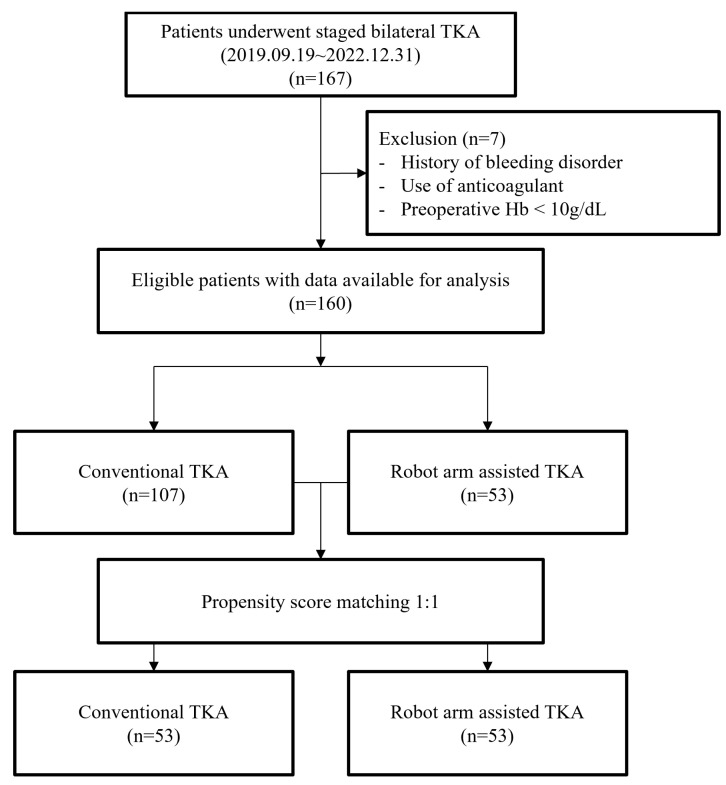 그림 크게 보기
1주 간격 양측 TKA의 대상 선정과 성향점수 매칭을 보여주는 원문 흐름도입니다. 두 군 각 53명이 비교됐습니다.
Jong Hwa Lee, Ho Jung Jung, Byung Sun Choi, Du Hyun Ro, Joong Il Kim. Effectiveness of Robotic Arm-Assisted Total Knee Arthroplasty on Transfusion Rate in Staged Bilateral Surgery. Journal of Clinical Medicine (2023). DOI: 10.3390/jcm12144570. © 2023 by the authors.
원문 캡션
Flow diagram for the patients’ enrollment.
대상과 방법
그림을 읽는 순서
주요 결과
진료·수술에서 읽을 지점
해석의 제한
짧게 정리하면
이 연구가 확인한 것은 무엇인가요?
첫 수술 수혈: 기존군 2/53명(3.8%), 로봇군 1/53명(1.9%); P=0.558.
개별 환자의 치료 결정에 바로 적용할 수 있나요?
비무작위 후향적 연구입니다. 두 번째 수술의 비율은 서로 다른 분모를 사용했습니다. 본문에는 7.6%, 표에는 7.7%로 기재되어 있어, Table 3의 실제 건수인 4/52와 함께 읽어야 합니다. 일측 수술이나 다른 수술 간격으로의 일반화에 제한이 있습니다.
Keywords · 주제어
- perioperative blood management
- robotic arm-assisted total knee arthroplasty
- staged bilateral total knee arthroplasty
- total knee arthroplasty
- transfusion
- TKA
- robotics
- blood management
Abstract · 원문 초록
Jong Hwa Lee, Ho Jung Jung, Byung Sun Choi, Du Hyun Ro, Joong Il Kim. Effectiveness of Robotic Arm-Assisted Total Knee Arthroplasty on Transfusion Rate in Staged Bilateral Surgery. Journal of clinical medicine. 2023;12(14):4570. doi:10.3390/jcm12144570.
The transfusion rate in staged bilateral total knee arthroplasty (TKA) remains high despite the application of blood management techniques. The potential of robotic arm-assisted TKA (R-TKA) in reducing the transfusion rate in staged bilateral surgery has not yet been investigated. Therefore, we aimed to evaluate the effectiveness of R-TKA on transfusion reduction compared with conventional TKA (C-TKA) in staged bilateral surgery. This retrospective study involved two groups of patients who underwent 1-week interval staged bilateral TKA-the C-TKA group and the R-TKA group-using MAKO SmartRobotics (Stryker, Kalamazoo, MI, USA). Each group comprised 53 patients after propensity score matching and was compared in terms of nadir hemoglobin (Hb) level and transfusion rate after each stage of surgery. Both groups showed no significant differences in the propensity-matched variables of age, sex, body mass index, American Society of Anesthesiologists physical status score, and preoperative Hb level. The R-TKA group showed a significantly higher nadir Hb level than the C-TKA group after the second TKA (p = 0.002). The transfusion rate was not significantly different between the two groups after the first TKA (p = 0.558). However, the R-TKA group showed a significantly lower transfusion rate in the TKA (p = 0.030) and overall period (p = 0.023) than the C-TKA group. Patients who undergo staged bilateral R-TKA have lower transfusion rate than those who undergo C-TKA. R-TKA may be effective in minimizing unnecessary allogeneic transfusions in staged bilateral surgery.
© 2023 by the authors.
원래 논문
Effectiveness of Robotic Arm-Assisted Total Knee Arthroplasty on Transfusion Rate in Staged Bilateral Surgery
Jong Hwa Lee, Ho Jung Jung, Byung Sun Choi, Du Hyun Ro, Joong Il Kim
Journal of Clinical Medicine · 2023