2023 · Journal of Clinical Medicine
1週間隔の段階的両側TKAで、ロボット使用は輸血率と関連するか?
最初の手術の出血は従来の軍隊の 2/53人 3.8% ロボット軍では 1/53人が 1.9パーセント P=0.558
原図Figure 1
 図を拡大する
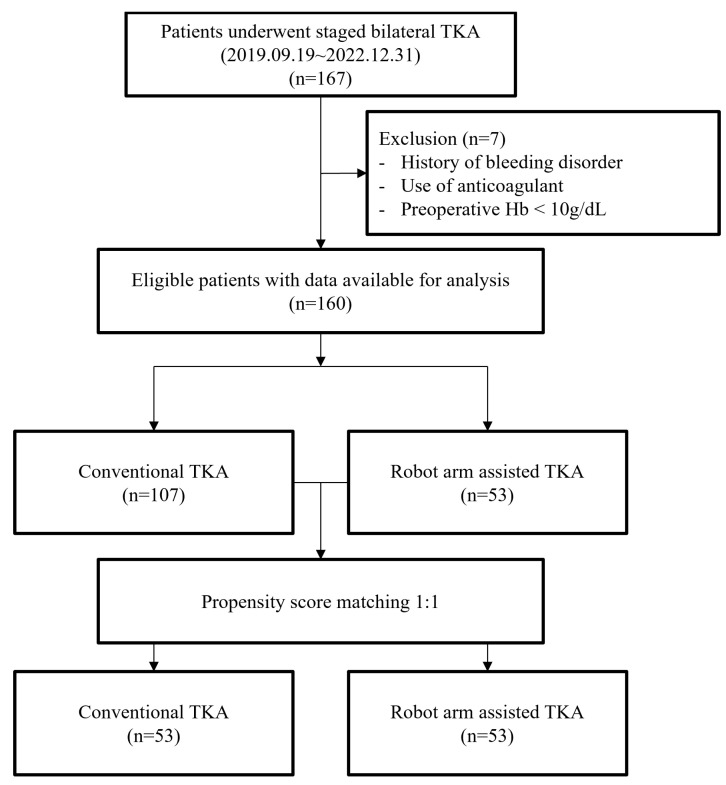
1週間隔の両側TKAにおける対象選定と傾向スコアマッチングを示した原著フローチャートです。各群53人を比較しました。
Jong Hwa Lee, Ho Jung Jung, Byung Sun Choi, Du Hyun Ro, Joong Il Kim. Effectiveness of Robotic Arm-Assisted Total Knee Arthroplasty on Transfusion Rate in Staged Bilateral Surgery. Journal of Clinical Medicine (2023). DOI: 10.3390/jcm12144570. © 2023 by the authors.
原著の図の説明
Flow diagram for the patients’ enrollment.
対象と方法
絵を読んだ順序です
主な結果
手術に関する読書のポイント
解釈の限界
簡単に説明しましょう
この研究で何が確認されましたか?
最初の手術の出血は従来の軍隊の 2/53人 3.8% ロボット軍では 1/53人が 1.9パーセント P=0.558
治療決定に直接適用できるか?
非無作為化の後ろ向き研究です。2回目手術の割合には異なる分母を用いています。本文は7.6%、表は7.7%であり、Table 3の実数4/52と併せて読む必要があります。片側手術や異なる手術間隔への一般化には限界があります。
Keywords・キーワード
- perioperative blood management
- robotic arm-assisted total knee arthroplasty
- staged bilateral total knee arthroplasty
- total knee arthroplasty
- transfusion
- TKA
- robotics
- blood management
Abstract・原文の抄録
Jong Hwa Lee, Ho Jung Jung, Byung Sun Choi, Du Hyun Ro, Joong Il Kim. Effectiveness of Robotic Arm-Assisted Total Knee Arthroplasty on Transfusion Rate in Staged Bilateral Surgery. Journal of clinical medicine. 2023;12(14):4570. doi:10.3390/jcm12144570.
The transfusion rate in staged bilateral total knee arthroplasty (TKA) remains high despite the application of blood management techniques. The potential of robotic arm-assisted TKA (R-TKA) in reducing the transfusion rate in staged bilateral surgery has not yet been investigated. Therefore, we aimed to evaluate the effectiveness of R-TKA on transfusion reduction compared with conventional TKA (C-TKA) in staged bilateral surgery. This retrospective study involved two groups of patients who underwent 1-week interval staged bilateral TKA-the C-TKA group and the R-TKA group-using MAKO SmartRobotics (Stryker, Kalamazoo, MI, USA). Each group comprised 53 patients after propensity score matching and was compared in terms of nadir hemoglobin (Hb) level and transfusion rate after each stage of surgery. Both groups showed no significant differences in the propensity-matched variables of age, sex, body mass index, American Society of Anesthesiologists physical status score, and preoperative Hb level. The R-TKA group showed a significantly higher nadir Hb level than the C-TKA group after the second TKA (p = 0.002). The transfusion rate was not significantly different between the two groups after the first TKA (p = 0.558). However, the R-TKA group showed a significantly lower transfusion rate in the TKA (p = 0.030) and overall period (p = 0.023) than the C-TKA group. Patients who undergo staged bilateral R-TKA have lower transfusion rate than those who undergo C-TKA. R-TKA may be effective in minimizing unnecessary allogeneic transfusions in staged bilateral surgery.
© 2023 by the authors.
オリジナル紙だ
Effectiveness of Robotic Arm-Assisted Total Knee Arthroplasty on Transfusion Rate in Staged Bilateral Surgery
Jong Hwa Lee, Ho Jung Jung, Byung Sun Choi, Du Hyun Ro, Joong Il Kim
Journal of Clinical Medicine · 2023