2025 · Arthroscopy and Orthopedic Sports Medicine
Does Automatically Measured PTS Differ between East Asian Patients with ACL Tears and Controls?
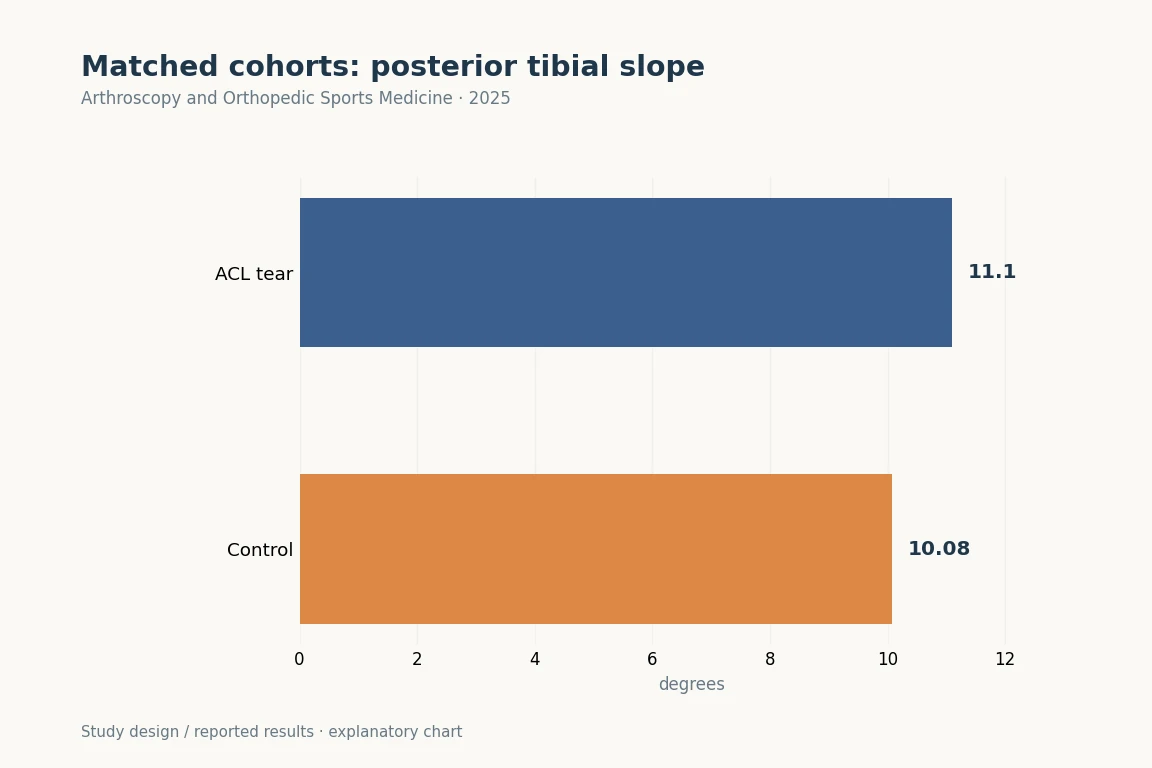
PTS was 11.10 ± 2.98° in the ACL-tear group and 10.08 ± 3.43° in controls, a difference of approximately 1° (P < 0.001).
Results explained with study numbers
 Enlarge Figure
After 1:1 matching, mean PTS in 377 participants per group was 11.10° with ACL tears and 10.08° in controls. A group association does not directly determine individual tear risk or surgical targets.
Arthroscopy and Orthopedic Sports Medicine (2025). DOI: 10.14517/aosm25006 · Original explanatory chart based on reported data
The research question
Participants and Methods
Main Findings
Implications for clinical and surgical practice
Limitations
Let's put it briefly.
Which clinical question does this address?
The findings support consistent PTS measurement in ACL risk assessment. Mean differences and exploratory cutoffs alone cannot establish indications for slope-correcting osteotomy.
Keywords
- Tibia
- Anterior cruciate ligament injuries
- Risk factors
- ACL
- posterior tibial slope
- AI measurement
- propensity matching
Abstract · Original text
Donghyuk Kwak, Sung Eun Kim, Jaeseok Park, Hyuk-Soo Han, Byung Sun Choi, Du Hyun Ro. Posterior tibial slope as a risk factor for anterior cruciate ligament tears: a retrospective study using automated measurement. Arthroscopy and Orthopedic Sports Medicine. 2025. doi:10.14517/aosm25006.
Background
The association between anterior cruciate ligament (ACL) tears and posterior tibial slope (PTS) is well established; however, large-scale retrospective cohort studies in East Asian populations remain limited. Therefore, using a cohort from a tertiary hospital, this study aimed to investigate the difference in PTS between patients with ACL tears and matched controls.
Methods
Patients aged ≥ 18 years were included in both the ACL tear and control groups, excluding those with histories of lower limb surgery, tibial fractures, amputations, or posterior cruciate ligament injuries. Propensity score matching (1:1) was performed based on age, sex, and body mass index. Using a validated, landmark-based algorithm, PTS measurements were automatically obtained from lateral knee radiographs.
Results
After 1:1 propensity score matching, each group included 377 patients. The mean PTS was significantly higher in the ACL tear group (11.10° ± 2.98°) than in the control group (10.08° ± 3.43°) (P < 0.001). No significant differences were found in age (ACL tear, 35.96 ± 13.79 years; control, 35.40 ± 15.20 years, P = 0.60), body mass index (ACL tear, 25.28 ± 3.88; control, 24.96 ± 4.33, P = 0.29), or sex (ACL tear, 78.5% male; control: 78.8% male, P > 0.999). When a cutoff value of 9.42° was applied, the incidence of ACL tears was significantly higher in individuals with PTS ≥ 9.42° (55.3%) than in those with 9.42° (40.8%) (P < 0.001).
Conclusion
This study shows that a greater PTS is significantly associated with ACL tears in an East Asian cohort, as patients with ACL injuries had an average PTS roughly 1° higher than that of matched controls.
© 2025 Korean Arthroscopy Society and Korean Orthopedic Society for Sports Medicine.
The original paper.
Posterior tibial slope as a risk factor for anterior cruciate ligament tears: a retrospective study using automated measurement
Donghyuk Kwak, Sung Eun Kim, Jaeseok Park, Hyuk-Soo Han, Byung Sun Choi, Du Hyun Ro
Arthroscopy and Orthopedic Sports Medicine · 2025