2025 · Arthroscopy and Orthopedic Sports Medicine
자동 측정한 PTS는 동아시아 ACL 파열 환자와 대조군 사이에서 차이를 보일까?
PTS는 ACL 파열군 11.10 ± 2.98°, 대조군 10.08 ± 3.43°로 약 1° 차이가 있었습니다(P < 0.001).
연구 수치로 읽는 결과
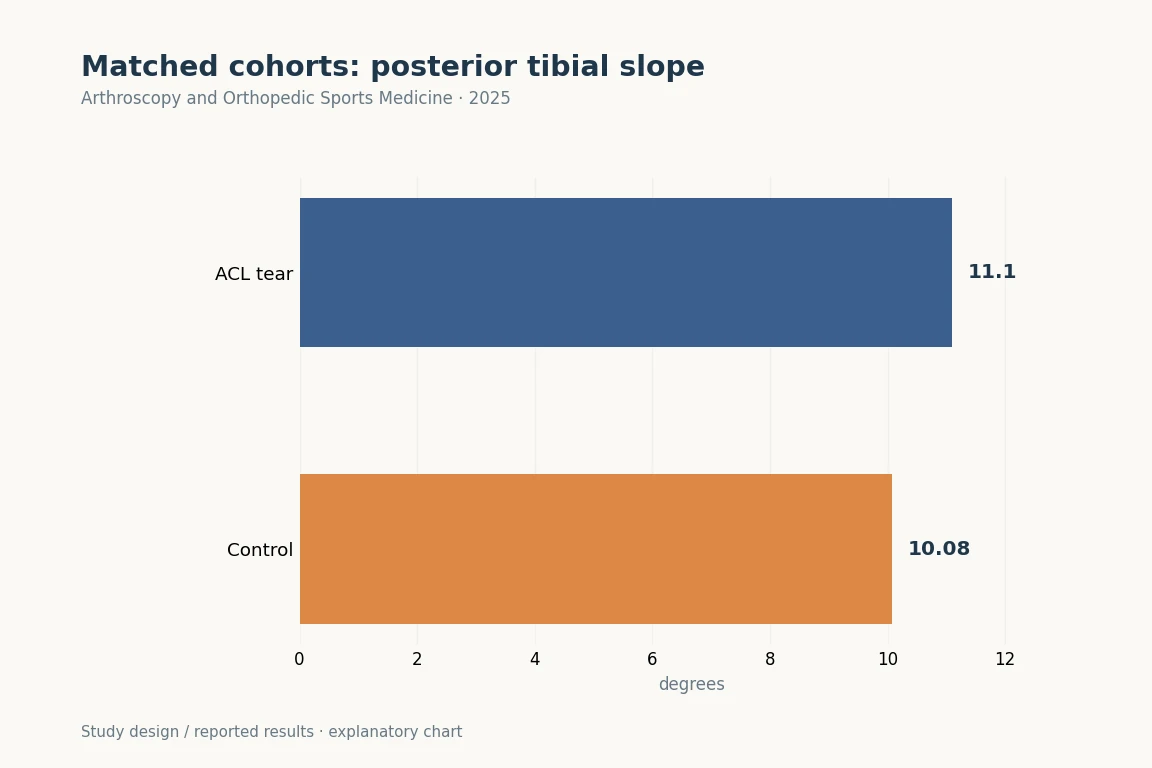 그림 크게 보기
1:1 매칭 후 각 377명의 평균 PTS는 ACL 파열군 11.10°, 대조군 10.08°였습니다. 두 집단의 연관성으로 개인에게 파열이 생길 확률이나 수술 목표를 바로 정할 수 없습니다.
Arthroscopy and Orthopedic Sports Medicine (2025). DOI: 10.14517/aosm25006 · Original explanatory chart based on reported data
연구에서 묻는 질문
대상과 방법
주요 결과
진료와 수술에서 읽을 지점
해석의 제한
짧게 정리하면
어떤 진료 질문과 연결되나요?
ACL 위험 평가에서 PTS를 일관되게 측정할 필요성을 뒷받침합니다. 평균 차이와 탐색적 cut-off만으로 slope 교정 절골술의 적응증을 정할 수 없습니다.
Keywords · 주제어
- Tibia
- Anterior cruciate ligament injuries
- Risk factors
- ACL
- posterior tibial slope
- AI measurement
- propensity matching
Abstract · 원문 초록
Donghyuk Kwak, Sung Eun Kim, Jaeseok Park, Hyuk-Soo Han, Byung Sun Choi, Du Hyun Ro. Posterior tibial slope as a risk factor for anterior cruciate ligament tears: a retrospective study using automated measurement. Arthroscopy and Orthopedic Sports Medicine. 2025. doi:10.14517/aosm25006.
Background
The association between anterior cruciate ligament (ACL) tears and posterior tibial slope (PTS) is well established; however, large-scale retrospective cohort studies in East Asian populations remain limited. Therefore, using a cohort from a tertiary hospital, this study aimed to investigate the difference in PTS between patients with ACL tears and matched controls.
Methods
Patients aged ≥ 18 years were included in both the ACL tear and control groups, excluding those with histories of lower limb surgery, tibial fractures, amputations, or posterior cruciate ligament injuries. Propensity score matching (1:1) was performed based on age, sex, and body mass index. Using a validated, landmark-based algorithm, PTS measurements were automatically obtained from lateral knee radiographs.
Results
After 1:1 propensity score matching, each group included 377 patients. The mean PTS was significantly higher in the ACL tear group (11.10° ± 2.98°) than in the control group (10.08° ± 3.43°) (P < 0.001). No significant differences were found in age (ACL tear, 35.96 ± 13.79 years; control, 35.40 ± 15.20 years, P = 0.60), body mass index (ACL tear, 25.28 ± 3.88; control, 24.96 ± 4.33, P = 0.29), or sex (ACL tear, 78.5% male; control: 78.8% male, P > 0.999). When a cutoff value of 9.42° was applied, the incidence of ACL tears was significantly higher in individuals with PTS ≥ 9.42° (55.3%) than in those with 9.42° (40.8%) (P < 0.001).
Conclusion
This study shows that a greater PTS is significantly associated with ACL tears in an East Asian cohort, as patients with ACL injuries had an average PTS roughly 1° higher than that of matched controls.
© 2025 Korean Arthroscopy Society and Korean Orthopedic Society for Sports Medicine.
원래 논문
Posterior tibial slope as a risk factor for anterior cruciate ligament tears: a retrospective study using automated measurement
Donghyuk Kwak, Sung Eun Kim, Jaeseok Park, Hyuk-Soo Han, Byung Sun Choi, Du Hyun Ro
Arthroscopy and Orthopedic Sports Medicine · 2025