2025 · Arthroscopy and Orthopedic Sports Medicine
自動測定したPTSは、東アジアのACL断裂患者と対照群で異なるか?
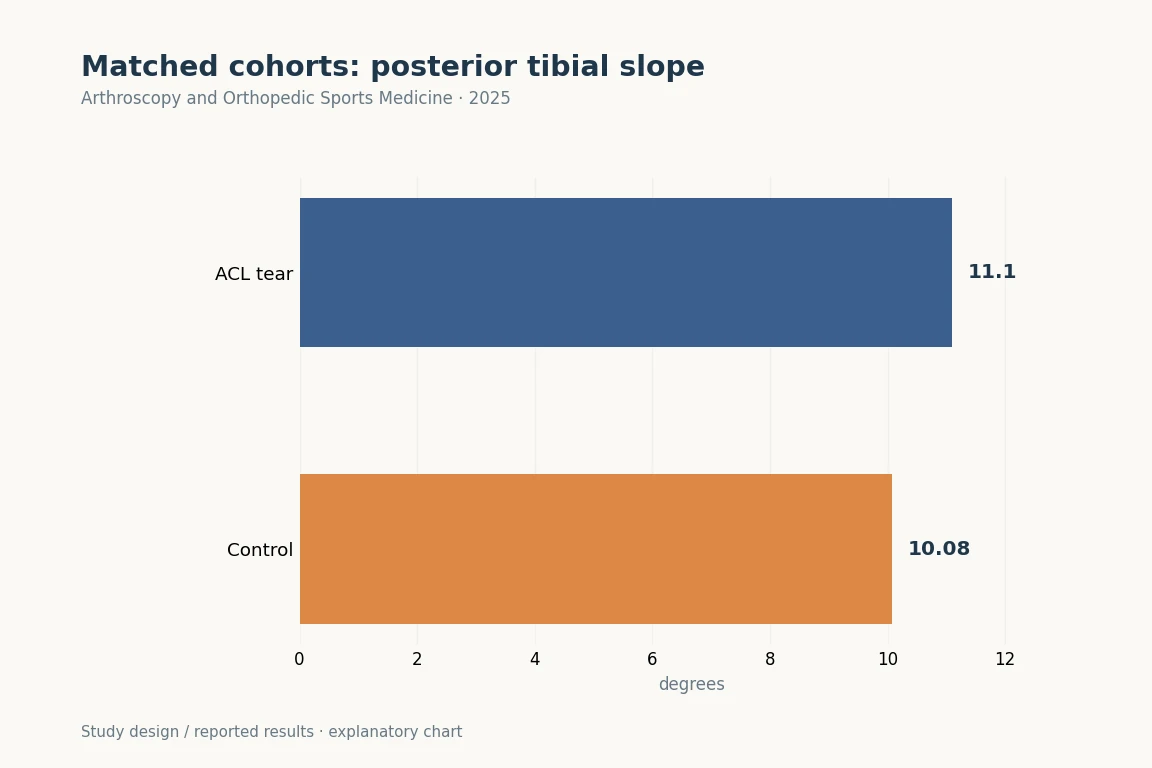
PTSはACL断裂群11.10 ± 2.98°、対照群10.08 ± 3.43°で、約1°の差でした(P < 0.001)。
研究の数値から読む結果
 図を拡大する
1:1マッチング後の各377人の平均PTSはACL断裂群11.10°、対照群10.08°でした。集団の関連から個人の断裂確率や手術目標を直接決めることはできません。
Arthroscopy and Orthopedic Sports Medicine (2025). DOI: 10.14517/aosm25006 · Original explanatory chart based on reported data
研究で問うこと
対象と方法
主な結果
診療・手術で考える点
解釈の限界
簡単に説明しましょう
どの診療上の問いにつながりますか?
ACLリスク評価でPTSを一貫して測定する必要性を裏付けています。平均差と探索的カットオフだけで、傾斜矯正骨切り術の適応は決められません。
Keywords・キーワード
- Tibia
- Anterior cruciate ligament injuries
- Risk factors
- ACL
- posterior tibial slope
- AI measurement
- propensity matching
Abstract・原文の抄録
Donghyuk Kwak, Sung Eun Kim, Jaeseok Park, Hyuk-Soo Han, Byung Sun Choi, Du Hyun Ro. Posterior tibial slope as a risk factor for anterior cruciate ligament tears: a retrospective study using automated measurement. Arthroscopy and Orthopedic Sports Medicine. 2025. doi:10.14517/aosm25006.
Background
The association between anterior cruciate ligament (ACL) tears and posterior tibial slope (PTS) is well established; however, large-scale retrospective cohort studies in East Asian populations remain limited. Therefore, using a cohort from a tertiary hospital, this study aimed to investigate the difference in PTS between patients with ACL tears and matched controls.
Methods
Patients aged ≥ 18 years were included in both the ACL tear and control groups, excluding those with histories of lower limb surgery, tibial fractures, amputations, or posterior cruciate ligament injuries. Propensity score matching (1:1) was performed based on age, sex, and body mass index. Using a validated, landmark-based algorithm, PTS measurements were automatically obtained from lateral knee radiographs.
Results
After 1:1 propensity score matching, each group included 377 patients. The mean PTS was significantly higher in the ACL tear group (11.10° ± 2.98°) than in the control group (10.08° ± 3.43°) (P < 0.001). No significant differences were found in age (ACL tear, 35.96 ± 13.79 years; control, 35.40 ± 15.20 years, P = 0.60), body mass index (ACL tear, 25.28 ± 3.88; control, 24.96 ± 4.33, P = 0.29), or sex (ACL tear, 78.5% male; control: 78.8% male, P > 0.999). When a cutoff value of 9.42° was applied, the incidence of ACL tears was significantly higher in individuals with PTS ≥ 9.42° (55.3%) than in those with 9.42° (40.8%) (P < 0.001).
Conclusion
This study shows that a greater PTS is significantly associated with ACL tears in an East Asian cohort, as patients with ACL injuries had an average PTS roughly 1° higher than that of matched controls.
© 2025 Korean Arthroscopy Society and Korean Orthopedic Society for Sports Medicine.
オリジナル紙だ
Posterior tibial slope as a risk factor for anterior cruciate ligament tears: a retrospective study using automated measurement
Donghyuk Kwak, Sung Eun Kim, Jaeseok Park, Hyuk-Soo Han, Byung Sun Choi, Du Hyun Ro
Arthroscopy and Orthopedic Sports Medicine · 2025