
2025 · Knee Surgery, Sports Traumatology, Arthroscopy
Deep-learning oJSW measurement and quantitative joint-space narrowing assessment
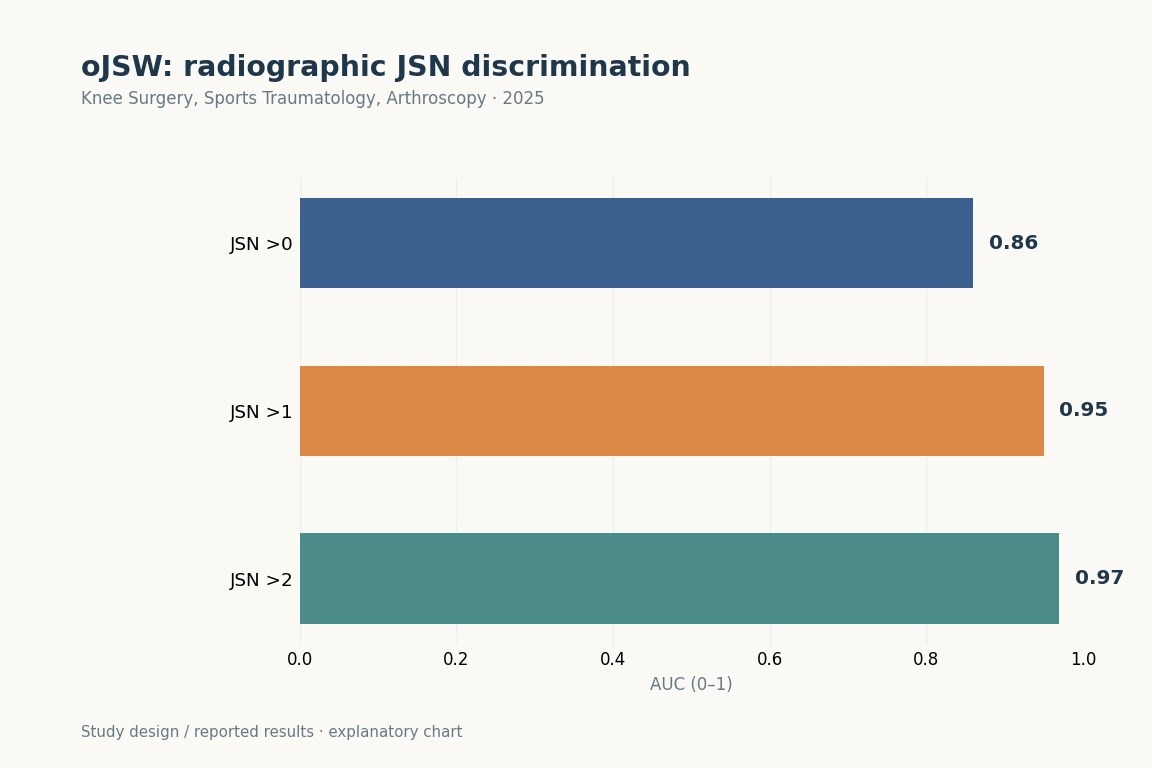
AUCs for discriminating JSN >0, >1 and >2 were 0.86, 0.95 and 0.97, respectively. The abstract summarises the absolute AUC advantage over fixed-location JSW as 0.04–0.08. These are cross-sectional discrimination results, not an individual’s probability of future osteoarthritis progression.
Results explained with study numbers
 Enlarge Figure
AUC was 0.86 for the earliest JSN distinction and 0.95 and 0.97 for more advanced stages.
Knee Surgery, Sports Traumatology, Arthroscopy (2025). DOI: 10.1002/ksa.70227 · Original explanatory chart based on reported data
The research question
Participants and Methods
Main Findings
Implications for clinical and surgical practice
Limitations
Let's put it briefly.
Which clinical question does this address?
It is a candidate continuous structural imaging measure for OA research and joint-preserving treatment trials.
Keywords
- biomarkers
- deep learning
- joint space width
- knee osteoarthritis
- radiography
- AI
- JSW
- OA progression
Abstract · Original text
Do Weon Lee, Dae Seok Song, Yong Seuk Lee, Ja-Young Choi, Du Hyun Ro. Deep learning-derived orthogonal minimum joint space width improves radiographic assessment of knee osteoarthritis severity and progression. Knee surgery, sports traumatology, arthroscopy : official journal of the ESSKA. 2025. doi:10.1002/ksa.70227.
PURPOSE
To evaluate the performance of a novel orthogonal minimum joint space width, defined as the narrowest distance measured orthogonally to the tibial joint line within a standardised medial axis, for detecting and monitoring knee osteoarthritis progression. This artificial intelligence-derived metric, obtained through deep learning, was compared with conventional fixed-location joint space width measures.
METHODS
A total of 15,313 knee radiographs from the Osteoarthritis Initiative (OAI), spanning baseline to 72-month follow-up, were analysed in this retrospective cohort study. Orthogonal minimum joint space width was automatically measured using a deep learning model. Discriminative ability for cross-sectional joint space narrowing severity was assessed using the area under the receiver operating characteristic curve. Longitudinal responsiveness was evaluated with the standardised response mean and relative standardised response mean, computed from pooled 12-month intervals and stratified by baseline narrowing grade. Variability was estimated through 1000 bootstrap resamples. Performance was compared with fixed-location measures at 22.5% and 25.0% from the medial edge of the tibial plateau.
RESULTS
Orthogonal minimum joint space width demonstrated strong discriminative performance, with area under the curve values of 0.86, 0.95 and 0.97 for joint space narrowing greater than grades 0, 1 and 2, respectively - exceeding the corresponding values for fixed-location measures by absolute margins of 0.04-0.08. Pooled relative standardised response mean analysis showed consistently higher responsiveness for orthogonal minimum joint space width, with median values of 0.97, 0.95 and 0.91 for baseline narrowing grades 0, 1 and 2, representing approximately 2%-4% greater responsiveness than fixed-location measures across all strata.
CONCLUSIONS
Orthogonal minimum joint space width, automatically quantified by deep learning, enhances both sensitivity and specificity for assessing knee osteoarthritis severity and progression. This metric may serve as a robust and reproducible structural imaging endpoint for clinical trials and longitudinal research.
LEVEL OF EVIDENCE
Level II.
The original paper.
Deep learning-derived orthogonal minimum joint space width improves radiographic assessment of knee osteoarthritis severity and progression
Do Weon Lee, Dae Seok Song, Yong Seuk Lee, Ja-Young Choi, Du Hyun Ro
Knee Surgery, Sports Traumatology, Arthroscopy · 2025