
2025 · Knee Surgery, Sports Traumatology, Arthroscopy
딥러닝 oJSW 측정과 관절간격 협소화의 정량 평가
관절간격 협소 JSN >0, >1, >2를 구분하는 AUC는 각각 0.86, 0.95, 0.97이었습니다. 초록에서는 고정 위치 JSW 측정과의 AUC 차이를 0.04–0.08로 요약했습니다. 이는 같은 시점의 영상에서 협소 정도를 구분한 결과이며, 개인의 향후 관절염 진행 확률을 뜻하지 않습니다.
연구 수치로 읽는 결과
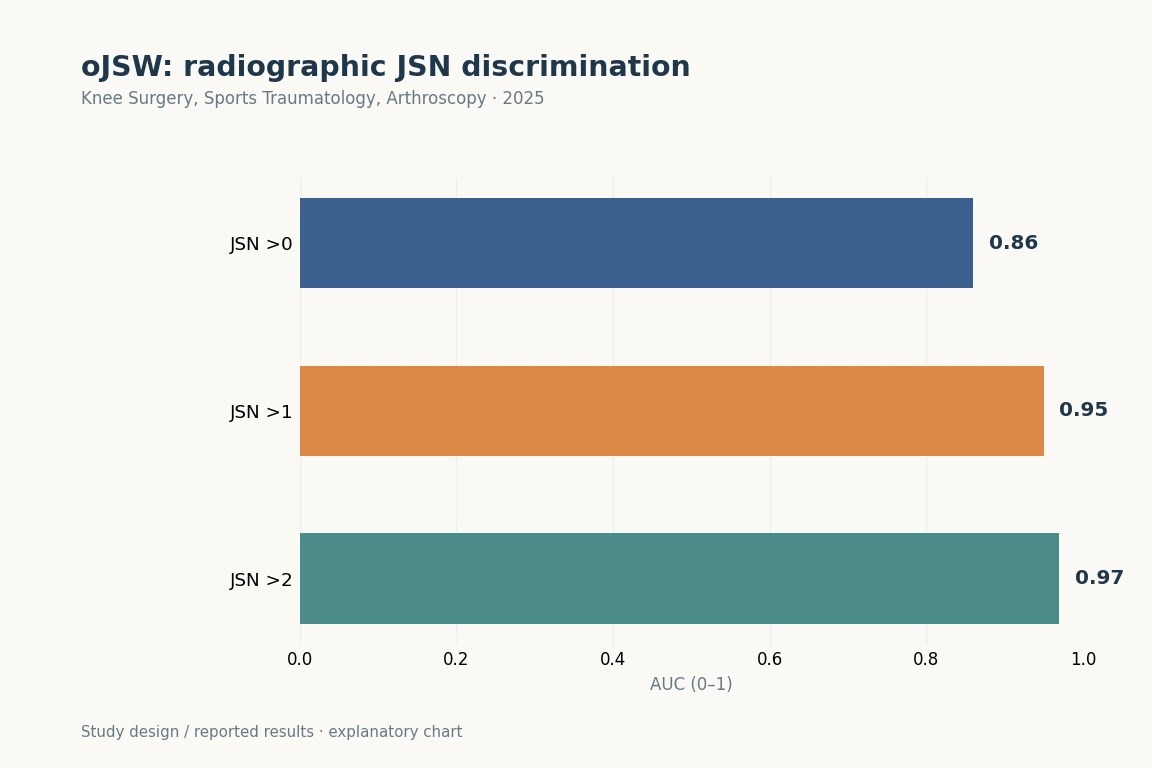 그림 크게 보기
가장 이른 JSN 구분의 AUC는 0.86, 더 심한 단계는 0.95와 0.97이었습니다.
Knee Surgery, Sports Traumatology, Arthroscopy (2025). DOI: 10.1002/ksa.70227 · Original explanatory chart based on reported data
연구에서 묻는 질문
대상과 방법
주요 결과
진료와 수술에서 읽을 지점
해석의 제한
짧게 정리하면
어떤 진료 질문과 연결되나요?
OA 연구와 관절 보존 치료 시험에서 사용할 연속형 구조적 영상 지표의 후보입니다.
Keywords · 주제어
- biomarkers
- deep learning
- joint space width
- knee osteoarthritis
- radiography
- AI
- JSW
- OA progression
Abstract · 원문 초록
Do Weon Lee, Dae Seok Song, Yong Seuk Lee, Ja-Young Choi, Du Hyun Ro. Deep learning-derived orthogonal minimum joint space width improves radiographic assessment of knee osteoarthritis severity and progression. Knee surgery, sports traumatology, arthroscopy : official journal of the ESSKA. 2025. doi:10.1002/ksa.70227.
PURPOSE
To evaluate the performance of a novel orthogonal minimum joint space width, defined as the narrowest distance measured orthogonally to the tibial joint line within a standardised medial axis, for detecting and monitoring knee osteoarthritis progression. This artificial intelligence-derived metric, obtained through deep learning, was compared with conventional fixed-location joint space width measures.
METHODS
A total of 15,313 knee radiographs from the Osteoarthritis Initiative (OAI), spanning baseline to 72-month follow-up, were analysed in this retrospective cohort study. Orthogonal minimum joint space width was automatically measured using a deep learning model. Discriminative ability for cross-sectional joint space narrowing severity was assessed using the area under the receiver operating characteristic curve. Longitudinal responsiveness was evaluated with the standardised response mean and relative standardised response mean, computed from pooled 12-month intervals and stratified by baseline narrowing grade. Variability was estimated through 1000 bootstrap resamples. Performance was compared with fixed-location measures at 22.5% and 25.0% from the medial edge of the tibial plateau.
RESULTS
Orthogonal minimum joint space width demonstrated strong discriminative performance, with area under the curve values of 0.86, 0.95 and 0.97 for joint space narrowing greater than grades 0, 1 and 2, respectively - exceeding the corresponding values for fixed-location measures by absolute margins of 0.04-0.08. Pooled relative standardised response mean analysis showed consistently higher responsiveness for orthogonal minimum joint space width, with median values of 0.97, 0.95 and 0.91 for baseline narrowing grades 0, 1 and 2, representing approximately 2%-4% greater responsiveness than fixed-location measures across all strata.
CONCLUSIONS
Orthogonal minimum joint space width, automatically quantified by deep learning, enhances both sensitivity and specificity for assessing knee osteoarthritis severity and progression. This metric may serve as a robust and reproducible structural imaging endpoint for clinical trials and longitudinal research.
LEVEL OF EVIDENCE
Level II.
원래 논문
Deep learning-derived orthogonal minimum joint space width improves radiographic assessment of knee osteoarthritis severity and progression
Do Weon Lee, Dae Seok Song, Yong Seuk Lee, Ja-Young Choi, Du Hyun Ro
Knee Surgery, Sports Traumatology, Arthroscopy · 2025