
2025 · Knee Surgery, Sports Traumatology, Arthroscopy
深層学習によるoJSW測定と関節裂隙狭小化の定量評価
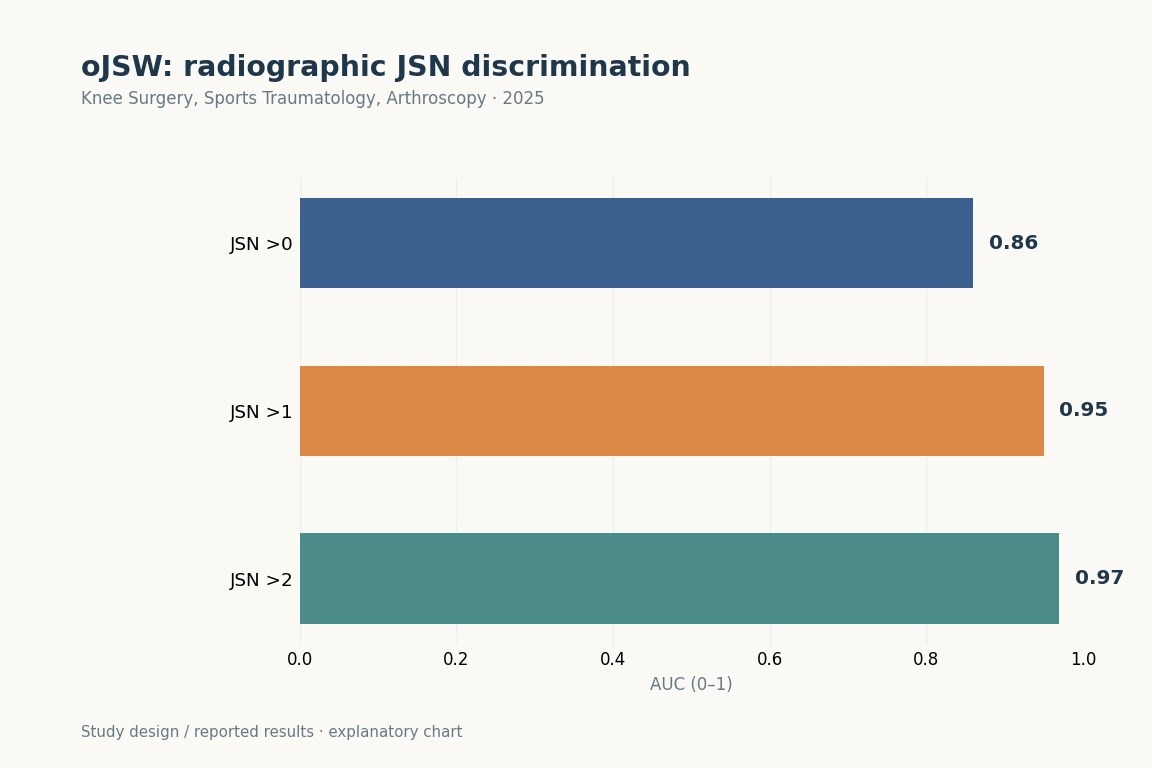
関節裂隙狭小化(JSN)>0、>1、>2を識別するAUCは、それぞれ0.86、0.95、0.97でした。抄録では、固定位置で測定するJSWとの差を0.04–0.08と要約しています。同じ時点の画像で狭小化の程度を識別した結果であり、個人の将来の変形性膝関節症の進行確率を示す値ではありません。
研究の数値から読む結果
 図を拡大する
最も早期のJSN識別のAUCは0.86、より進行した段階では0.95と0.97でした。
Knee Surgery, Sports Traumatology, Arthroscopy (2025). DOI: 10.1002/ksa.70227 · Original explanatory chart based on reported data
研究で問うこと
対象と方法
主な結果
診療・手術で考える点
解釈の限界
簡単に説明しましょう
どの診療上の問いにつながりますか?
OA研究や関節温存治療の試験に用いる連続量の構造的画像指標の候補です。
Keywords・キーワード
- biomarkers
- deep learning
- joint space width
- knee osteoarthritis
- radiography
- AI
- JSW
- OA progression
Abstract・原文の抄録
Do Weon Lee, Dae Seok Song, Yong Seuk Lee, Ja-Young Choi, Du Hyun Ro. Deep learning-derived orthogonal minimum joint space width improves radiographic assessment of knee osteoarthritis severity and progression. Knee surgery, sports traumatology, arthroscopy : official journal of the ESSKA. 2025. doi:10.1002/ksa.70227.
PURPOSE
To evaluate the performance of a novel orthogonal minimum joint space width, defined as the narrowest distance measured orthogonally to the tibial joint line within a standardised medial axis, for detecting and monitoring knee osteoarthritis progression. This artificial intelligence-derived metric, obtained through deep learning, was compared with conventional fixed-location joint space width measures.
METHODS
A total of 15,313 knee radiographs from the Osteoarthritis Initiative (OAI), spanning baseline to 72-month follow-up, were analysed in this retrospective cohort study. Orthogonal minimum joint space width was automatically measured using a deep learning model. Discriminative ability for cross-sectional joint space narrowing severity was assessed using the area under the receiver operating characteristic curve. Longitudinal responsiveness was evaluated with the standardised response mean and relative standardised response mean, computed from pooled 12-month intervals and stratified by baseline narrowing grade. Variability was estimated through 1000 bootstrap resamples. Performance was compared with fixed-location measures at 22.5% and 25.0% from the medial edge of the tibial plateau.
RESULTS
Orthogonal minimum joint space width demonstrated strong discriminative performance, with area under the curve values of 0.86, 0.95 and 0.97 for joint space narrowing greater than grades 0, 1 and 2, respectively - exceeding the corresponding values for fixed-location measures by absolute margins of 0.04-0.08. Pooled relative standardised response mean analysis showed consistently higher responsiveness for orthogonal minimum joint space width, with median values of 0.97, 0.95 and 0.91 for baseline narrowing grades 0, 1 and 2, representing approximately 2%-4% greater responsiveness than fixed-location measures across all strata.
CONCLUSIONS
Orthogonal minimum joint space width, automatically quantified by deep learning, enhances both sensitivity and specificity for assessing knee osteoarthritis severity and progression. This metric may serve as a robust and reproducible structural imaging endpoint for clinical trials and longitudinal research.
LEVEL OF EVIDENCE
Level II.
オリジナル紙だ
Deep learning-derived orthogonal minimum joint space width improves radiographic assessment of knee osteoarthritis severity and progression
Do Weon Lee, Dae Seok Song, Yong Seuk Lee, Ja-Young Choi, Du Hyun Ro
Knee Surgery, Sports Traumatology, Arthroscopy · 2025