
2025 · Osteoarthritis and Cartilage Open
Can Knees with the Same OA Grade Progress at Different Rates?
Within the same KL grade 1 or 2, pain and function did not differ between osteophyte-predominant and joint-space-narrowing-predominant groups.
Original Figure 1
 Enlarge Figure
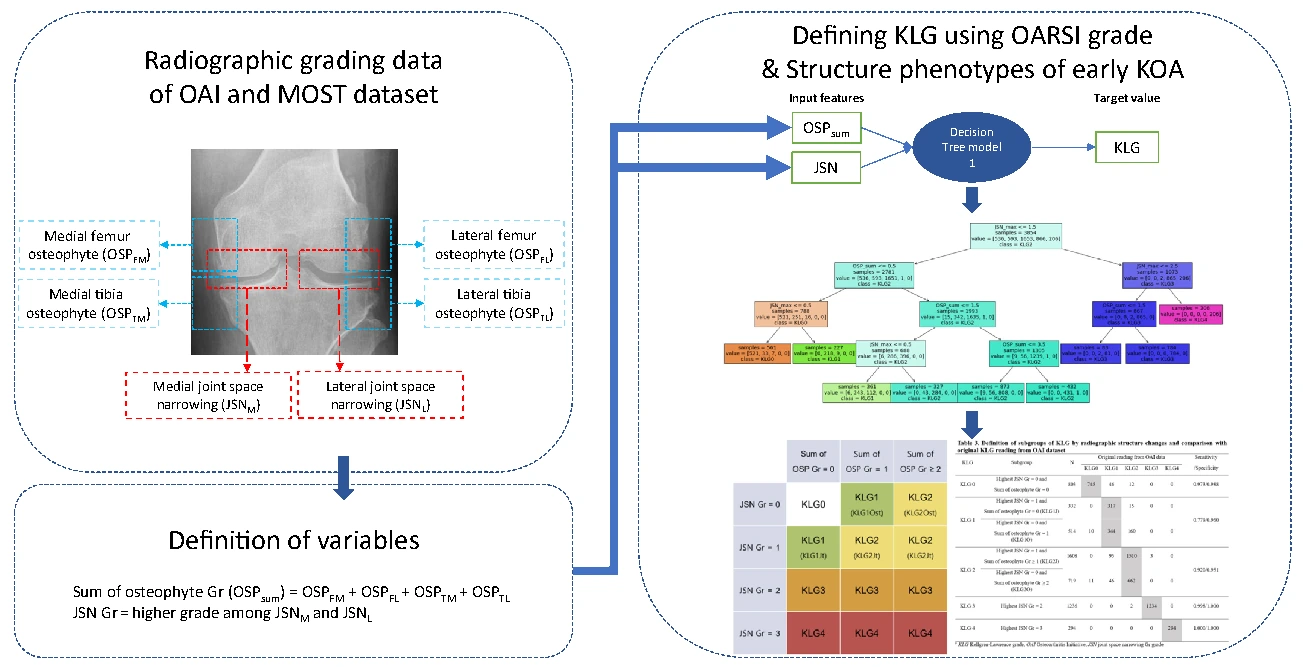
Original study workflow uses osteophytes and joint space narrowing on OAI and MOST radiographs to distinguish early OA structural phenotypes.
Osteoarthritis and Cartilage Open (2025). DOI: 10.1016/j.ocarto.2025.100566 · Original Figure 1
Original Figure 2
 Enlarge Figure
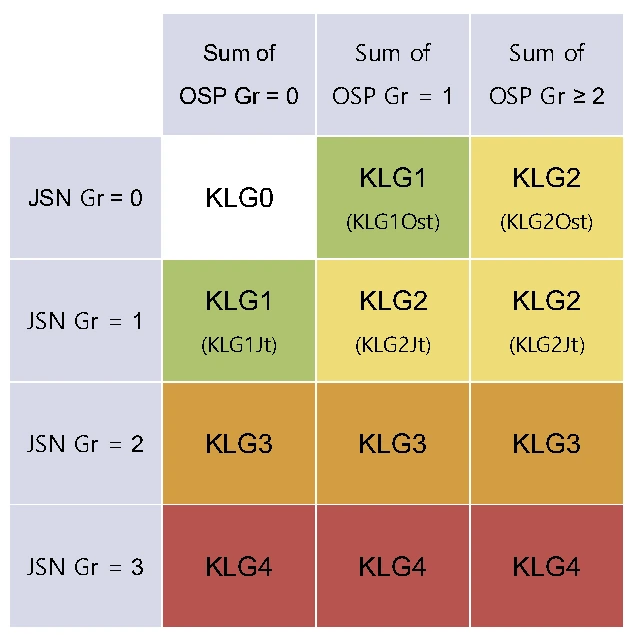
The original table subdivides KL grades by joint space narrowing and osteophytes. Structural phenotypes can differ within a grade.
Osteoarthritis and Cartilage Open (2025). DOI: 10.1016/j.ocarto.2025.100566 · Original Figure 2
Original Figure 4
 Enlarge Figure
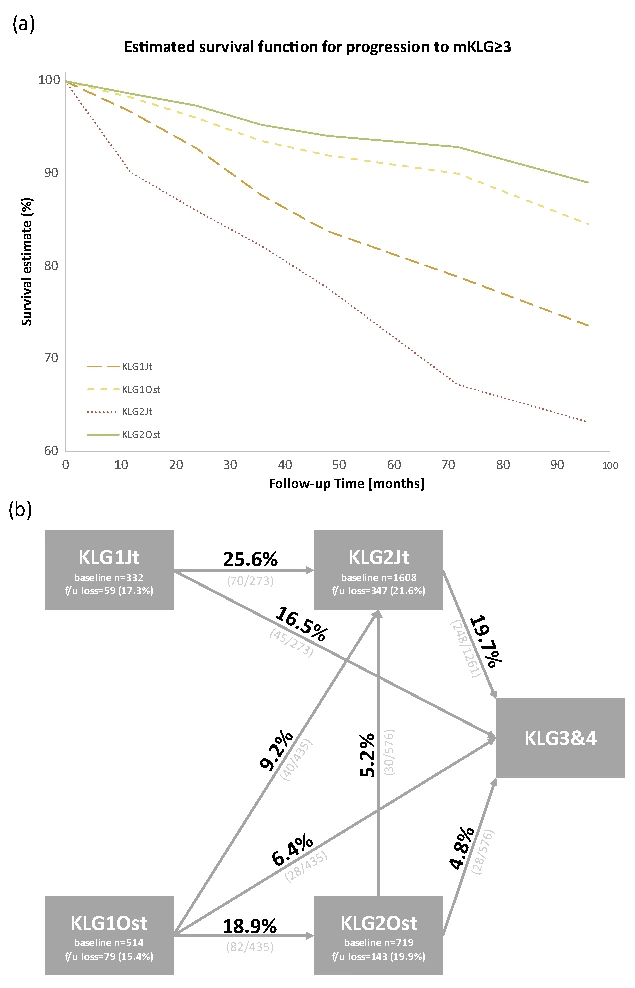
Survival curves and mean progression times to KL 3 or higher by structural phenotype. Current pain and radiographic progression should be interpreted separately.
Osteoarthritis and Cartilage Open (2025). DOI: 10.1016/j.ocarto.2025.100566 · Original Figure 4
The research question
Participants and Methods
Main Findings
Implications for clinical and surgical practice
Limitations
Let's put it briefly.
Which clinical question does this address?
Separating narrowing and osteophytes alongside KL grade can explain progression risk more precisely. Similar structural changes still require separate assessment of symptoms and treatment needs.
Keywords
- Artificial intelligence
- Kellgren-Lawrence
- Knee osteoarthritis
- Machine learning
- OARSI
- OA
- radiographic phenotype
- progression
Abstract · Original text
Sunho Ko, Yunhee Choi, Hyuk-Soo Han, Seong Hwan Kim, Du Hyun Ro. Association of radiographic structure deformity phenotypes of knee OA to clinical symptoms and risk for progression: Proposing a modification of Kellgren-Lawrence grade - Data from the Osteoarthritis Initiative and the MOST study. Osteoarthritis and cartilage open. 2025;7(1):100566. doi:10.1016/j.ocarto.2025.100566.
OBJECTIVE
This study aims to define Kellgren-Lawrence grade (KLG) using OARSI grade and stratify radiographic knee osteoarthritis (KOA) into distinct phenotypes based on radiographic structure changes and compare clinical symptoms and disease progression.
DESIGN
We used radiographic grading data provided by the OAI and MOST study. Decision tree was used to (1) Find OARSI grade criteria for each KLG and (2) Phenotype early osteoarthritic knees (=KLG1, 2) by the radiographic structure changes. Pain, function, and progression to KLG ≥3 were compared between phenotypes.
RESULTS
10,804 knees from 5802 patients were included. The mean follow-up duration was 55.6 ± 24.5 months. Criteria for KLG1 was: (1) Joint space narrowing (JSN) grade (more severe grade among medial and lateral compartments) = 1 without osteophytes (i.e., KLG1Jt) (2) A single grade 1 osteophyte without JSN (i.e., KLG1Ost). Criteria for KLG2 was (1) JSN = 1 with a sum of osteophyte grades ≥1 (i.e., KLG2Jt): (2) Sum of osteophyte grades ≥2 without JSN (i.e., KLG2Ost). In terms of pain and function, there was no difference between KLG1Ost and KLG1Jt or between KLG2Ost and KLG2Jt. For progression to KLG ≥3, the mean survival time of KLG1Ost was 1.87-fold (95 % CI: 1.31-2.67) longer than that of KLG1Jt, while KLG2Ost was 5.42-fold (95 % CI: 3.69-7.96) longer than KLG2Jt.
CONCLUSIONS
We proposed the criteria for each KLG using OARSI grade and phenotypes characterized by radiographic structure deformity in early KLG. Within the same KLG, the rate of disease progression was different depending on the structural deformity.
© 2025 The Author(s)
The original paper.
Association of radiographic structure deformity phenotypes of knee OA to clinical symptoms and risk for progression: Proposing a modification of Kellgren-Lawrence grade - Data from the Osteoarthritis Initiative and the MOST study
Sunho Ko, Yunhee Choi, Hyuk-Soo Han, Seong Hwan Kim, Du Hyun Ro
Osteoarthritis and Cartilage Open · 2025