
2025 · Osteoarthritis and Cartilage Open
같은 관절염 등급인데 진행 속도가 다를 수 있을까?
같은 KL 1 또는 2에서 골극 중심군과 관절간격 협소 중심군의 통증·기능은 차이가 없었습니다.
원문 Figure 1
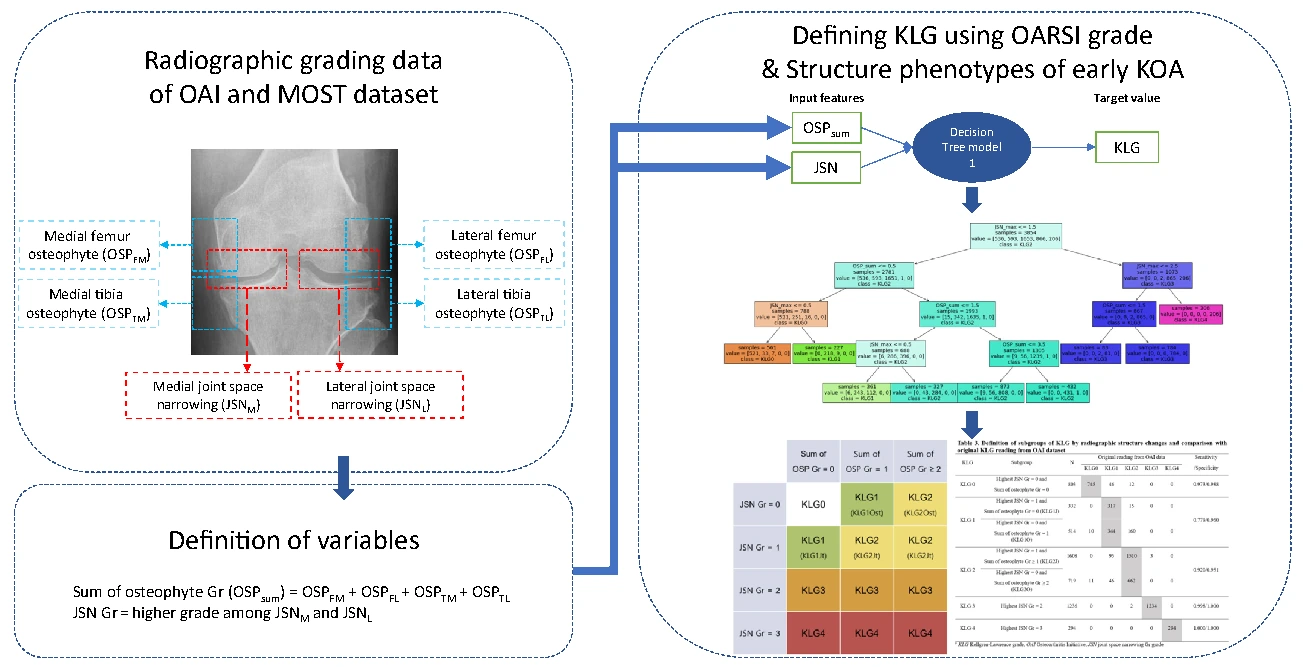 그림 크게 보기
OAI·MOST X선의 골극과 관절간격 협소를 이용해 초기 관절염의 구조적 형태를 구분한 원문 연구 흐름입니다.
Osteoarthritis and Cartilage Open (2025). DOI: 10.1016/j.ocarto.2025.100566 · Original Figure 1
원문 Figure 2
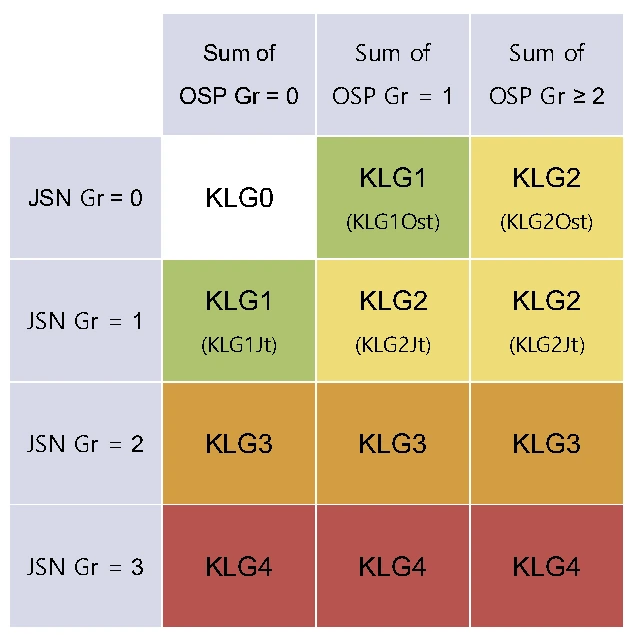 그림 크게 보기
관절간격 협소와 골극의 조합으로 KL 등급을 세분화한 원문 표입니다. 같은 등급 안에서도 구조적 형태가 다를 수 있습니다.
Osteoarthritis and Cartilage Open (2025). DOI: 10.1016/j.ocarto.2025.100566 · Original Figure 2
원문 Figure 4
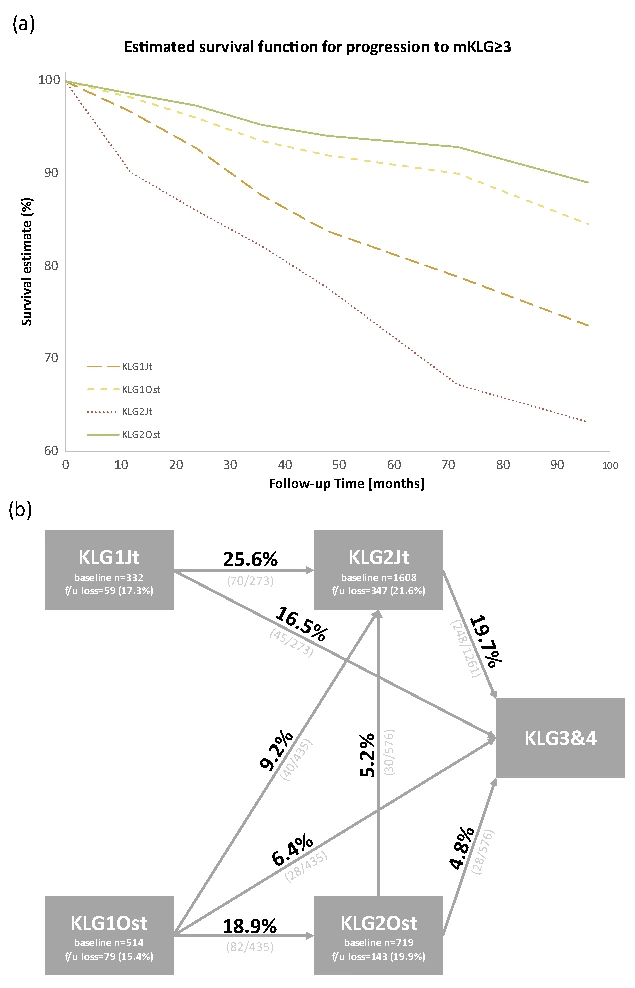 그림 크게 보기
구조적 형태별 KL 3 이상 진행의 생존곡선과 평균 진행 시간을 보여줍니다. 현재의 통증 차이와 영상학적 진행 차이는 구분해 해석합니다.
Osteoarthritis and Cartilage Open (2025). DOI: 10.1016/j.ocarto.2025.100566 · Original Figure 4
연구에서 묻는 질문
대상과 방법
주요 결과
진료와 수술에서 읽을 지점
해석의 제한
짧게 정리하면
어떤 진료 질문과 연결되나요?
KL 숫자 외에 관절간격 협소와 골극을 분리해 해석하면 진행 위험을 더 자세히 설명할 수 있습니다. 구조적 변화가 비슷해도 증상과 치료 필요성은 별도로 평가해야 합니다.
Keywords · 주제어
- Artificial intelligence
- Kellgren-Lawrence
- Knee osteoarthritis
- Machine learning
- OARSI
- OA
- radiographic phenotype
- progression
Abstract · 원문 초록
Sunho Ko, Yunhee Choi, Hyuk-Soo Han, Seong Hwan Kim, Du Hyun Ro. Association of radiographic structure deformity phenotypes of knee OA to clinical symptoms and risk for progression: Proposing a modification of Kellgren-Lawrence grade - Data from the Osteoarthritis Initiative and the MOST study. Osteoarthritis and cartilage open. 2025;7(1):100566. doi:10.1016/j.ocarto.2025.100566.
OBJECTIVE
This study aims to define Kellgren-Lawrence grade (KLG) using OARSI grade and stratify radiographic knee osteoarthritis (KOA) into distinct phenotypes based on radiographic structure changes and compare clinical symptoms and disease progression.
DESIGN
We used radiographic grading data provided by the OAI and MOST study. Decision tree was used to (1) Find OARSI grade criteria for each KLG and (2) Phenotype early osteoarthritic knees (=KLG1, 2) by the radiographic structure changes. Pain, function, and progression to KLG ≥3 were compared between phenotypes.
RESULTS
10,804 knees from 5802 patients were included. The mean follow-up duration was 55.6 ± 24.5 months. Criteria for KLG1 was: (1) Joint space narrowing (JSN) grade (more severe grade among medial and lateral compartments) = 1 without osteophytes (i.e., KLG1Jt) (2) A single grade 1 osteophyte without JSN (i.e., KLG1Ost). Criteria for KLG2 was (1) JSN = 1 with a sum of osteophyte grades ≥1 (i.e., KLG2Jt): (2) Sum of osteophyte grades ≥2 without JSN (i.e., KLG2Ost). In terms of pain and function, there was no difference between KLG1Ost and KLG1Jt or between KLG2Ost and KLG2Jt. For progression to KLG ≥3, the mean survival time of KLG1Ost was 1.87-fold (95 % CI: 1.31-2.67) longer than that of KLG1Jt, while KLG2Ost was 5.42-fold (95 % CI: 3.69-7.96) longer than KLG2Jt.
CONCLUSIONS
We proposed the criteria for each KLG using OARSI grade and phenotypes characterized by radiographic structure deformity in early KLG. Within the same KLG, the rate of disease progression was different depending on the structural deformity.
© 2025 The Author(s)
원래 논문
Association of radiographic structure deformity phenotypes of knee OA to clinical symptoms and risk for progression: Proposing a modification of Kellgren-Lawrence grade - Data from the Osteoarthritis Initiative and the MOST study
Sunho Ko, Yunhee Choi, Hyuk-Soo Han, Seong Hwan Kim, Du Hyun Ro
Osteoarthritis and Cartilage Open · 2025