
2025 · Osteoarthritis and Cartilage Open
同じ関節症の等級でも、進行速度は異なるか?
同じKL 1または2では、骨棘優位群と関節裂隙狭小化優位群の痛み・機能に差はありませんでした。
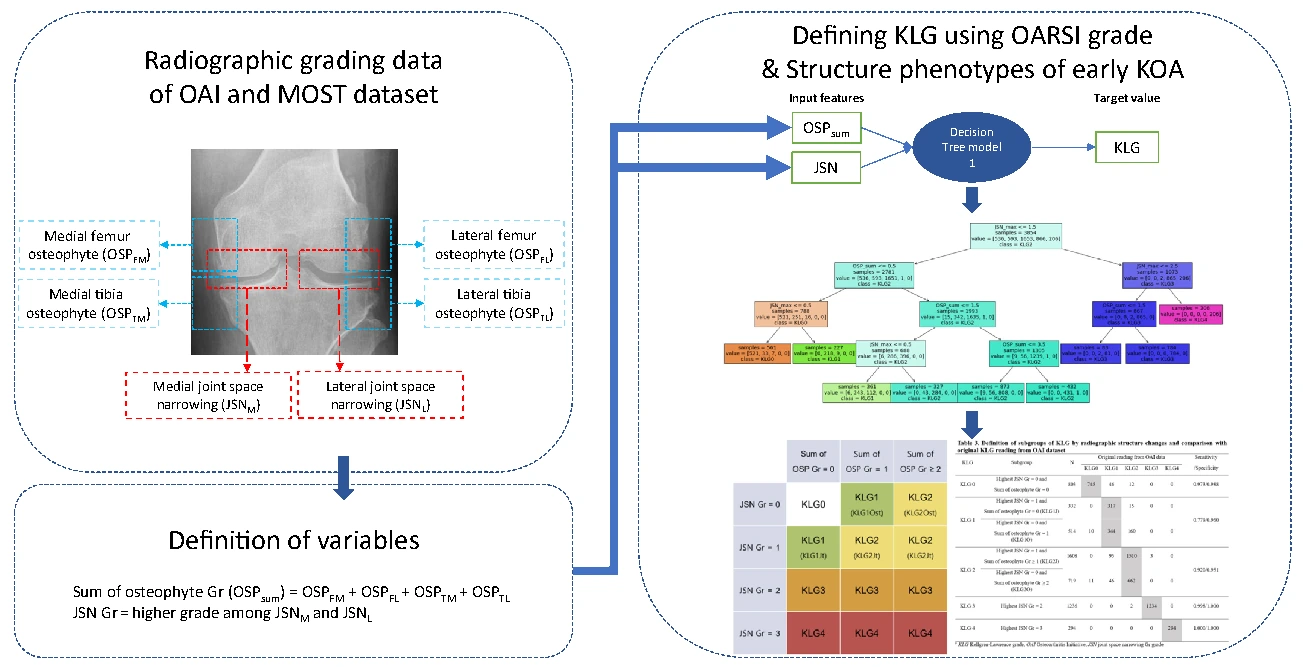
原図Figure 1
 図を拡大する
OAI・MOSTのX線の骨棘と関節裂隙狭小化から、初期関節症の構造的な型を分ける原図の研究フローです。
Osteoarthritis and Cartilage Open (2025). DOI: 10.1016/j.ocarto.2025.100566 · Original Figure 1
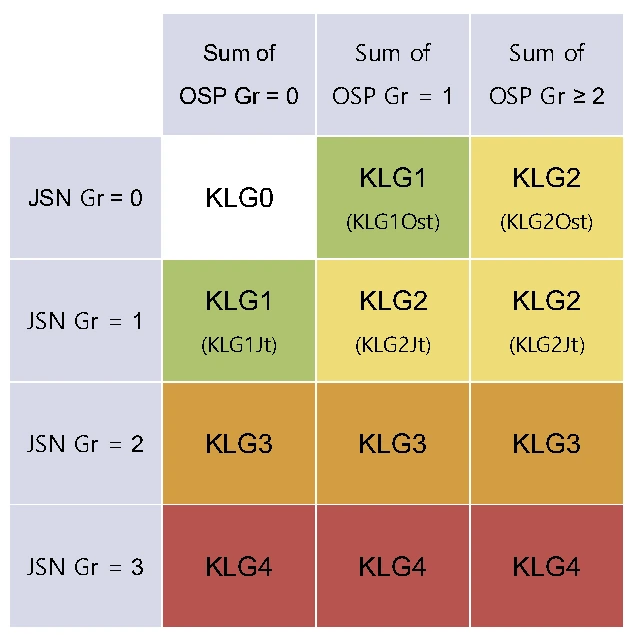
原図Figure 2
 図を拡大する
関節裂隙狭小化と骨棘の組み合わせでKLグレードを細分化した原表です。同じグレード内でも構造的な型が異なります。
Osteoarthritis and Cartilage Open (2025). DOI: 10.1016/j.ocarto.2025.100566 · Original Figure 2
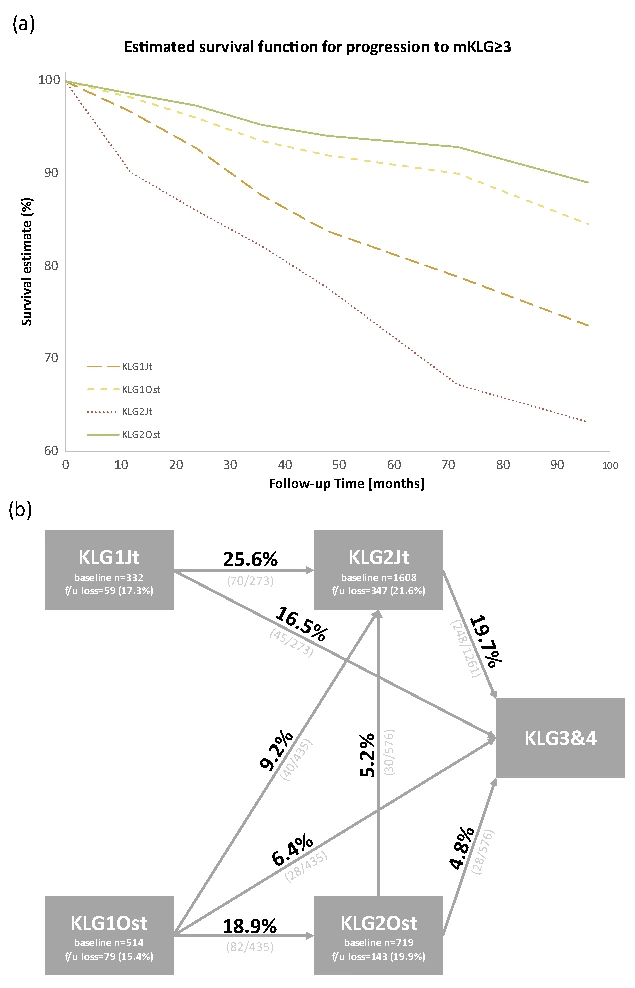
原図Figure 4
 図を拡大する
構造的な型別のKL 3以上への進行の生存曲線と平均時間です。現在の痛みと画像上の進行は分けて解釈します。
Osteoarthritis and Cartilage Open (2025). DOI: 10.1016/j.ocarto.2025.100566 · Original Figure 4
研究で問うこと
対象と方法
主な結果
診療・手術で考える点
解釈の限界
簡単に説明しましょう
どの診療上の問いにつながりますか?
KL等級に加えて狭小化と骨棘を分けると、進行リスクをより詳しく説明できます。構造変化が似ていても、症状と治療の必要性は別に評価します。
Keywords・キーワード
- Artificial intelligence
- Kellgren-Lawrence
- Knee osteoarthritis
- Machine learning
- OARSI
- OA
- radiographic phenotype
- progression
Abstract・原文の抄録
Sunho Ko, Yunhee Choi, Hyuk-Soo Han, Seong Hwan Kim, Du Hyun Ro. Association of radiographic structure deformity phenotypes of knee OA to clinical symptoms and risk for progression: Proposing a modification of Kellgren-Lawrence grade - Data from the Osteoarthritis Initiative and the MOST study. Osteoarthritis and cartilage open. 2025;7(1):100566. doi:10.1016/j.ocarto.2025.100566.
OBJECTIVE
This study aims to define Kellgren-Lawrence grade (KLG) using OARSI grade and stratify radiographic knee osteoarthritis (KOA) into distinct phenotypes based on radiographic structure changes and compare clinical symptoms and disease progression.
DESIGN
We used radiographic grading data provided by the OAI and MOST study. Decision tree was used to (1) Find OARSI grade criteria for each KLG and (2) Phenotype early osteoarthritic knees (=KLG1, 2) by the radiographic structure changes. Pain, function, and progression to KLG ≥3 were compared between phenotypes.
RESULTS
10,804 knees from 5802 patients were included. The mean follow-up duration was 55.6 ± 24.5 months. Criteria for KLG1 was: (1) Joint space narrowing (JSN) grade (more severe grade among medial and lateral compartments) = 1 without osteophytes (i.e., KLG1Jt) (2) A single grade 1 osteophyte without JSN (i.e., KLG1Ost). Criteria for KLG2 was (1) JSN = 1 with a sum of osteophyte grades ≥1 (i.e., KLG2Jt): (2) Sum of osteophyte grades ≥2 without JSN (i.e., KLG2Ost). In terms of pain and function, there was no difference between KLG1Ost and KLG1Jt or between KLG2Ost and KLG2Jt. For progression to KLG ≥3, the mean survival time of KLG1Ost was 1.87-fold (95 % CI: 1.31-2.67) longer than that of KLG1Jt, while KLG2Ost was 5.42-fold (95 % CI: 3.69-7.96) longer than KLG2Jt.
CONCLUSIONS
We proposed the criteria for each KLG using OARSI grade and phenotypes characterized by radiographic structure deformity in early KLG. Within the same KLG, the rate of disease progression was different depending on the structural deformity.
© 2025 The Author(s)
オリジナル紙だ
Association of radiographic structure deformity phenotypes of knee OA to clinical symptoms and risk for progression: Proposing a modification of Kellgren-Lawrence grade - Data from the Osteoarthritis Initiative and the MOST study
Sunho Ko, Yunhee Choi, Hyuk-Soo Han, Seong Hwan Kim, Du Hyun Ro
Osteoarthritis and Cartilage Open · 2025