2024 · Scientific Reports
Can Lower-leg and Thigh Muscle Coactivation during Walking Estimate WOMAC and VAS Symptoms in Advanced OA?
The abstract reported an R² of 0.85 for the cross-validated WOMAC estimation model.
Original Figure 2
 Enlarge Figure
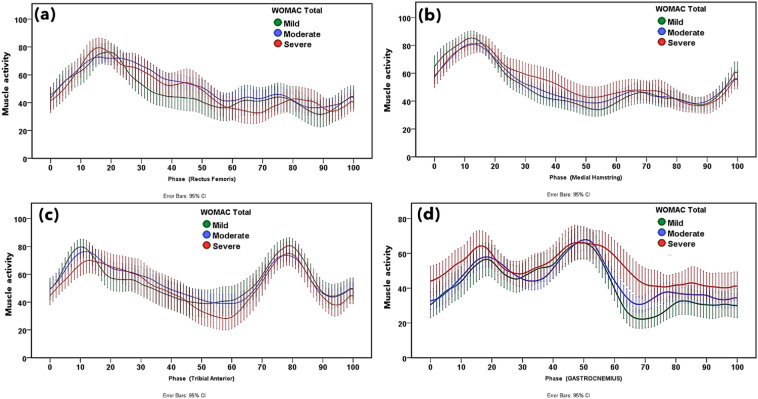
Gait-cycle EMG from four muscles is grouped by WOMAC symptom severity. Examine the colored means and confidence intervals, including overlap during parts of the cycle.
Iqram Hussain, Sung Eun Kim, Chiheon Kwon, Seo Kyung Hoon, Hee Chan Kim, Yunseo Ku, Du Hyun Ro. Estimation of patient-reported outcome measures based on features of knee joint muscle co-activation in advanced knee osteoarthritis. Scientific Reports (2024). DOI: 10.1038/s41598-024-63266-7. © The Author(s) 2024
Original Figure Legend
Muscle activation pattern of the (a) rectus femoris, (b) medial hamstring, (c) tibialis anterior, and (d) gastrocnemius muscles in mild, …
Participants and Methods
The order in which you read the painting.
Main Findings
The point of reading on surgery
Limitations
Let's put it briefly.
What did this study confirm?
The abstract reported an R² of 0.85 for the cross-validated WOMAC estimation model.
Can it be applied directly to individual patients' treatment decisions?
This cross-sectional symptom-estimation study did not evaluate external-institution validation or postoperative outcome prediction. A high R² within the same cohort cannot be generalized to prediction performance across clinical practice.
Keywords
- Co-contraction index
- Electromyography
- Knee osteoarthritis
- Machine-learning
- WOMAC
- Osteoarthritis, Knee
- Patient Reported Outcome Measures
- Knee Joint
Abstract · Original text
Iqram Hussain, Sung Eun Kim, Chiheon Kwon, Seo Kyung Hoon, Hee Chan Kim, Yunseo Ku, Du Hyun Ro. Estimation of patient-reported outcome measures based on features of knee joint muscle co-activation in advanced knee osteoarthritis. Scientific reports. 2024;14(1):12428. doi:10.1038/s41598-024-63266-7.
Electromyography (EMG) is considered a potential predictive tool for the severity of knee osteoarthritis (OA) symptoms and functional outcomes. Patient-reported outcome measures (PROMs), such as the Western Ontario and McMaster Universities Osteoarthritis Index (WOMAC) and visual analog scale (VAS), are used to determine the severity of knee OA. We aim to investigate muscle activation and co-contraction patterns through EMG from the lower extremity muscles of patients with advanced knee OA patients and evaluate the effectiveness of an interpretable machine-learning model to estimate the severity of knee OA according to the WOMAC (pain, stiffness, and physical function) and VAS using EMG gait features. To explore neuromuscular gait patterns with knee OA severity, EMG from rectus femoris, medial hamstring, tibialis anterior, and gastrocnemius muscles were recorded from 84 patients diagnosed with advanced knee OA during ground walking. Muscle activation patterns and co-activation indices were calculated over the gait cycle for pairs of medial and lateral muscles. We utilized machine-learning regression models to estimate the severity of knee OA symptoms according to the PROMs using muscle activity and co-contraction features. Additionally, we utilized the Shapley Additive Explanations (SHAP) to interpret the contribution of the EMG features to the regression model for estimation of knee OA severity according to WOMAC and VAS. Muscle activity and co-contraction patterns varied according to the functional limitations associated with knee OA severity according to VAS and WOMAC. The coefficient of determination of the cross-validated regression model is 0.85 for estimating WOMAC, 0.82 for pain, 0.85 for stiffness, and 0.85 for physical function, as well as VAS scores, utilizing the gait features. SHAP explanation revealed that greater co-contraction of lower extremity muscles during the weight acceptance and swing phases indicated more severe knee OA. The identified muscle co-activation patterns may be utilized as objective candidate outcomes to better understand the severity of knee OA.
© The Author(s) 2024
The original paper.
Estimation of patient-reported outcome measures based on features of knee joint muscle co-activation in advanced knee osteoarthritis
Iqram Hussain, Sung Eun Kim, Chiheon Kwon, Seo Kyung Hoon, Hee Chan Kim, Yunseo Ku, Du Hyun Ro
Scientific Reports · 2024