2024 · Scientific Reports
보행 중 하퇴·대퇴근의 동시활성 패턴으로 진행성 OA의 WOMAC·VAS 증상을 추정할 수 있을까?
초록에서 교차검증 WOMAC 추정 모델의 R²는 0.85였습니다.
원문 Figure 2
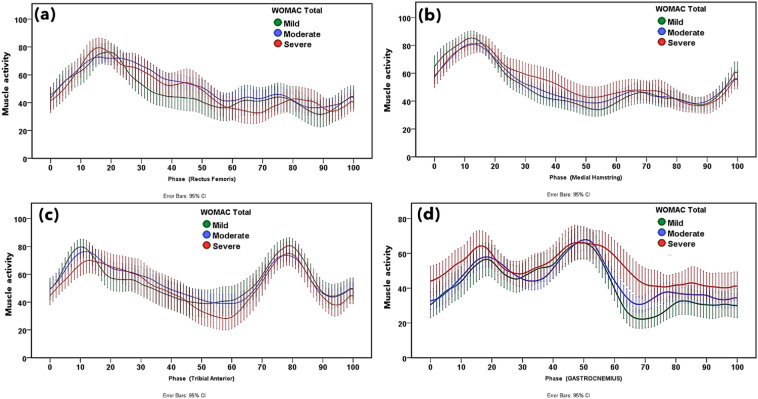 그림 크게 보기
WOMAC 증상 정도로 나눈 네 근육의 보행 주기 EMG입니다. 색깔별 평균과 신뢰구간을 확인하며 일부 구간의 중첩도 읽습니다.
Iqram Hussain, Sung Eun Kim, Chiheon Kwon, Seo Kyung Hoon, Hee Chan Kim, Yunseo Ku, Du Hyun Ro. Estimation of patient-reported outcome measures based on features of knee joint muscle co-activation in advanced knee osteoarthritis. Scientific Reports (2024). DOI: 10.1038/s41598-024-63266-7. © The Author(s) 2024
원문 캡션
Muscle activation pattern of the (a) rectus femoris, (b) medial hamstring, (c) tibialis anterior, and (d) gastrocnemius muscles in mild, …
대상과 방법
그림을 읽는 순서
주요 결과
진료·수술에서 읽을 지점
해석의 제한
짧게 정리하면
이 연구가 확인한 것은 무엇인가요?
초록에서 교차검증 WOMAC 추정 모델의 R²는 0.85였습니다.
개별 환자의 치료 결정에 바로 적용할 수 있나요?
단면적 증상 추정 연구이며 외부 기관 검증이나 수술 후 결과 예측을 평가하지 않았습니다. 동일 코호트에서의 높은 R²를 임상 전반의 예측 성능으로 일반화할 수 없습니다.
Keywords · 주제어
- Co-contraction index
- Electromyography
- Knee osteoarthritis
- Machine-learning
- WOMAC
- Osteoarthritis, Knee
- Patient Reported Outcome Measures
- Knee Joint
Abstract · 원문 초록
Iqram Hussain, Sung Eun Kim, Chiheon Kwon, Seo Kyung Hoon, Hee Chan Kim, Yunseo Ku, Du Hyun Ro. Estimation of patient-reported outcome measures based on features of knee joint muscle co-activation in advanced knee osteoarthritis. Scientific reports. 2024;14(1):12428. doi:10.1038/s41598-024-63266-7.
Electromyography (EMG) is considered a potential predictive tool for the severity of knee osteoarthritis (OA) symptoms and functional outcomes. Patient-reported outcome measures (PROMs), such as the Western Ontario and McMaster Universities Osteoarthritis Index (WOMAC) and visual analog scale (VAS), are used to determine the severity of knee OA. We aim to investigate muscle activation and co-contraction patterns through EMG from the lower extremity muscles of patients with advanced knee OA patients and evaluate the effectiveness of an interpretable machine-learning model to estimate the severity of knee OA according to the WOMAC (pain, stiffness, and physical function) and VAS using EMG gait features. To explore neuromuscular gait patterns with knee OA severity, EMG from rectus femoris, medial hamstring, tibialis anterior, and gastrocnemius muscles were recorded from 84 patients diagnosed with advanced knee OA during ground walking. Muscle activation patterns and co-activation indices were calculated over the gait cycle for pairs of medial and lateral muscles. We utilized machine-learning regression models to estimate the severity of knee OA symptoms according to the PROMs using muscle activity and co-contraction features. Additionally, we utilized the Shapley Additive Explanations (SHAP) to interpret the contribution of the EMG features to the regression model for estimation of knee OA severity according to WOMAC and VAS. Muscle activity and co-contraction patterns varied according to the functional limitations associated with knee OA severity according to VAS and WOMAC. The coefficient of determination of the cross-validated regression model is 0.85 for estimating WOMAC, 0.82 for pain, 0.85 for stiffness, and 0.85 for physical function, as well as VAS scores, utilizing the gait features. SHAP explanation revealed that greater co-contraction of lower extremity muscles during the weight acceptance and swing phases indicated more severe knee OA. The identified muscle co-activation patterns may be utilized as objective candidate outcomes to better understand the severity of knee OA.
© The Author(s) 2024
원래 논문
Estimation of patient-reported outcome measures based on features of knee joint muscle co-activation in advanced knee osteoarthritis
Iqram Hussain, Sung Eun Kim, Chiheon Kwon, Seo Kyung Hoon, Hee Chan Kim, Yunseo Ku, Du Hyun Ro
Scientific Reports · 2024