2024 · Scientific Reports
歩行中の下腿・大腿筋の共収縮パターンから、進行期OAのWOMAC・VAS症状を推定できるか?
抄録に示された交差検証WOMAC推定モデルのR²は0.85でした。
原図Figure 2
 図を拡大する
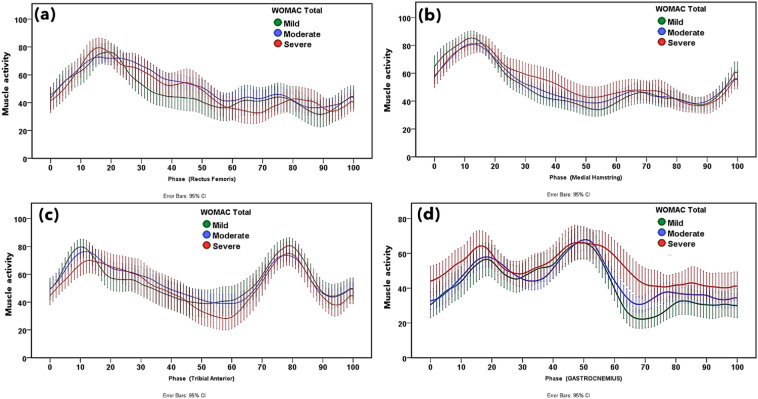
WOMACの症状程度で分けた4筋の歩行周期EMGです。色別の平均と信頼区間、周期の一部での重なりも確認します。
Iqram Hussain, Sung Eun Kim, Chiheon Kwon, Seo Kyung Hoon, Hee Chan Kim, Yunseo Ku, Du Hyun Ro. Estimation of patient-reported outcome measures based on features of knee joint muscle co-activation in advanced knee osteoarthritis. Scientific Reports (2024). DOI: 10.1038/s41598-024-63266-7. © The Author(s) 2024
原著の図の説明
Muscle activation pattern of the (a) rectus femoris, (b) medial hamstring, (c) tibialis anterior, and (d) gastrocnemius muscles in mild, …
対象と方法
絵を読んだ順序です
主な結果
手術に関する読書のポイント
解釈の限界
簡単に説明しましょう
この研究で何が確認されましたか?
抄録に示された交差検証WOMAC推定モデルのR²は0.85でした。
治療決定に直接適用できるか?
横断的な症状推定研究で、外部施設検証や術後結果の予測は評価していません。同一コホート内の高いR²を、臨床全般の予測性能に一般化できません。
Keywords・キーワード
- Co-contraction index
- Electromyography
- Knee osteoarthritis
- Machine-learning
- WOMAC
- Osteoarthritis, Knee
- Patient Reported Outcome Measures
- Knee Joint
Abstract・原文の抄録
Iqram Hussain, Sung Eun Kim, Chiheon Kwon, Seo Kyung Hoon, Hee Chan Kim, Yunseo Ku, Du Hyun Ro. Estimation of patient-reported outcome measures based on features of knee joint muscle co-activation in advanced knee osteoarthritis. Scientific reports. 2024;14(1):12428. doi:10.1038/s41598-024-63266-7.
Electromyography (EMG) is considered a potential predictive tool for the severity of knee osteoarthritis (OA) symptoms and functional outcomes. Patient-reported outcome measures (PROMs), such as the Western Ontario and McMaster Universities Osteoarthritis Index (WOMAC) and visual analog scale (VAS), are used to determine the severity of knee OA. We aim to investigate muscle activation and co-contraction patterns through EMG from the lower extremity muscles of patients with advanced knee OA patients and evaluate the effectiveness of an interpretable machine-learning model to estimate the severity of knee OA according to the WOMAC (pain, stiffness, and physical function) and VAS using EMG gait features. To explore neuromuscular gait patterns with knee OA severity, EMG from rectus femoris, medial hamstring, tibialis anterior, and gastrocnemius muscles were recorded from 84 patients diagnosed with advanced knee OA during ground walking. Muscle activation patterns and co-activation indices were calculated over the gait cycle for pairs of medial and lateral muscles. We utilized machine-learning regression models to estimate the severity of knee OA symptoms according to the PROMs using muscle activity and co-contraction features. Additionally, we utilized the Shapley Additive Explanations (SHAP) to interpret the contribution of the EMG features to the regression model for estimation of knee OA severity according to WOMAC and VAS. Muscle activity and co-contraction patterns varied according to the functional limitations associated with knee OA severity according to VAS and WOMAC. The coefficient of determination of the cross-validated regression model is 0.85 for estimating WOMAC, 0.82 for pain, 0.85 for stiffness, and 0.85 for physical function, as well as VAS scores, utilizing the gait features. SHAP explanation revealed that greater co-contraction of lower extremity muscles during the weight acceptance and swing phases indicated more severe knee OA. The identified muscle co-activation patterns may be utilized as objective candidate outcomes to better understand the severity of knee OA.
© The Author(s) 2024
オリジナル紙だ
Estimation of patient-reported outcome measures based on features of knee joint muscle co-activation in advanced knee osteoarthritis
Iqram Hussain, Sung Eun Kim, Chiheon Kwon, Seo Kyung Hoon, Hee Chan Kim, Yunseo Ku, Du Hyun Ro
Scientific Reports · 2024