2024 · Knee Surgery & Related Research
Can similar OA grades be distinguished more precisely?
Overall KL classification accuracy was 75.7%. This was five-category classification of grades 0–4.
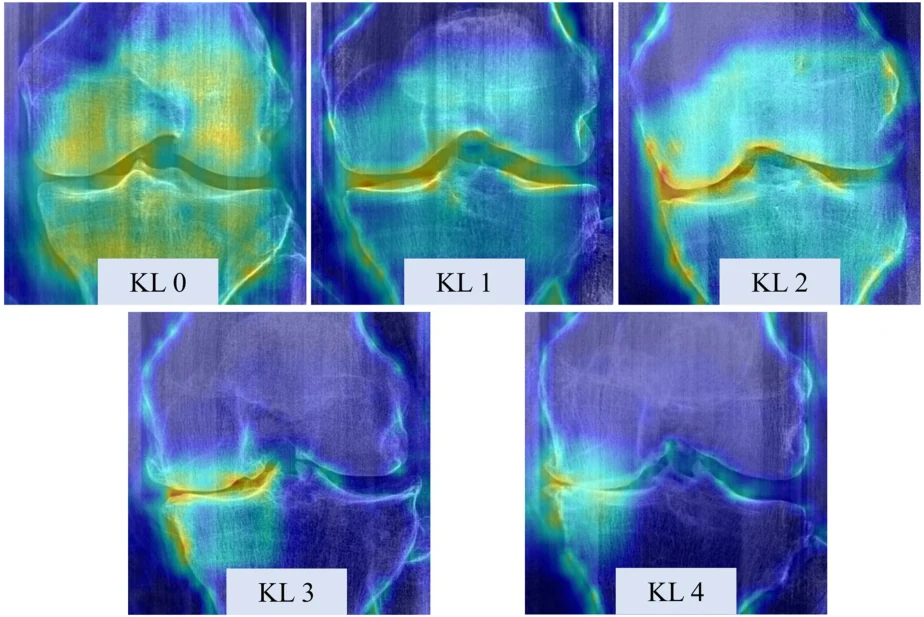
Original Figure 6 · Image regions highlighted by OA grade
 Enlarge Figure
Eigen-CAM visualizations on radiographs spanning KL grades 0–4.
Do Weon Lee, Dae Seok Song, Hyuk-Soo Han, Du Hyun Ro. Knee Surgery & Related Research (2024). DOI: 10.1186/s43019-024-00228-3
The research question
Participants and Methods
Main Findings
Implications for clinical and surgical practice
Limitations
Let's put it briefly.
Which clinical question does this address?
This foundational grading study leads to CONNEVO KOA. Alongside technology for subtle differences, clinicians need to assess uncertainty in borderline grades.
Keywords
- Classification
- Deep learning
- Knee osteoarthritis
- AI
- KOA
- KL
- external validation
Abstract · Original text
Do Weon Lee, Dae Seok Song, Hyuk-Soo Han, Du Hyun Ro. Accurate, automated classification of radiographic knee osteoarthritis severity using a novel method of deep learning: Plug-in modules. Knee surgery & related research. 2024;36(1):24. doi:10.1186/s43019-024-00228-3.
BACKGROUND
Fine-grained classification deals with data with a large degree of similarity, such as cat or bird species, and similarly, knee osteoarthritis severity classification [Kellgren-Lawrence (KL) grading] is one such fine-grained classification task. Recently, a plug-in module (PIM) that can be integrated into convolutional neural-network-based or transformer-based networks has been shown to provide strong discriminative regions for fine-grained classification, with results that outperformed the previous deep learning models. PIM utilizes each pixel of an image as an independent feature and can subsequently better classify images with minor differences. It was hypothesized that, as a fine-grained classification task, knee osteoarthritis severity may be classified well using PIMs. The aim of the study was to develop this automated knee osteoarthritis classification model.
METHODS
A deep learning model that classifies knee osteoarthritis severity of a radiograph was developed utilizing PIMs. A retrospective analysis on prospectively collected data was performed. The model was trained and developed using the Osteoarthritis Initiative dataset and was subsequently tested on an independent dataset, the Multicenter Osteoarthritis Study (test set size: 17,040). The final deep learning model was designed through an ensemble of four different PIMs.
RESULTS
The accuracy of the model was 84%, 43%, 70%, 81%, and 96% for KL grade 0, 1, 2, 3, and 4, respectively, with an overall accuracy of 75.7%.
CONCLUSIONS
The ensemble of PIMs could classify knee osteoarthritis severity using simple radiographs with a fine accuracy. Although improvements will be needed in the future, the model has been proven to have the potential to be clinically useful.
© The Author(s) 2024, corrected publication 2025
The original paper.
Accurate, automated classification of radiographic knee osteoarthritis severity using a novel method of deep learning: Plug-in modules
Do Weon Lee, Dae Seok Song, Hyuk-Soo Han, Du Hyun Ro
Knee Surgery & Related Research · 2024