2024 · Knee Surgery & Related Research
서로 비슷한 관절염 등급을 더 세밀하게 구분할 수 있을까요?
앙상블 모델의 전체 KL 등급 분류 정확도는 75.7%였습니다. 0–4등급을 각각 구분하는 5개 범주의 결과입니다.
원문 Figure 6 · 관절염 등급별로 주목한 영상 영역
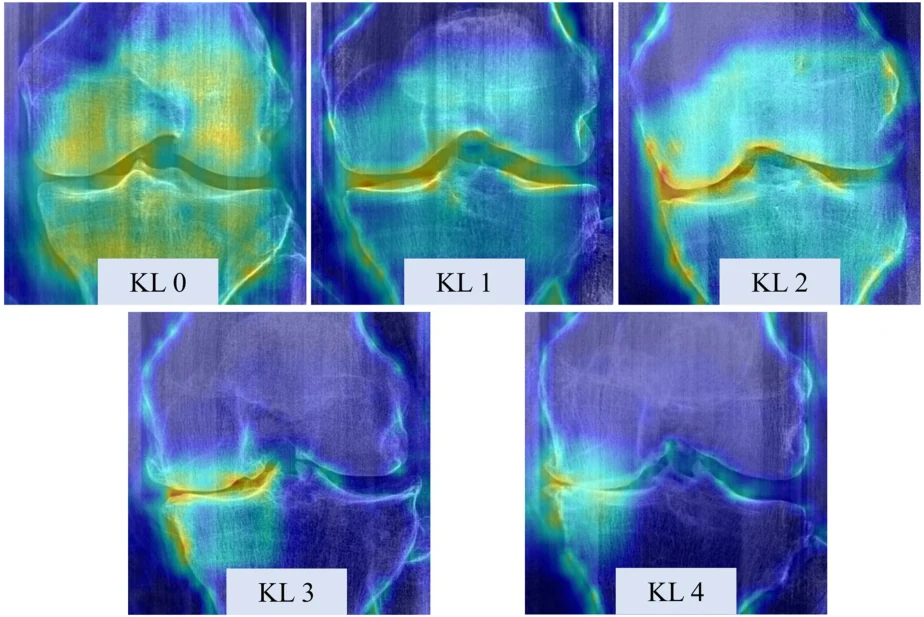 그림 크게 보기
KL 0–4 방사선영상에 Eigen-CAM을 표시한 그림입니다.
Do Weon Lee, Dae Seok Song, Hyuk-Soo Han, Du Hyun Ro. Knee Surgery & Related Research (2024). DOI: 10.1186/s43019-024-00228-3
연구에서 묻는 질문
대상과 방법
주요 결과
진료와 수술에서 읽을 지점
해석의 제한
짧게 정리하면
어떤 진료 질문과 연결되나요?
CONNEVO KOA로 이어지는 영상 등급 분석의 기반 연구입니다. 작은 차이를 구분하는 기술과 함께, 경계 등급의 불확실성을 의사가 확인하는 과정이 필요합니다.
Keywords · 주제어
- Classification
- Deep learning
- Knee osteoarthritis
- AI
- KOA
- KL
- external validation
Abstract · 원문 초록
Do Weon Lee, Dae Seok Song, Hyuk-Soo Han, Du Hyun Ro. Accurate, automated classification of radiographic knee osteoarthritis severity using a novel method of deep learning: Plug-in modules. Knee surgery & related research. 2024;36(1):24. doi:10.1186/s43019-024-00228-3.
BACKGROUND
Fine-grained classification deals with data with a large degree of similarity, such as cat or bird species, and similarly, knee osteoarthritis severity classification [Kellgren-Lawrence (KL) grading] is one such fine-grained classification task. Recently, a plug-in module (PIM) that can be integrated into convolutional neural-network-based or transformer-based networks has been shown to provide strong discriminative regions for fine-grained classification, with results that outperformed the previous deep learning models. PIM utilizes each pixel of an image as an independent feature and can subsequently better classify images with minor differences. It was hypothesized that, as a fine-grained classification task, knee osteoarthritis severity may be classified well using PIMs. The aim of the study was to develop this automated knee osteoarthritis classification model.
METHODS
A deep learning model that classifies knee osteoarthritis severity of a radiograph was developed utilizing PIMs. A retrospective analysis on prospectively collected data was performed. The model was trained and developed using the Osteoarthritis Initiative dataset and was subsequently tested on an independent dataset, the Multicenter Osteoarthritis Study (test set size: 17,040). The final deep learning model was designed through an ensemble of four different PIMs.
RESULTS
The accuracy of the model was 84%, 43%, 70%, 81%, and 96% for KL grade 0, 1, 2, 3, and 4, respectively, with an overall accuracy of 75.7%.
CONCLUSIONS
The ensemble of PIMs could classify knee osteoarthritis severity using simple radiographs with a fine accuracy. Although improvements will be needed in the future, the model has been proven to have the potential to be clinically useful.
© The Author(s) 2024, corrected publication 2025
원래 논문
Accurate, automated classification of radiographic knee osteoarthritis severity using a novel method of deep learning: Plug-in modules
Do Weon Lee, Dae Seok Song, Hyuk-Soo Han, Du Hyun Ro
Knee Surgery & Related Research · 2024