2024 · Knee Surgery & Related Research
似た関節症の等級をより細かく区別できますか?
全体のKL分類正確度は75.7%でした。0–4等級を個別に区別する5分類の結果です。
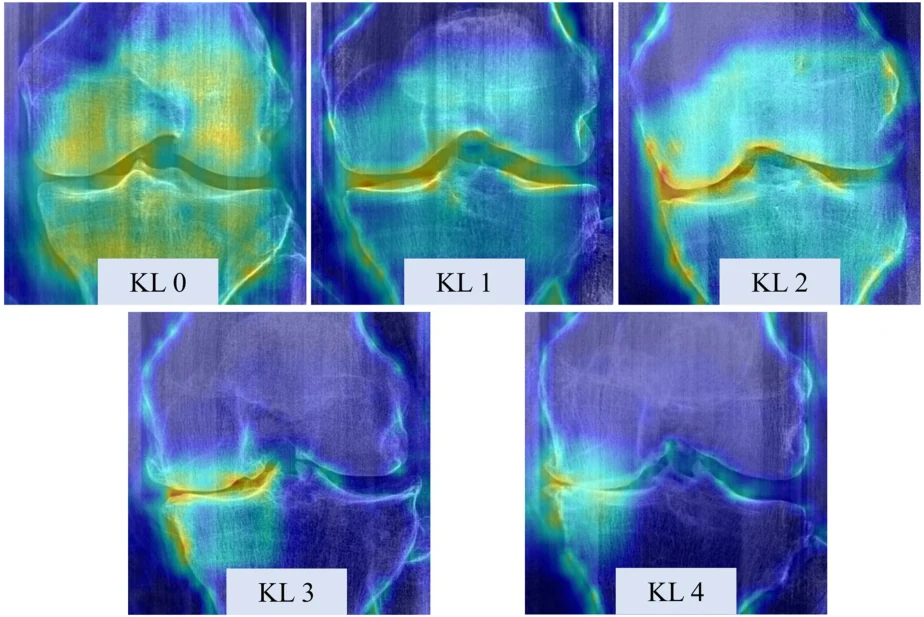
原論文Figure 6・関節症等級別に注目した画像領域
 図を拡大する
KL 0–4のX線画像にEigen-CAMを表示した図です。
Do Weon Lee, Dae Seok Song, Hyuk-Soo Han, Du Hyun Ro. Knee Surgery & Related Research (2024). DOI: 10.1186/s43019-024-00228-3
研究で問うこと
対象と方法
主な結果
診療・手術で考える点
解釈の限界
簡単に説明しましょう
どの診療上の問いにつながりますか?
CONNEVO KOAにつながる画像等級分析の基盤研究です。微細な差を区別する技術とともに、境界等級の不確実性を医師が確認する過程が必要です。
Keywords・キーワード
- Classification
- Deep learning
- Knee osteoarthritis
- AI
- KOA
- KL
- external validation
Abstract・原文の抄録
Do Weon Lee, Dae Seok Song, Hyuk-Soo Han, Du Hyun Ro. Accurate, automated classification of radiographic knee osteoarthritis severity using a novel method of deep learning: Plug-in modules. Knee surgery & related research. 2024;36(1):24. doi:10.1186/s43019-024-00228-3.
BACKGROUND
Fine-grained classification deals with data with a large degree of similarity, such as cat or bird species, and similarly, knee osteoarthritis severity classification [Kellgren-Lawrence (KL) grading] is one such fine-grained classification task. Recently, a plug-in module (PIM) that can be integrated into convolutional neural-network-based or transformer-based networks has been shown to provide strong discriminative regions for fine-grained classification, with results that outperformed the previous deep learning models. PIM utilizes each pixel of an image as an independent feature and can subsequently better classify images with minor differences. It was hypothesized that, as a fine-grained classification task, knee osteoarthritis severity may be classified well using PIMs. The aim of the study was to develop this automated knee osteoarthritis classification model.
METHODS
A deep learning model that classifies knee osteoarthritis severity of a radiograph was developed utilizing PIMs. A retrospective analysis on prospectively collected data was performed. The model was trained and developed using the Osteoarthritis Initiative dataset and was subsequently tested on an independent dataset, the Multicenter Osteoarthritis Study (test set size: 17,040). The final deep learning model was designed through an ensemble of four different PIMs.
RESULTS
The accuracy of the model was 84%, 43%, 70%, 81%, and 96% for KL grade 0, 1, 2, 3, and 4, respectively, with an overall accuracy of 75.7%.
CONCLUSIONS
The ensemble of PIMs could classify knee osteoarthritis severity using simple radiographs with a fine accuracy. Although improvements will be needed in the future, the model has been proven to have the potential to be clinically useful.
© The Author(s) 2024, corrected publication 2025
オリジナル紙だ
Accurate, automated classification of radiographic knee osteoarthritis severity using a novel method of deep learning: Plug-in modules
Do Weon Lee, Dae Seok Song, Hyuk-Soo Han, Du Hyun Ro
Knee Surgery & Related Research · 2024