2022 · Medicina
Can different hardware and implants be detected automatically on postoperative knee X-rays?
External overall accuracy was 0.956, sensitivity 0.493 and specificity 0.975. High accuracy must be read alongside low sensitivity.
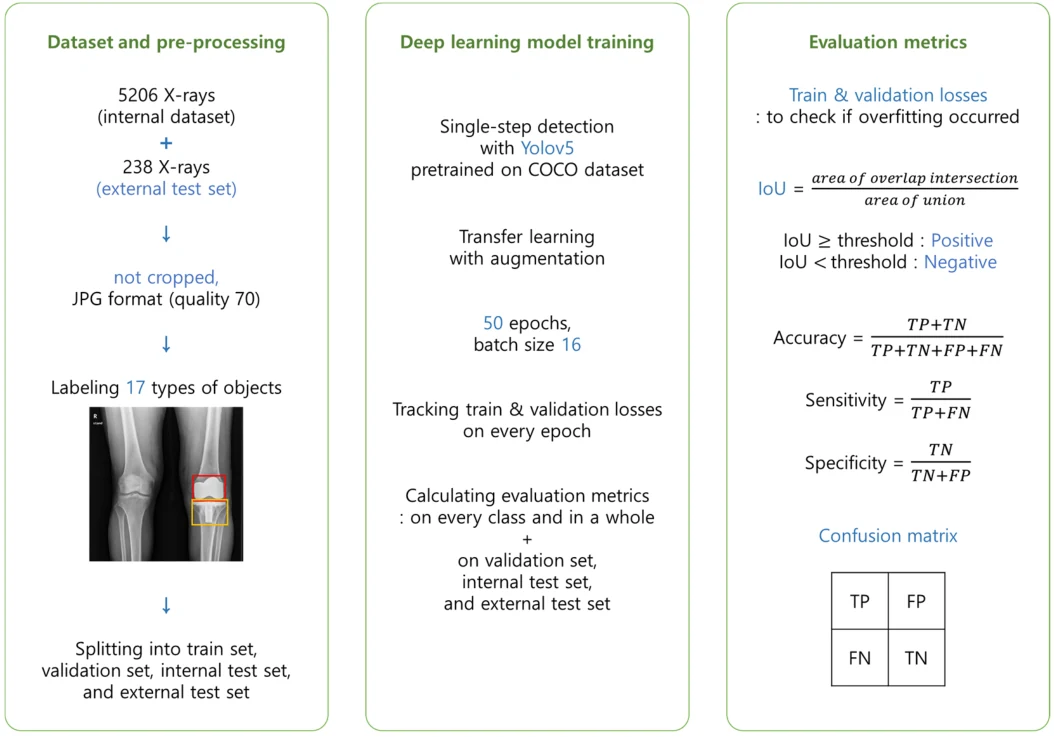
Original Figure 1 · Implant-detection workflow
 Enlarge Figure
The workflow labels 17 implant types and detects their location and type with YOLO. Accuracy, sensitivity and specificity have different meanings; examine the external-data metrics together.
Back Kim, Do Weon Lee, Sanggyu Lee, Sunho Ko, Changwung Jo, Jaeseok Park, Byung Sun Choi, Aaron John Krych, Ayoosh Pareek, Hyuk-Soo Han, Du Hyun Ro. Medicina (2022). DOI: 10.3390/medicina58111677
The research question
Participants and Methods
Main Findings
Implications for clinical and surgical practice
Limitations
Let's put it briefly.
Which clinical question does this address?
This is foundational technology for organising implant locations in postoperative images. Revision planning also requires operative records, implant information and direct image review.
Keywords
- automated detection
- deep learning
- detection algorithm
- Deep Learning
- Arthroplasty, Replacement, Knee
- Radiography
- Algorithms
- Knee Joint
Abstract · Original text
Back Kim, Do Weon Lee, Sanggyu Lee, Sunho Ko, Changwung Jo, Jaeseok Park, Byung Sun Choi, Aaron John Krych, Ayoosh Pareek, Hyuk-Soo Han, Du Hyun Ro. Automated Detection of Surgical Implants on Plain Knee Radiographs Using a Deep Learning Algorithm. Medicina (Kaunas, Lithuania). 2022;58(11):1677. doi:10.3390/medicina58111677.
Background and Objectives: The number of patients who undergo multiple operations on a knee is increasing. The objective of this study was to develop a deep learning algorithm that could detect 17 different surgical implants on plain knee radiographs. Materials and Methods: An internal dataset consisted of 5206 plain knee antero-posterior X-rays from a single, tertiary institute for model development. An external set contained 238 X-rays from another tertiary institute. A total of 17 different types of implants including total knee arthroplasty, unicompartmental knee arthroplasty, plate, and screw were labeled. The internal dataset was approximately split into a train set, a validation set, and an internal test set at a ratio of 7:1:2. You Only look Once (YOLO) was selected as the detection network. Model performances with the validation set, internal test set, and external test set were compared. Results: Total accuracy, total sensitivity, total specificity value of the validation set, internal test set, and external test set were (0.978, 0.768, 0.999), (0.953, 0.810, 0.990), and (0.956, 0.493, 0.975), respectively. Means ± standard deviations (SDs) of diagonal components of confusion matrix for these three subsets were 0.858 ± 0.242, 0.852 ± 0.182, and 0.576 ± 0.312, respectively. True positive rate of total knee arthroplasty, the most dominant class of the dataset, was higher than 0.99 with internal subsets and 0.96 with an external test set. Conclusion: Implant identification on plain knee radiographs could be automated using a deep learning technique. The detection algorithm dealt with overlapping cases while maintaining high accuracy on total knee arthroplasty. This could be applied in future research that analyzes X-ray images with deep learning, which would help prompt decision-making in clinics.
© 2022 by the authors.
The original paper.
Automated Detection of Surgical Implants on Plain Knee Radiographs Using a Deep Learning Algorithm
Back Kim, Do Weon Lee, Sanggyu Lee, Sunho Ko, Changwung Jo, Jaeseok Park, Byung Sun Choi, Aaron John Krych, Ayoosh Pareek, Hyuk-Soo Han, Du Hyun Ro
Medicina · 2022