2022 · Medicina
術後膝X線で異なる金属物やインプラントを自動検出できますか?
外部資料の全体正確度は0.956、感度0.493、特異度0.975でした。高い正確度と低い感度を合わせて読む必要があります。
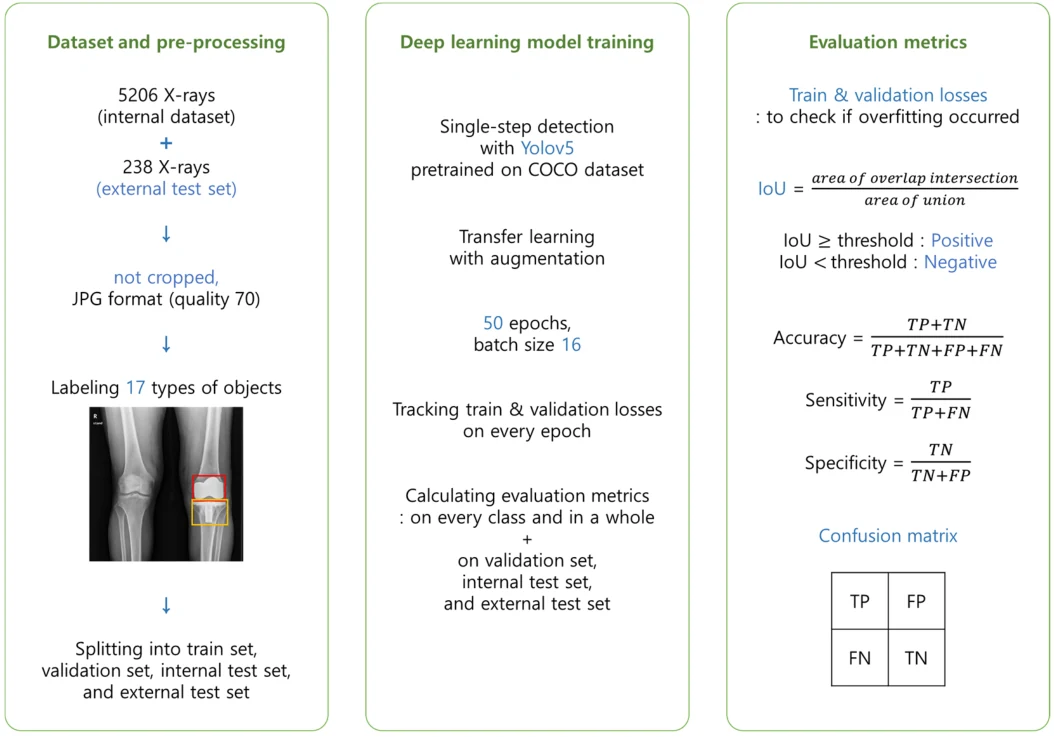
原論文Figure 1・インプラント検出の研究過程
 図を拡大する
17種類のインプラントを標識し、YOLOで位置と種類を検出した過程です。正確度・感度・特異度の意味は異なるため、外部資料の指標を合わせて確認します。
Back Kim, Do Weon Lee, Sanggyu Lee, Sunho Ko, Changwung Jo, Jaeseok Park, Byung Sun Choi, Aaron John Krych, Ayoosh Pareek, Hyuk-Soo Han, Du Hyun Ro. Medicina (2022). DOI: 10.3390/medicina58111677
研究で問うこと
対象と方法
主な結果
診療・手術で考える点
解釈の限界
簡単に説明しましょう
どの診療上の問いにつながりますか?
術後画像のインプラント位置を自動整理する基盤技術です。再置換の計画では手術記録、インプラント情報、実際の画像を合わせて確認する必要があります。
Keywords・キーワード
- automated detection
- deep learning
- detection algorithm
- Deep Learning
- Arthroplasty, Replacement, Knee
- Radiography
- Algorithms
- Knee Joint
Abstract・原文の抄録
Back Kim, Do Weon Lee, Sanggyu Lee, Sunho Ko, Changwung Jo, Jaeseok Park, Byung Sun Choi, Aaron John Krych, Ayoosh Pareek, Hyuk-Soo Han, Du Hyun Ro. Automated Detection of Surgical Implants on Plain Knee Radiographs Using a Deep Learning Algorithm. Medicina (Kaunas, Lithuania). 2022;58(11):1677. doi:10.3390/medicina58111677.
Background and Objectives: The number of patients who undergo multiple operations on a knee is increasing. The objective of this study was to develop a deep learning algorithm that could detect 17 different surgical implants on plain knee radiographs. Materials and Methods: An internal dataset consisted of 5206 plain knee antero-posterior X-rays from a single, tertiary institute for model development. An external set contained 238 X-rays from another tertiary institute. A total of 17 different types of implants including total knee arthroplasty, unicompartmental knee arthroplasty, plate, and screw were labeled. The internal dataset was approximately split into a train set, a validation set, and an internal test set at a ratio of 7:1:2. You Only look Once (YOLO) was selected as the detection network. Model performances with the validation set, internal test set, and external test set were compared. Results: Total accuracy, total sensitivity, total specificity value of the validation set, internal test set, and external test set were (0.978, 0.768, 0.999), (0.953, 0.810, 0.990), and (0.956, 0.493, 0.975), respectively. Means ± standard deviations (SDs) of diagonal components of confusion matrix for these three subsets were 0.858 ± 0.242, 0.852 ± 0.182, and 0.576 ± 0.312, respectively. True positive rate of total knee arthroplasty, the most dominant class of the dataset, was higher than 0.99 with internal subsets and 0.96 with an external test set. Conclusion: Implant identification on plain knee radiographs could be automated using a deep learning technique. The detection algorithm dealt with overlapping cases while maintaining high accuracy on total knee arthroplasty. This could be applied in future research that analyzes X-ray images with deep learning, which would help prompt decision-making in clinics.
© 2022 by the authors.
オリジナル紙だ
Automated Detection of Surgical Implants on Plain Knee Radiographs Using a Deep Learning Algorithm
Back Kim, Do Weon Lee, Sanggyu Lee, Sunho Ko, Changwung Jo, Jaeseok Park, Byung Sun Choi, Aaron John Krych, Ayoosh Pareek, Hyuk-Soo Han, Du Hyun Ro
Medicina · 2022