2022 · Medicina
수술 후 무릎 X-ray에서 서로 다른 금속물과 삽입물을 자동으로 찾을 수 있을까요?
외부 자료의 전체 정확도는 0.956, 민감도는 0.493, 특이도는 0.975였습니다. 높은 정확도와 낮은 민감도를 함께 읽어야 합니다.
원문 Figure 1 · 수술 삽입물 검출의 연구 과정
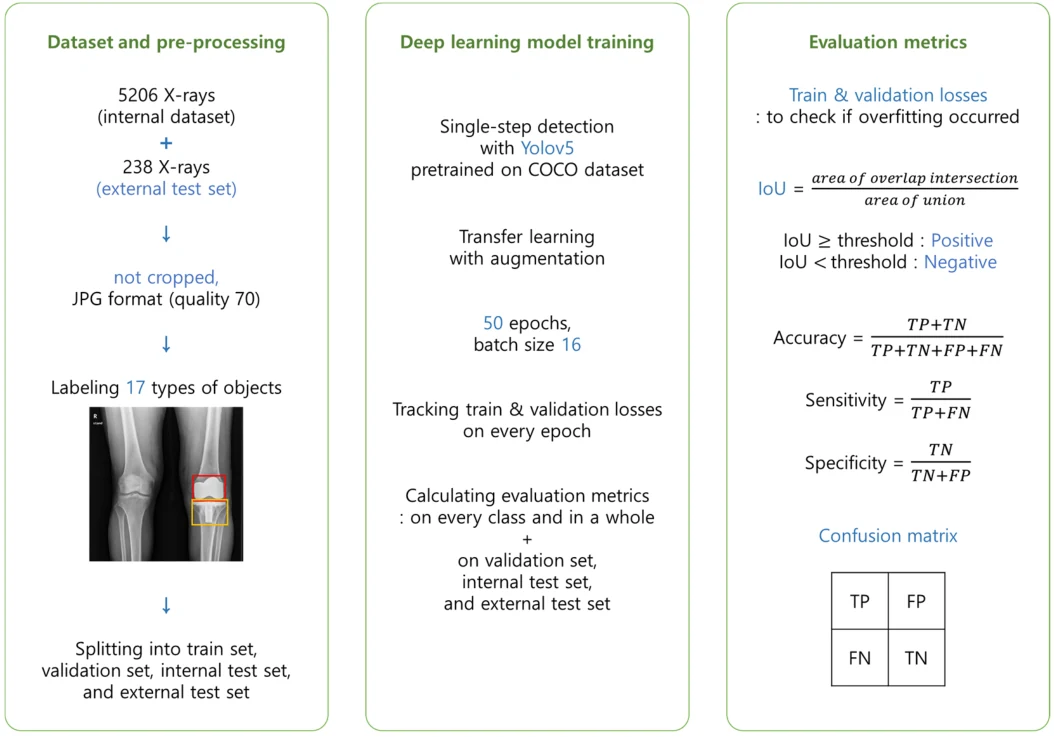 그림 크게 보기
17개 삽입물 유형을 표시하고 YOLO로 위치와 유형을 검출한 연구 과정입니다. 정확도·민감도·특이도의 의미가 다르므로 외부 자료의 지표를 함께 확인해야 합니다.
Back Kim, Do Weon Lee, Sanggyu Lee, Sunho Ko, Changwung Jo, Jaeseok Park, Byung Sun Choi, Aaron John Krych, Ayoosh Pareek, Hyuk-Soo Han, Du Hyun Ro. Medicina (2022). DOI: 10.3390/medicina58111677
연구에서 묻는 질문
대상과 방법
주요 결과
진료와 수술에서 읽을 지점
해석의 제한
짧게 정리하면
어떤 진료 질문과 연결되나요?
수술 후 영상의 삽입물 위치를 자동으로 정리하는 기반 기술입니다. 재치환 계획에서는 수술 기록, 삽입물 정보와 실제 영상 검토를 함께 확인해야 합니다.
Keywords · 주제어
- automated detection
- deep learning
- detection algorithm
- Deep Learning
- Arthroplasty, Replacement, Knee
- Radiography
- Algorithms
- Knee Joint
Abstract · 원문 초록
Back Kim, Do Weon Lee, Sanggyu Lee, Sunho Ko, Changwung Jo, Jaeseok Park, Byung Sun Choi, Aaron John Krych, Ayoosh Pareek, Hyuk-Soo Han, Du Hyun Ro. Automated Detection of Surgical Implants on Plain Knee Radiographs Using a Deep Learning Algorithm. Medicina (Kaunas, Lithuania). 2022;58(11):1677. doi:10.3390/medicina58111677.
Background and Objectives: The number of patients who undergo multiple operations on a knee is increasing. The objective of this study was to develop a deep learning algorithm that could detect 17 different surgical implants on plain knee radiographs. Materials and Methods: An internal dataset consisted of 5206 plain knee antero-posterior X-rays from a single, tertiary institute for model development. An external set contained 238 X-rays from another tertiary institute. A total of 17 different types of implants including total knee arthroplasty, unicompartmental knee arthroplasty, plate, and screw were labeled. The internal dataset was approximately split into a train set, a validation set, and an internal test set at a ratio of 7:1:2. You Only look Once (YOLO) was selected as the detection network. Model performances with the validation set, internal test set, and external test set were compared. Results: Total accuracy, total sensitivity, total specificity value of the validation set, internal test set, and external test set were (0.978, 0.768, 0.999), (0.953, 0.810, 0.990), and (0.956, 0.493, 0.975), respectively. Means ± standard deviations (SDs) of diagonal components of confusion matrix for these three subsets were 0.858 ± 0.242, 0.852 ± 0.182, and 0.576 ± 0.312, respectively. True positive rate of total knee arthroplasty, the most dominant class of the dataset, was higher than 0.99 with internal subsets and 0.96 with an external test set. Conclusion: Implant identification on plain knee radiographs could be automated using a deep learning technique. The detection algorithm dealt with overlapping cases while maintaining high accuracy on total knee arthroplasty. This could be applied in future research that analyzes X-ray images with deep learning, which would help prompt decision-making in clinics.
© 2022 by the authors.
원래 논문
Automated Detection of Surgical Implants on Plain Knee Radiographs Using a Deep Learning Algorithm
Back Kim, Do Weon Lee, Sanggyu Lee, Sunho Ko, Changwung Jo, Jaeseok Park, Byung Sun Choi, Aaron John Krych, Ayoosh Pareek, Hyuk-Soo Han, Du Hyun Ro
Medicina · 2022