2026 · Knee Surgery & Related Research
Does Adding Information from Other Positions to Supine X-rays Change the Surgical Plan?
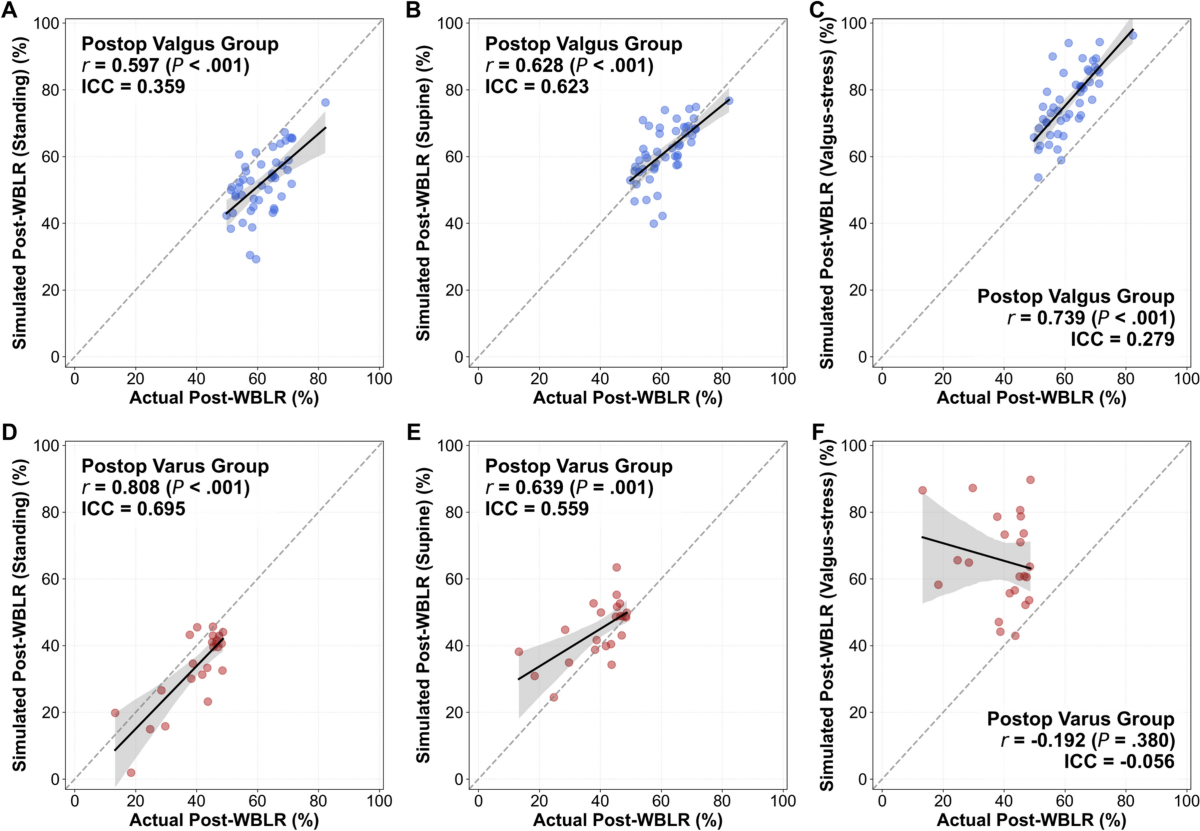
In the valgus subgroup, mean error and RMSE were 0.0% ± 6.9% and 6.8% supine, −9.3% ± 7.8% and 12.1% standing, and +15.2% ± 6.7% and 16.6% under valgus stress.
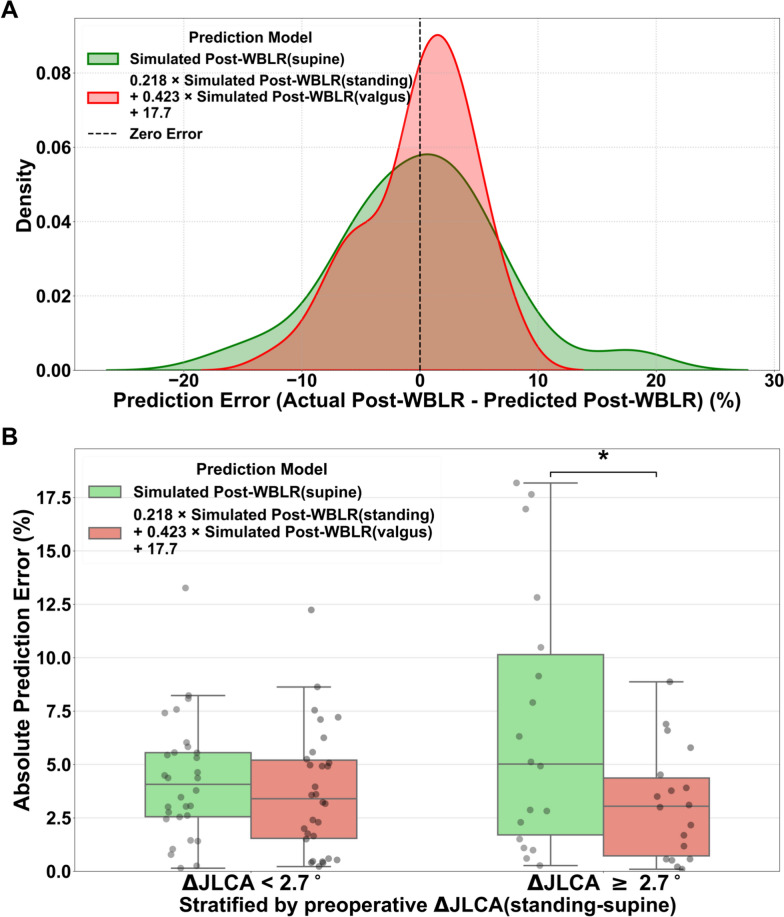
Original Figure 4
 Enlarge Figure
Original Figure 4 compares prediction errors from supine simulation and a regression model combining several positions in the postoperative valgus subgroup. The combined model had smaller errors when positional differences in JLCA were large.
Geunwu Gimm, Hyunjeong Ra, Seok Gyun Yang, Byung Sun Choi, Du Hyun Ro, Hyuk-Soo Han. Complementary roles of standing, supine, and valgus-stress whole-leg radiographs in medial open-wedge high tibial osteotomy planning: supine minimizes bias, whereas standing and valgus-stress reduce outliers. Knee Surgery & Related Research (2026). https://doi.org/10.1186/s43019-026-00340-6
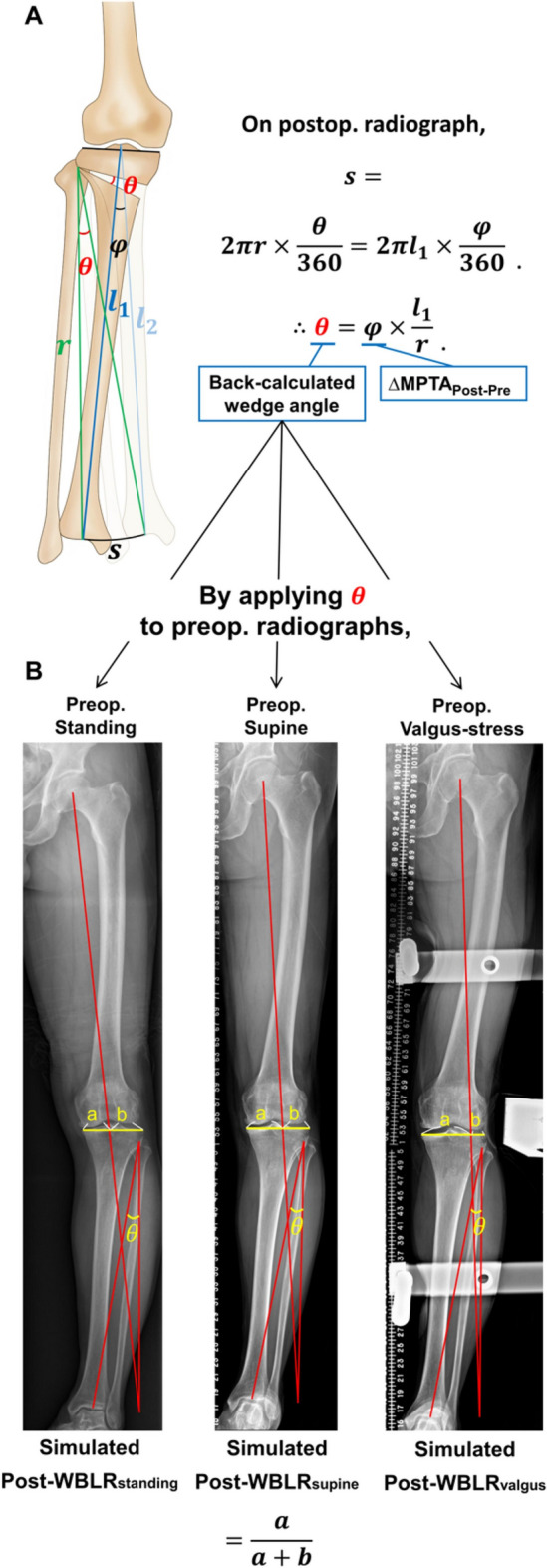
Original Figure 1
 Enlarge Figure
Study design back-calculating correction from postoperative bone-angle changes and applying the same angle to each preoperative imaging position. It illustrates an analytical method, not a treatment guideline.
Geunwu Gimm, Hyunjeong Ra, Seok Gyun Yang, Byung Sun Choi, Du Hyun Ro, Hyuk-Soo Han. Complementary roles of standing, supine, and valgus-stress whole-leg radiographs in medial open-wedge high tibial osteotomy planning: supine minimizes bias, whereas standing and valgus-stress reduce outliers. Knee Surgery & Related Research (2026). https://doi.org/10.1186/s43019-026-00340-6
Original Figure 2
 Enlarge Figure
Simulated versus actual postoperative WBLR from standing, supine and valgus-stress images. The upper row shows postoperative valgus and the lower row residual varus; distinguish correlation from agreement.
Geunwu Gimm, Hyunjeong Ra, Seok Gyun Yang, Byung Sun Choi, Du Hyun Ro, Hyuk-Soo Han. Complementary roles of standing, supine, and valgus-stress whole-leg radiographs in medial open-wedge high tibial osteotomy planning: supine minimizes bias, whereas standing and valgus-stress reduce outliers. Knee Surgery & Related Research (2026). https://doi.org/10.1186/s43019-026-00340-6 · Figure 2.
Participants and Methods
Main Findings
The point of reading on surgery
Limitations
Let's put it briefly.
What did this study confirm?
In the valgus subgroup, mean error and RMSE were 0.0% ± 6.9% and 6.8% supine, −9.3% ± 7.8% and 12.1% standing, and +15.2% ± 6.7% and 16.6% under valgus stress.
Can it be applied directly to individual patients' treatment decisions?
Back-calculating the wedge cannot fully separate errors in surgical execution. The model was developed in subgroups defined by postoperative outcomes and has no external validation. Generalizability to centers that divide the sMCL is limited. Improvement in PROMs was not established.
Keywords
- High tibial osteotomy
- Preoperative planning
- Standing
- Supine
- Valgus-stress
- Whole-leg radiograph
- HTO
- alignment
Abstract · Original text
Geunwu Gimm, Hyunjeong Ra, Seok Gyun Yang, Byung Sun Choi, Du Hyun Ro, Hyuk-Soo Han. Complementary roles of standing, supine, and valgus-stress whole-leg radiographs in medial open-wedge high tibial osteotomy planning: supine minimizes bias, whereas standing and valgus-stress reduce outliers. Knee surgery & related research. 2026;38(1):38. doi:10.1186/s43019-026-00340-6.
BACKGROUND
Accurate alignment correction is essential in medial open-wedge high tibial osteotomy (MOWHTO). However, conventional planning based on standing radiographs may not reflect postoperative intra-articular alignment changes. While differences between standing and supine radiographs have been investigated, the role of valgus-stress whole-leg radiographs in preoperative planning remains largely unexplored. This study evaluated the predictive accuracy of standing, supine, and valgus-stress whole-leg radiographs in MOWHTO planning and determined whether integrating these modalities improves alignment prediction compared with single-modality planning.
METHODS
This retrospective study included 71 patients who underwent MOWHTO. Preoperative standing, supine, and valgus-stress whole-leg radiographs, along with 1-year postoperative standing radiographs, were analyzed. To minimize the influence of surgical execution error and allow the analysis to focus on planning error, the achieved wedge angle was back-calculated from postoperative bony correction and reapplied to each preoperative modality to simulate the postoperative weight-bearing line ratio (Post-WBLR). Accuracy was assessed by comparing simulated and actual Post-WBLR. Multivariable regression was performed to identify predictors of actual Post-WBLR and to compare a multimodal model with the best-performing single-modality simulation.
RESULTS
In the postoperative valgus subgroup (n = 48), supine-based simulation showed no significant difference from actual Post-WBLR (mean difference, 0.0% ± 6.9%; root mean square error [RMSE], 6.8%). In contrast, standing-based simulation underestimated alignment (-9.3% ± 7.8%; RMSE, 12.1%), whereas valgus-stress simulation overestimated it (15.2% ± 6.7%; RMSE, 16.6%). A multimodal regression model incorporating simulated Post-WBLR from standing and valgus-stress radiographs demonstrated significantly improved predictive accuracy compared with the supine-only simulation (R2, 0.606 versus 0.080; RMSE, 4.5% versus 6.8%). Notably, in patients with a preoperative standing-to-supine joint line convergence angle difference (∆JLCAstanding-supine) ≥ 2.7°, the multimodal model significantly reduced prediction errors (absolute error: 3.2% versus 6.8%; RMSE: 4.0% versus 9.0%; all P < 0.015).
CONCLUSIONS
Supine radiographs generally provided the most accurate single-modality basis for MOWHTO planning. Standing and valgus-stress radiographs offered complementary information, and their integration improved prediction accuracy and reduced planning outliers. While further validation is required, a stepwise planning workflow-using supine radiographs as the default modality and multimodal integration when ∆JLCAstanding-supine ≥ 2.7°-may serve as an exploratory framework for reducing the risk of planning-related under- or overcorrection.
© The Author(s) 2026
The original paper.
Complementary roles of standing, supine, and valgus-stress whole-leg radiographs in medial open-wedge high tibial osteotomy planning: supine minimizes bias, whereas standing and valgus-stress reduce outliers
Geunwu Gimm, Hyunjeong Ra, Seok Gyun Yang, Byung Sun Choi, Du Hyun Ro, Hyuk-Soo Han
Knee Surgery & Related Research · 2026