2026 · Knee Surgery & Related Research
仰臥位X線に別の姿勢の情報を加えると、手術計画は変わるか?
外反サブグループの平均誤差・RMSEは、仰臥位0.0% ± 6.9%・6.8%、立位−9.3% ± 7.8%・12.1%、外反ストレス+15.2% ± 6.7%・16.6%でした。
原図Figure 4
 図を拡大する
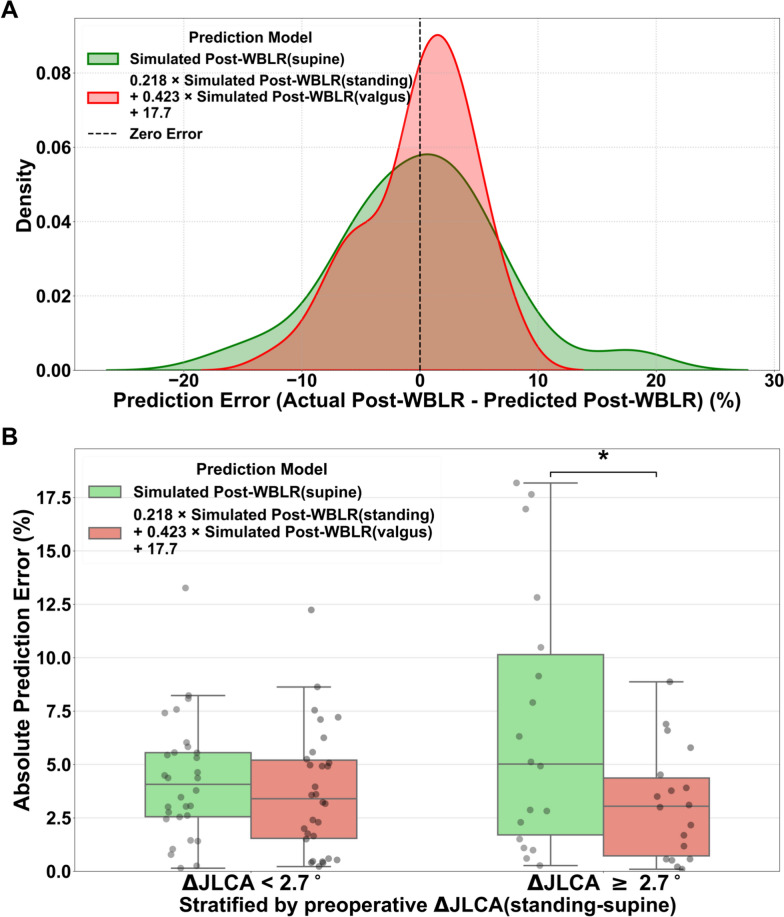
原著Figure 4は、術後外反のサブグループで、仰臥位のシミュレーションと複数の姿勢を組み合わせた回帰モデルの予測誤差を比較しています。姿勢によるJLCAの差が大きい場合、複合モデルの誤差が小さくなっていました。
Geunwu Gimm, Hyunjeong Ra, Seok Gyun Yang, Byung Sun Choi, Du Hyun Ro, Hyuk-Soo Han. Complementary roles of standing, supine, and valgus-stress whole-leg radiographs in medial open-wedge high tibial osteotomy planning: supine minimizes bias, whereas standing and valgus-stress reduce outliers. Knee Surgery & Related Research (2026). https://doi.org/10.1186/s43019-026-00340-6
原図Figure 1
 図を拡大する
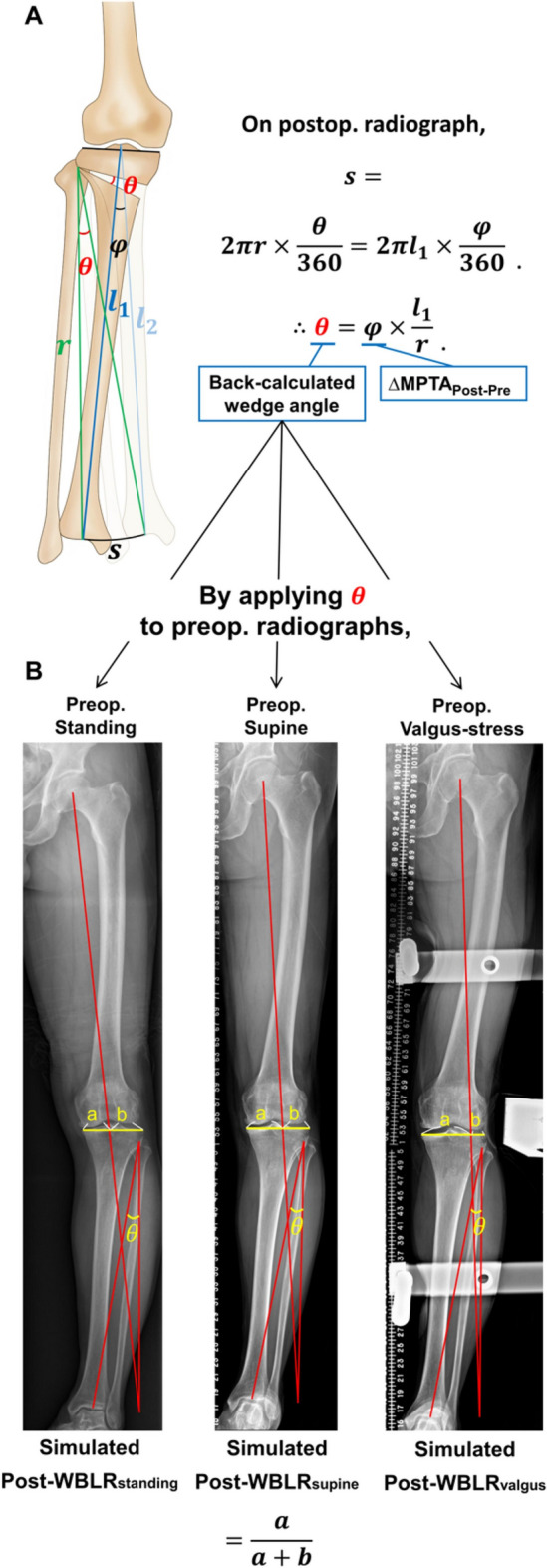
術後の骨角変化から矯正角を逆算し、術前の各撮影肢位に同じ角度を適用した研究方法です。治療指針ではなく解析設計を示します。
Geunwu Gimm, Hyunjeong Ra, Seok Gyun Yang, Byung Sun Choi, Du Hyun Ro, Hyuk-Soo Han. Complementary roles of standing, supine, and valgus-stress whole-leg radiographs in medial open-wedge high tibial osteotomy planning: supine minimizes bias, whereas standing and valgus-stress reduce outliers. Knee Surgery & Related Research (2026). https://doi.org/10.1186/s43019-026-00340-6
原図Figure 2
 図を拡大する
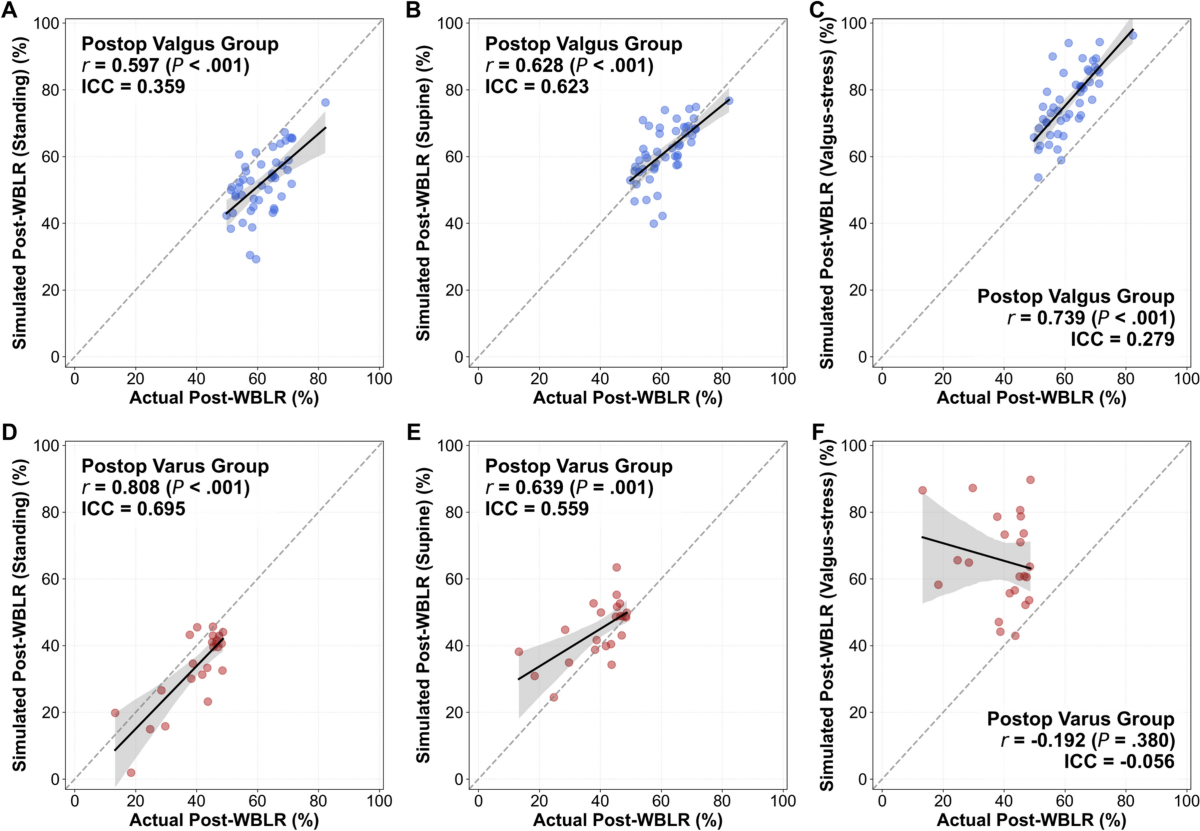
立位・臥位・外反ストレス画像の予測WBLRと実際の術後WBLR。上段は術後外反、下段は残存内反で、相関と一致度を分けて読みます。
Geunwu Gimm, Hyunjeong Ra, Seok Gyun Yang, Byung Sun Choi, Du Hyun Ro, Hyuk-Soo Han. Complementary roles of standing, supine, and valgus-stress whole-leg radiographs in medial open-wedge high tibial osteotomy planning: supine minimizes bias, whereas standing and valgus-stress reduce outliers. Knee Surgery & Related Research (2026). https://doi.org/10.1186/s43019-026-00340-6 · Figure 2.
対象と方法
主な結果
手術に関する読書のポイント
解釈の限界
簡単に説明しましょう
この研究で何が確認されましたか?
外反サブグループの平均誤差・RMSEは、仰臥位0.0% ± 6.9%・6.8%、立位−9.3% ± 7.8%・12.1%、外反ストレス+15.2% ± 6.7%・16.6%でした。
治療決定に直接適用できるか?
楔状角度を逆算しても、手術実施時の誤差を完全には分離できません。術後結果に基づくサブグループでモデルを開発しており、外部検証はありません。sMCLを切離する施設への一般化には限界があります。PROMの改善は確認していません。
Keywords・キーワード
- High tibial osteotomy
- Preoperative planning
- Standing
- Supine
- Valgus-stress
- Whole-leg radiograph
- HTO
- alignment
Abstract・原文の抄録
Geunwu Gimm, Hyunjeong Ra, Seok Gyun Yang, Byung Sun Choi, Du Hyun Ro, Hyuk-Soo Han. Complementary roles of standing, supine, and valgus-stress whole-leg radiographs in medial open-wedge high tibial osteotomy planning: supine minimizes bias, whereas standing and valgus-stress reduce outliers. Knee surgery & related research. 2026;38(1):38. doi:10.1186/s43019-026-00340-6.
BACKGROUND
Accurate alignment correction is essential in medial open-wedge high tibial osteotomy (MOWHTO). However, conventional planning based on standing radiographs may not reflect postoperative intra-articular alignment changes. While differences between standing and supine radiographs have been investigated, the role of valgus-stress whole-leg radiographs in preoperative planning remains largely unexplored. This study evaluated the predictive accuracy of standing, supine, and valgus-stress whole-leg radiographs in MOWHTO planning and determined whether integrating these modalities improves alignment prediction compared with single-modality planning.
METHODS
This retrospective study included 71 patients who underwent MOWHTO. Preoperative standing, supine, and valgus-stress whole-leg radiographs, along with 1-year postoperative standing radiographs, were analyzed. To minimize the influence of surgical execution error and allow the analysis to focus on planning error, the achieved wedge angle was back-calculated from postoperative bony correction and reapplied to each preoperative modality to simulate the postoperative weight-bearing line ratio (Post-WBLR). Accuracy was assessed by comparing simulated and actual Post-WBLR. Multivariable regression was performed to identify predictors of actual Post-WBLR and to compare a multimodal model with the best-performing single-modality simulation.
RESULTS
In the postoperative valgus subgroup (n = 48), supine-based simulation showed no significant difference from actual Post-WBLR (mean difference, 0.0% ± 6.9%; root mean square error [RMSE], 6.8%). In contrast, standing-based simulation underestimated alignment (-9.3% ± 7.8%; RMSE, 12.1%), whereas valgus-stress simulation overestimated it (15.2% ± 6.7%; RMSE, 16.6%). A multimodal regression model incorporating simulated Post-WBLR from standing and valgus-stress radiographs demonstrated significantly improved predictive accuracy compared with the supine-only simulation (R2, 0.606 versus 0.080; RMSE, 4.5% versus 6.8%). Notably, in patients with a preoperative standing-to-supine joint line convergence angle difference (∆JLCAstanding-supine) ≥ 2.7°, the multimodal model significantly reduced prediction errors (absolute error: 3.2% versus 6.8%; RMSE: 4.0% versus 9.0%; all P < 0.015).
CONCLUSIONS
Supine radiographs generally provided the most accurate single-modality basis for MOWHTO planning. Standing and valgus-stress radiographs offered complementary information, and their integration improved prediction accuracy and reduced planning outliers. While further validation is required, a stepwise planning workflow-using supine radiographs as the default modality and multimodal integration when ∆JLCAstanding-supine ≥ 2.7°-may serve as an exploratory framework for reducing the risk of planning-related under- or overcorrection.
© The Author(s) 2026
オリジナル紙だ
Complementary roles of standing, supine, and valgus-stress whole-leg radiographs in medial open-wedge high tibial osteotomy planning: supine minimizes bias, whereas standing and valgus-stress reduce outliers
Geunwu Gimm, Hyunjeong Ra, Seok Gyun Yang, Byung Sun Choi, Du Hyun Ro, Hyuk-Soo Han
Knee Surgery & Related Research · 2026