2026 · Knee Surgery & Related Research
누워서 찍은 X-ray에 다른 자세의 정보를 더하면, 수술 계획이 달라질까?
외반 하위군의 평균 오차·RMSE는 누운 자세 0.0% ± 6.9%·6.8%, 선 자세 −9.3% ± 7.8%·12.1%, 외반 스트레스 +15.2% ± 6.7%·16.6%였습니다.
원문 Figure 4
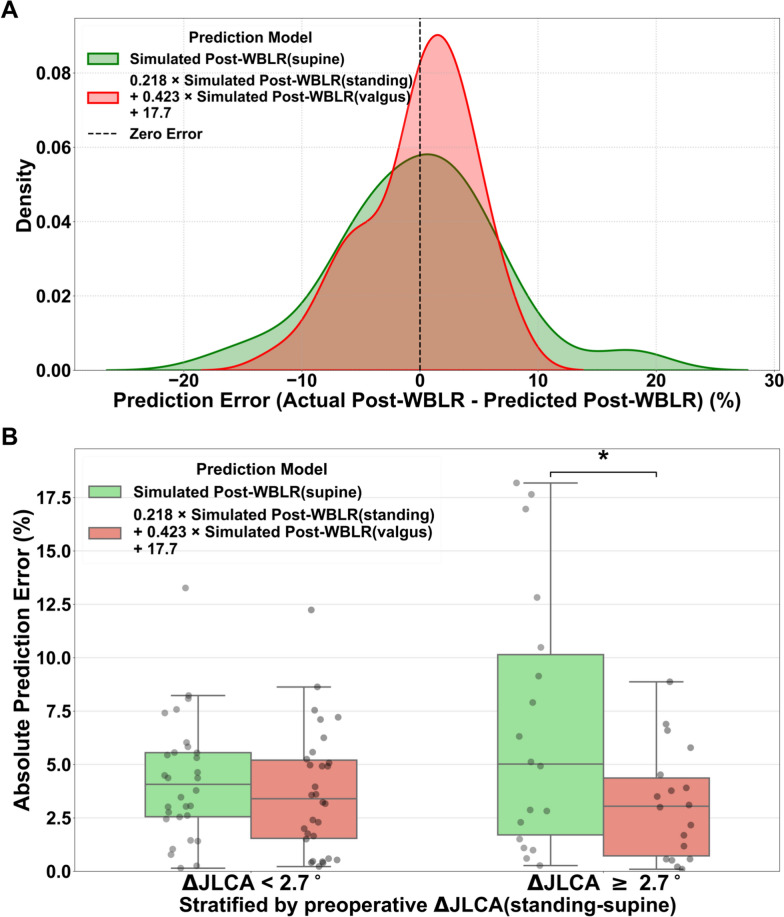 그림 크게 보기
술후 외반 하위군에서 누운 자세 시뮬레이션과 여러 자세를 합친 회귀모형의 예측 오차를 비교한 원문 Figure 4. 큰 JLCA 자세 차이에서 복합모형의 오차가 작았습니다.
Geunwu Gimm, Hyunjeong Ra, Seok Gyun Yang, Byung Sun Choi, Du Hyun Ro, Hyuk-Soo Han. Complementary roles of standing, supine, and valgus-stress whole-leg radiographs in medial open-wedge high tibial osteotomy planning: supine minimizes bias, whereas standing and valgus-stress reduce outliers. Knee Surgery & Related Research (2026). https://doi.org/10.1186/s43019-026-00340-6
원문 Figure 1
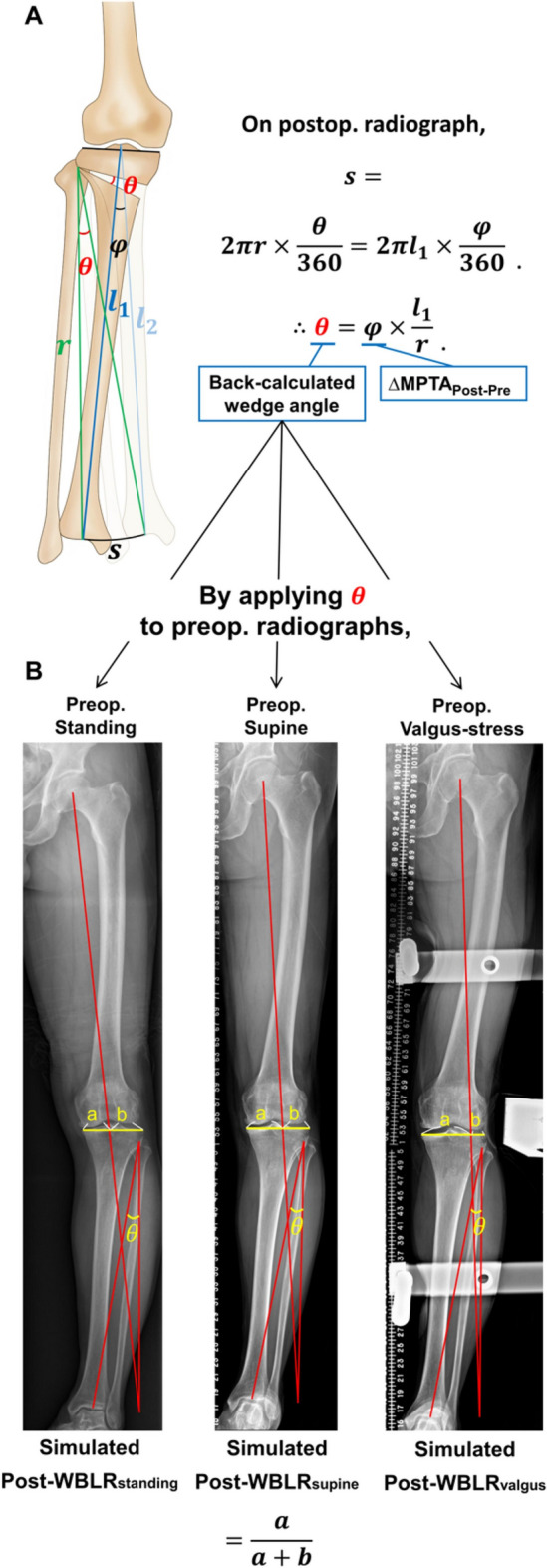 그림 크게 보기
수술 후 뼈 각도 변화에서 교정 각도를 역산하고, 같은 각도를 수술 전 각 자세의 영상에 적용한 연구 방법. 치료 지침이 아닌 분석 설계를 보여줍니다.
Geunwu Gimm, Hyunjeong Ra, Seok Gyun Yang, Byung Sun Choi, Du Hyun Ro, Hyuk-Soo Han. Complementary roles of standing, supine, and valgus-stress whole-leg radiographs in medial open-wedge high tibial osteotomy planning: supine minimizes bias, whereas standing and valgus-stress reduce outliers. Knee Surgery & Related Research (2026). https://doi.org/10.1186/s43019-026-00340-6
원문 Figure 2
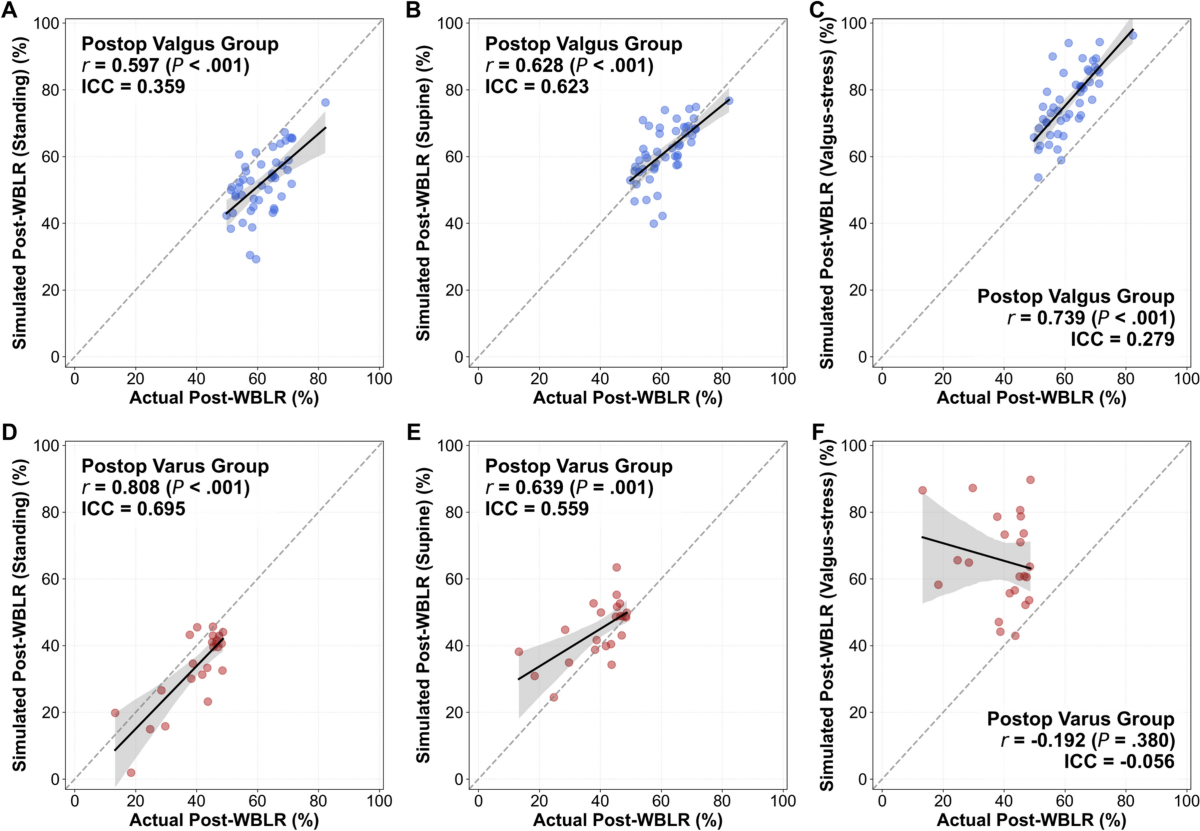 그림 크게 보기
선 자세·누운 자세·외반 스트레스 영상에서 시뮬레이션한 WBLR와 실제 술후 WBLR의 비교. 위쪽은 술후 외반군, 아래쪽은 잔여 내반군이며 상관계수와 측정 일치도를 구분해 읽습니다.
Geunwu Gimm, Hyunjeong Ra, Seok Gyun Yang, Byung Sun Choi, Du Hyun Ro, Hyuk-Soo Han. Complementary roles of standing, supine, and valgus-stress whole-leg radiographs in medial open-wedge high tibial osteotomy planning: supine minimizes bias, whereas standing and valgus-stress reduce outliers. Knee Surgery & Related Research (2026). https://doi.org/10.1186/s43019-026-00340-6 · Figure 2.
대상과 방법
주요 결과
진료·수술에서 읽을 지점
해석의 제한
짧게 정리하면
이 연구가 확인한 것은 무엇인가요?
외반 하위군의 평균 오차·RMSE는 누운 자세 0.0% ± 6.9%·6.8%, 선 자세 −9.3% ± 7.8%·12.1%, 외반 스트레스 +15.2% ± 6.7%·16.6%였습니다.
개별 환자의 치료 결정에 바로 적용할 수 있나요?
역산한 wedge로 수술 실행 오차를 완전히 분리할 수 없습니다. 술후 결과로 나눈 subgroup에서 모델을 개발했고 외부 검증은 없습니다. sMCL 절단을 시행하는 기관에 일반화하기 어렵습니다. PROM 개선은 확인하지 않았습니다.
Keywords · 주제어
- High tibial osteotomy
- Preoperative planning
- Standing
- Supine
- Valgus-stress
- Whole-leg radiograph
- HTO
- alignment
Abstract · 원문 초록
Geunwu Gimm, Hyunjeong Ra, Seok Gyun Yang, Byung Sun Choi, Du Hyun Ro, Hyuk-Soo Han. Complementary roles of standing, supine, and valgus-stress whole-leg radiographs in medial open-wedge high tibial osteotomy planning: supine minimizes bias, whereas standing and valgus-stress reduce outliers. Knee surgery & related research. 2026;38(1):38. doi:10.1186/s43019-026-00340-6.
BACKGROUND
Accurate alignment correction is essential in medial open-wedge high tibial osteotomy (MOWHTO). However, conventional planning based on standing radiographs may not reflect postoperative intra-articular alignment changes. While differences between standing and supine radiographs have been investigated, the role of valgus-stress whole-leg radiographs in preoperative planning remains largely unexplored. This study evaluated the predictive accuracy of standing, supine, and valgus-stress whole-leg radiographs in MOWHTO planning and determined whether integrating these modalities improves alignment prediction compared with single-modality planning.
METHODS
This retrospective study included 71 patients who underwent MOWHTO. Preoperative standing, supine, and valgus-stress whole-leg radiographs, along with 1-year postoperative standing radiographs, were analyzed. To minimize the influence of surgical execution error and allow the analysis to focus on planning error, the achieved wedge angle was back-calculated from postoperative bony correction and reapplied to each preoperative modality to simulate the postoperative weight-bearing line ratio (Post-WBLR). Accuracy was assessed by comparing simulated and actual Post-WBLR. Multivariable regression was performed to identify predictors of actual Post-WBLR and to compare a multimodal model with the best-performing single-modality simulation.
RESULTS
In the postoperative valgus subgroup (n = 48), supine-based simulation showed no significant difference from actual Post-WBLR (mean difference, 0.0% ± 6.9%; root mean square error [RMSE], 6.8%). In contrast, standing-based simulation underestimated alignment (-9.3% ± 7.8%; RMSE, 12.1%), whereas valgus-stress simulation overestimated it (15.2% ± 6.7%; RMSE, 16.6%). A multimodal regression model incorporating simulated Post-WBLR from standing and valgus-stress radiographs demonstrated significantly improved predictive accuracy compared with the supine-only simulation (R2, 0.606 versus 0.080; RMSE, 4.5% versus 6.8%). Notably, in patients with a preoperative standing-to-supine joint line convergence angle difference (∆JLCAstanding-supine) ≥ 2.7°, the multimodal model significantly reduced prediction errors (absolute error: 3.2% versus 6.8%; RMSE: 4.0% versus 9.0%; all P < 0.015).
CONCLUSIONS
Supine radiographs generally provided the most accurate single-modality basis for MOWHTO planning. Standing and valgus-stress radiographs offered complementary information, and their integration improved prediction accuracy and reduced planning outliers. While further validation is required, a stepwise planning workflow-using supine radiographs as the default modality and multimodal integration when ∆JLCAstanding-supine ≥ 2.7°-may serve as an exploratory framework for reducing the risk of planning-related under- or overcorrection.
© The Author(s) 2026
원래 논문
Complementary roles of standing, supine, and valgus-stress whole-leg radiographs in medial open-wedge high tibial osteotomy planning: supine minimizes bias, whereas standing and valgus-stress reduce outliers
Geunwu Gimm, Hyunjeong Ra, Seok Gyun Yang, Byung Sun Choi, Du Hyun Ro, Hyuk-Soo Han
Knee Surgery & Related Research · 2026