2024 · American Journal of Sports Medicine
Which Imaging Measures Are Related to Progression and Future Surgery in the Operated and Contralateral Knees after Unilateral HTO?
Smaller postoperative JLCA was associated with greater risk of contralateral OA progression (P = 0.027) and surgery (P = 0.006). Larger JLCA was associated with greater risk of OA progression (P = 0.014) and TKA (P = 0.027) on the operated side.
Research question and design
 Enlarge Figure
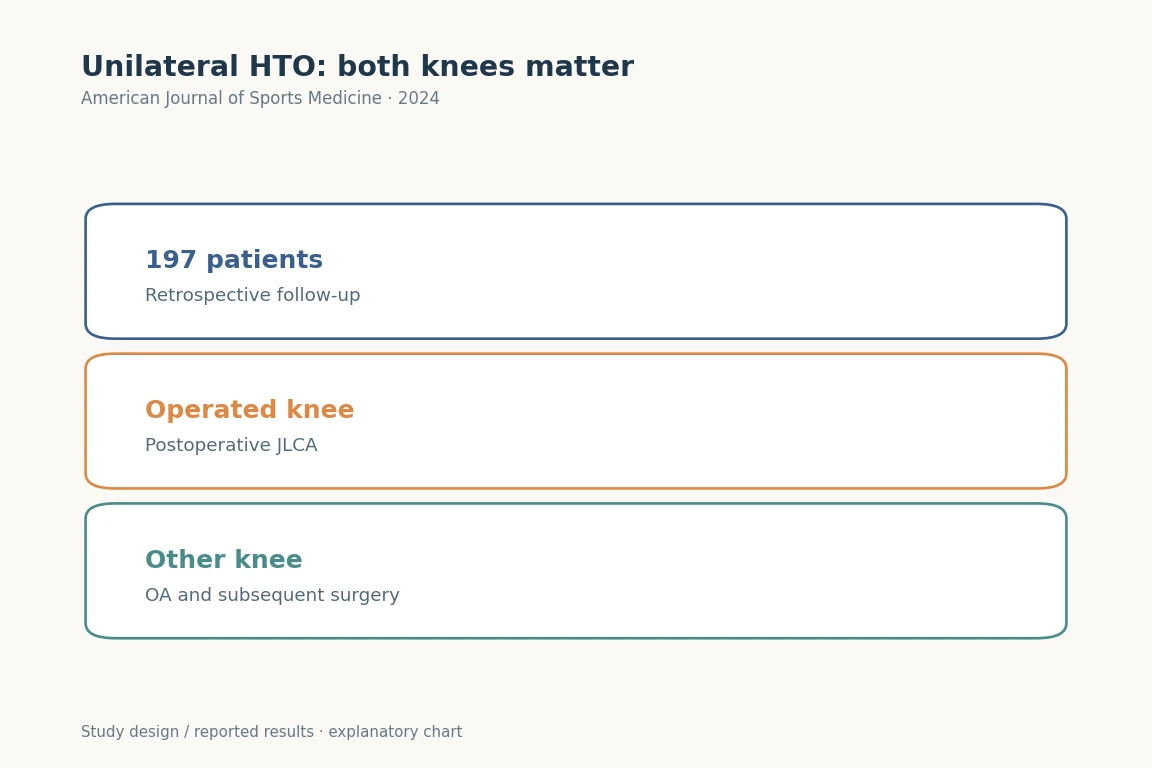
Both knees were followed in 197 patients after unilateral HTO. Medial opening on the operated side was associated with the other knee's course. An observational threshold should not be applied as a uniform surgical target.
American Journal of Sports Medicine (2024). DOI: 10.1177/03635465241285455 · Original explanatory chart based on reported data
The research question
Participants and Methods
Main Findings
Implications for clinical and surgical practice
Limitations
Let's put it briefly.
Which clinical question does this address?
This study assessed bilateral loading and subsequent surgery, in addition to the operated side, when evaluating HTO outcomes.
Keywords
- conversion to arthroplasty
- joint line convergence angle
- nonoperated knee
- osteoarthritis progression
- surgery
- unilateral high tibial osteotomy
- Osteoarthritis, Knee
- Osteotomy
Abstract · Original text
Geunwu Gimm, Hyunjun Ji, Du Hyun Ro, Myung Chul Lee, Hyuk-Soo Han. Medial Joint Opening in the Operated Knee After Unilateral High Tibial Osteotomy: Risk of Osteoarthritis and Future Surgery in the Operated and Nonoperated Knee. The American journal of sports medicine. 2024;52(13):3266-3276. doi:10.1177/03635465241285455.
BACKGROUND
High tibial osteotomy (HTO) modifies the mechanics of the affected knee but can also affect the nonoperated knee. However, no research has reported on the prognosis and risk factors related to the nonoperated knee after unilateral HTO.
PURPOSE
To assess the radiological parameters associated with osteoarthritis (OA) progression and the need for surgery in the nonoperated knee after unilateral HTO, with concurrent assessment of the operated knee.
STUDY DESIGN
Case series; Level of evidence, 4.
METHODS
The medical charts of 197 patients with knee OA who underwent unilateral HTO between March 2007 and December 2020 were retrospectively investigated. Radiological parameters such as the Kellgren-Lawrence grade, weightbearing line ratio, joint line convergence angle (JLCA), and joint line obliquity angle were assessed preoperatively and 1 year postoperatively.
RESULTS
The mean follow-up length for the 197 patients was 5.9 ± 3.2 years for the operated knee and 5.5 ± 3.2 years for the nonoperated knee. A smaller postoperative JLCA in the operated knee was a significant risk factor for OA progression (P = .027) and undergoing surgery (P = .006) in the nonoperated knee. Conversely, a larger postoperative JLCA in the operated knee was a significant risk factor for OA progression (P = .014) and conversion to arthroplasty (P = .027) in the operated knee. A postoperative JLCA >1.5° (P < .001) and <3.9° (P < .001) was needed to reduce the risk of undergoing surgery in the nonoperated knee and OA progression in the operated knee, respectively. Additionally, a pre- to postoperative change in the JLCA (ΔJLCA) between -5.6° and -1.7° (P = .021 and P = .004, respectively) was needed to reduce the risk of OA progression in both knees.
CONCLUSION
A large medial joint opening (a small postoperative JLCA) in the operated knee after unilateral HTO was associated with a higher risk of OA progression and surgery in the nonoperated knee. Conversely, a small medial joint opening (a large postoperative JLCA) was associated with a higher risk of OA progression and conversion to arthroplasty in the operated knee. For a balanced medial joint opening, if the postoperative JLCA was between 1.5° and 3.9° or the ΔJLCA was between -5.6° and -1.7°, a favorable prognosis in both knees could be anticipated.
The original paper.
Medial Joint Opening in the Operated Knee After Unilateral High Tibial Osteotomy: Risk of Osteoarthritis and Future Surgery in the Operated and Nonoperated Knee
Geunwu Gimm, Hyunjun Ji, Du Hyun Ro, Myung Chul Lee, Hyuk-Soo Han
American Journal of Sports Medicine · 2024