2024 · American Journal of Sports Medicine
편측 HTO 후 수술측과 반대측의 진행·향후 수술에 관련된 영상 지표는 무엇일까?
수술 후 JLCA가 작을수록 반대측 OA 진행(P = 0.027)·수술(P = 0.006) 위험이 높았습니다. 클수록 수술측 OA 진행(P = 0.014)·TKA(P = 0.027) 위험이 높았습니다.
연구 질문과 설계
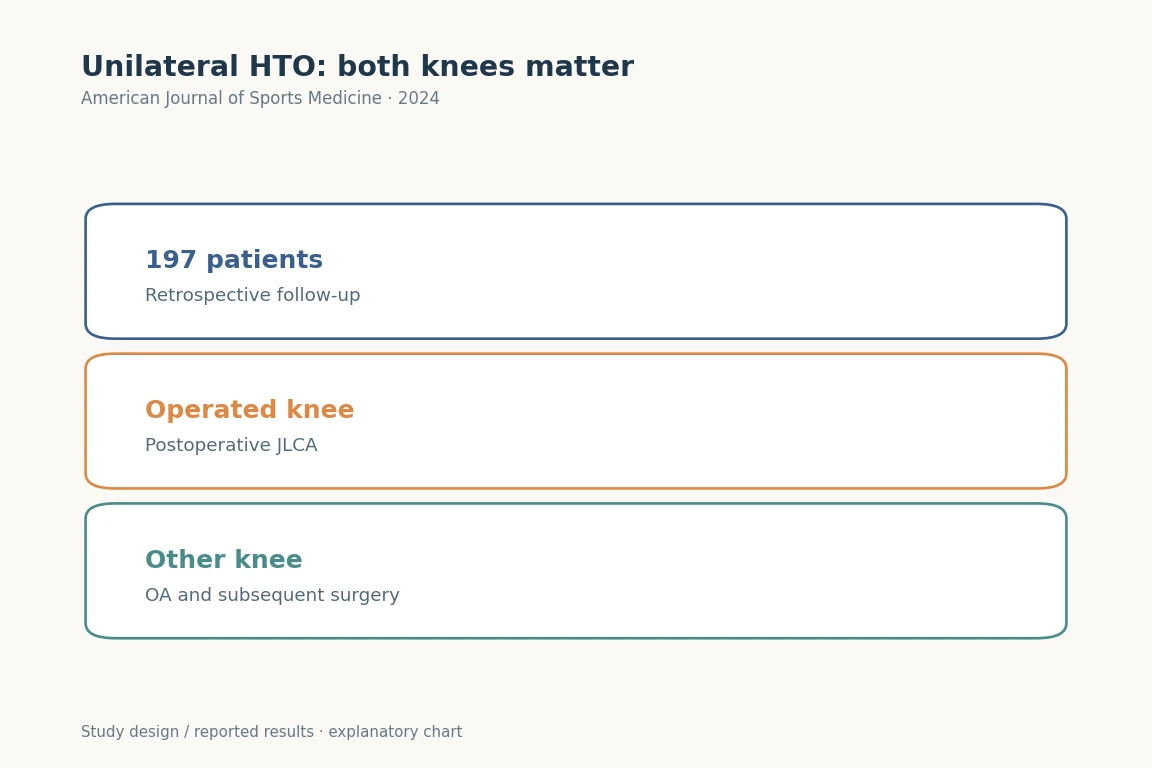 그림 크게 보기
197명의 편측 HTO 후 양쪽 무릎 경과를 평가했습니다. 수술한 쪽의 내측 벌어짐이 수술하지 않은 쪽 경과와도 연관됐습니다. 관찰 연구의 경계를 수술 목표 각도로 일괄 적용하지 않습니다.
American Journal of Sports Medicine (2024). DOI: 10.1177/03635465241285455 · Original explanatory chart based on reported data
연구에서 묻는 질문
대상과 방법
주요 결과
진료와 수술에서 읽을 지점
해석의 제한
짧게 정리하면
어떤 진료 질문과 연결되나요?
HTO 결과에서 수술측뿐 아니라 양측 부하와 향후 수술을 함께 평가하는 연구입니다.
Keywords · 주제어
- conversion to arthroplasty
- joint line convergence angle
- nonoperated knee
- osteoarthritis progression
- surgery
- unilateral high tibial osteotomy
- Osteoarthritis, Knee
- Osteotomy
Abstract · 원문 초록
Geunwu Gimm, Hyunjun Ji, Du Hyun Ro, Myung Chul Lee, Hyuk-Soo Han. Medial Joint Opening in the Operated Knee After Unilateral High Tibial Osteotomy: Risk of Osteoarthritis and Future Surgery in the Operated and Nonoperated Knee. The American journal of sports medicine. 2024;52(13):3266-3276. doi:10.1177/03635465241285455.
BACKGROUND
High tibial osteotomy (HTO) modifies the mechanics of the affected knee but can also affect the nonoperated knee. However, no research has reported on the prognosis and risk factors related to the nonoperated knee after unilateral HTO.
PURPOSE
To assess the radiological parameters associated with osteoarthritis (OA) progression and the need for surgery in the nonoperated knee after unilateral HTO, with concurrent assessment of the operated knee.
STUDY DESIGN
Case series; Level of evidence, 4.
METHODS
The medical charts of 197 patients with knee OA who underwent unilateral HTO between March 2007 and December 2020 were retrospectively investigated. Radiological parameters such as the Kellgren-Lawrence grade, weightbearing line ratio, joint line convergence angle (JLCA), and joint line obliquity angle were assessed preoperatively and 1 year postoperatively.
RESULTS
The mean follow-up length for the 197 patients was 5.9 ± 3.2 years for the operated knee and 5.5 ± 3.2 years for the nonoperated knee. A smaller postoperative JLCA in the operated knee was a significant risk factor for OA progression (P = .027) and undergoing surgery (P = .006) in the nonoperated knee. Conversely, a larger postoperative JLCA in the operated knee was a significant risk factor for OA progression (P = .014) and conversion to arthroplasty (P = .027) in the operated knee. A postoperative JLCA >1.5° (P < .001) and <3.9° (P < .001) was needed to reduce the risk of undergoing surgery in the nonoperated knee and OA progression in the operated knee, respectively. Additionally, a pre- to postoperative change in the JLCA (ΔJLCA) between -5.6° and -1.7° (P = .021 and P = .004, respectively) was needed to reduce the risk of OA progression in both knees.
CONCLUSION
A large medial joint opening (a small postoperative JLCA) in the operated knee after unilateral HTO was associated with a higher risk of OA progression and surgery in the nonoperated knee. Conversely, a small medial joint opening (a large postoperative JLCA) was associated with a higher risk of OA progression and conversion to arthroplasty in the operated knee. For a balanced medial joint opening, if the postoperative JLCA was between 1.5° and 3.9° or the ΔJLCA was between -5.6° and -1.7°, a favorable prognosis in both knees could be anticipated.
원래 논문
Medial Joint Opening in the Operated Knee After Unilateral High Tibial Osteotomy: Risk of Osteoarthritis and Future Surgery in the Operated and Nonoperated Knee
Geunwu Gimm, Hyunjun Ji, Du Hyun Ro, Myung Chul Lee, Hyuk-Soo Han
American Journal of Sports Medicine · 2024