2024 · American Journal of Sports Medicine
片側HTO後、手術側と反対側の進行・将来の手術に関連する画像指標は何か?
術後JLCAが小さいほど反対側のOA進行(P = 0.027)・手術(P = 0.006)のリスクが高く、大きいほど手術側のOA進行(P = 0.014)・TKA(P = 0.027)のリスクが高値でした。
研究の問いと設計
 図を拡大する
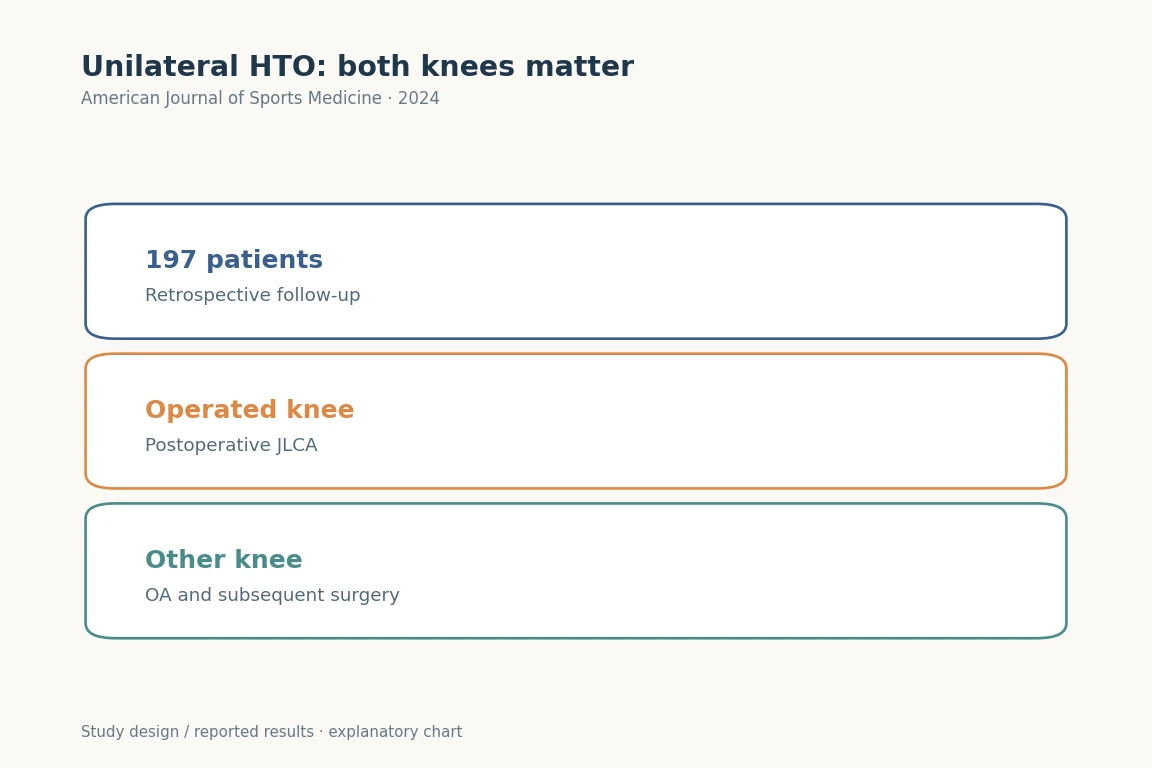
片側HTO後の197人で両膝の経過を評価しました。手術側の内側開大量は反対側の経過とも関連しました。観察研究の境界値を一律の手術目標に用いません。
American Journal of Sports Medicine (2024). DOI: 10.1177/03635465241285455 · Original explanatory chart based on reported data
研究で問うこと
対象と方法
主な結果
診療・手術で考える点
解釈の限界
簡単に説明しましょう
どの診療上の問いにつながりますか?
HTOの成績について、手術側だけでなく両側の荷重やその後の手術も併せて評価した研究です。
Keywords・キーワード
- conversion to arthroplasty
- joint line convergence angle
- nonoperated knee
- osteoarthritis progression
- surgery
- unilateral high tibial osteotomy
- Osteoarthritis, Knee
- Osteotomy
Abstract・原文の抄録
Geunwu Gimm, Hyunjun Ji, Du Hyun Ro, Myung Chul Lee, Hyuk-Soo Han. Medial Joint Opening in the Operated Knee After Unilateral High Tibial Osteotomy: Risk of Osteoarthritis and Future Surgery in the Operated and Nonoperated Knee. The American journal of sports medicine. 2024;52(13):3266-3276. doi:10.1177/03635465241285455.
BACKGROUND
High tibial osteotomy (HTO) modifies the mechanics of the affected knee but can also affect the nonoperated knee. However, no research has reported on the prognosis and risk factors related to the nonoperated knee after unilateral HTO.
PURPOSE
To assess the radiological parameters associated with osteoarthritis (OA) progression and the need for surgery in the nonoperated knee after unilateral HTO, with concurrent assessment of the operated knee.
STUDY DESIGN
Case series; Level of evidence, 4.
METHODS
The medical charts of 197 patients with knee OA who underwent unilateral HTO between March 2007 and December 2020 were retrospectively investigated. Radiological parameters such as the Kellgren-Lawrence grade, weightbearing line ratio, joint line convergence angle (JLCA), and joint line obliquity angle were assessed preoperatively and 1 year postoperatively.
RESULTS
The mean follow-up length for the 197 patients was 5.9 ± 3.2 years for the operated knee and 5.5 ± 3.2 years for the nonoperated knee. A smaller postoperative JLCA in the operated knee was a significant risk factor for OA progression (P = .027) and undergoing surgery (P = .006) in the nonoperated knee. Conversely, a larger postoperative JLCA in the operated knee was a significant risk factor for OA progression (P = .014) and conversion to arthroplasty (P = .027) in the operated knee. A postoperative JLCA >1.5° (P < .001) and <3.9° (P < .001) was needed to reduce the risk of undergoing surgery in the nonoperated knee and OA progression in the operated knee, respectively. Additionally, a pre- to postoperative change in the JLCA (ΔJLCA) between -5.6° and -1.7° (P = .021 and P = .004, respectively) was needed to reduce the risk of OA progression in both knees.
CONCLUSION
A large medial joint opening (a small postoperative JLCA) in the operated knee after unilateral HTO was associated with a higher risk of OA progression and surgery in the nonoperated knee. Conversely, a small medial joint opening (a large postoperative JLCA) was associated with a higher risk of OA progression and conversion to arthroplasty in the operated knee. For a balanced medial joint opening, if the postoperative JLCA was between 1.5° and 3.9° or the ΔJLCA was between -5.6° and -1.7°, a favorable prognosis in both knees could be anticipated.
オリジナル紙だ
Medial Joint Opening in the Operated Knee After Unilateral High Tibial Osteotomy: Risk of Osteoarthritis and Future Surgery in the Operated and Nonoperated Knee
Geunwu Gimm, Hyunjun Ji, Du Hyun Ro, Myung Chul Lee, Hyuk-Soo Han
American Journal of Sports Medicine · 2024