2025 · Bone & Joint Journal
Deep learning for hip fracture classification: external validation and reader-assistance evaluation
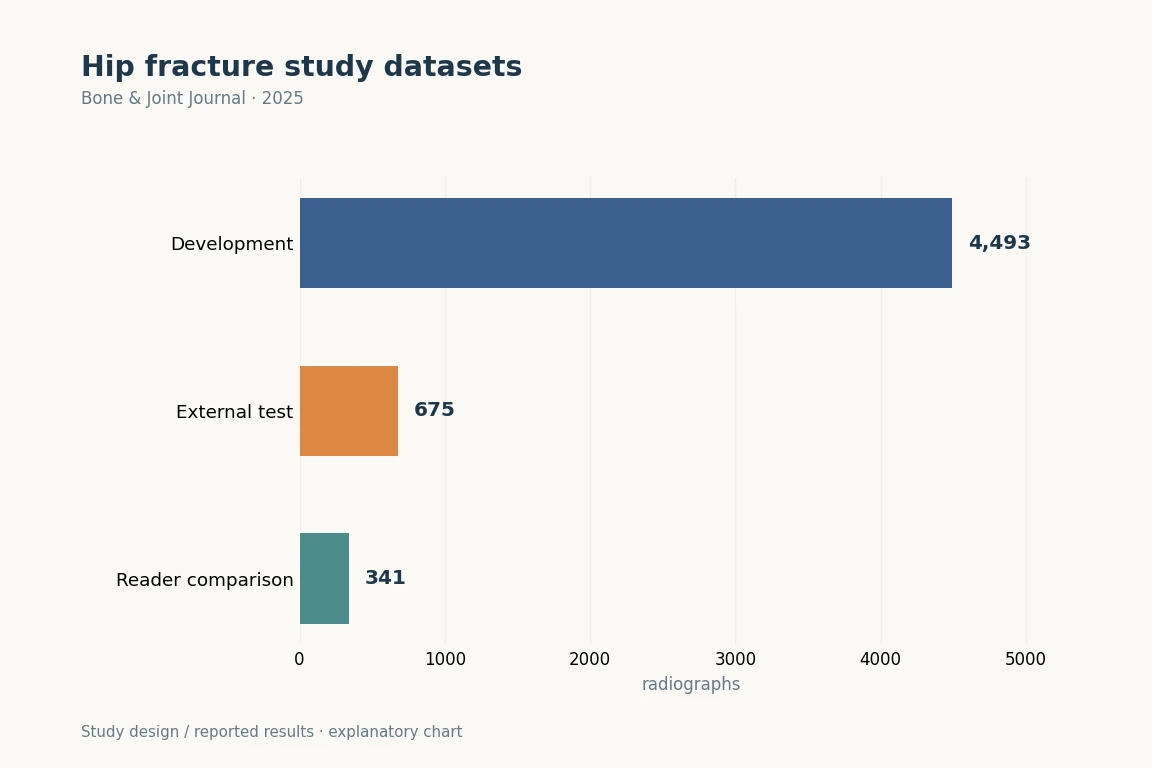
Development used 4,493 images from two institutions; external validation used 675 images from another institution.
Results explained with study numbers
 Enlarge Figure
Development (4,493), external validation (675) and reader comparison (341) images are shown separately. The 341 are part of the external set; do not add the bars. Table III's 0.83–0.89 values are averages for three doctors and are not labelled as standalone AI sensitivity because descriptions of the evaluator are inconsistent.
Bone & Joint Journal (2025). DOI: 10.1302/0301-620X.107B2.BJJ-2024-0791.R1 · Original explanatory chart based on reported data
The research question
Participants and Methods
Main Findings
Implications for clinical and surgical practice
Limitations
Let's put it briefly.
Which clinical question does this address?
The model assists diagnosis and fracture-type classification. It does not evaluate the effects of selecting particular operations.
Keywords
- Hip Fractures
- Deep Learning
- Retrospective Studies
- Sensitivity and Specificity
- Neural Networks, Computer
- Radiography
- Aged, 80 and over
- AI
Abstract · Original text
Zhiqian Zheng, Byeong Y Ryu, Sung E Kim, Dae S Song, Seong H Kim, Jung-Wee Park, Du H Ro. Deep learning for automated hip fracture detection and classification : achieving superior accuracy. The bone & joint journal. 2025;107-B(2):213-220. doi:10.1302/0301-620X.107B2.BJJ-2024-0791.R1.
AIMS
The aim of this study was to develop and evaluate a deep learning-based model for classification of hip fractures to enhance diagnostic accuracy.
METHODS
A retrospective study used 5,168 hip anteroposterior radiographs, with 4,493 radiographs from two institutes (internal dataset) for training and 675 radiographs from another institute for validation. A convolutional neural network (CNN)-based classification model was trained on four types of hip fractures (Displaced, Valgus-impacted, Stable, and Unstable), using DAMO-YOLO for data processing and augmentation. The model's accuracy, sensitivity, specificity, Intersection over Union (IoU), and Dice coefficient were evaluated. Orthopaedic surgeons' diagnoses served as the reference standard, with comparisons made before and after artificial intelligence assistance.
RESULTS
The accuracy, sensitivity, specificity, IoU, and Dice coefficients of the model for the four fracture categories in the internal dataset were as follows: Displaced (1.0, 0.79, 1.0, 0.70, 0.82), Valgus-impacted (1.0, 0.80, 1.0, 0.70, 0.82), Stable (0.99, 0.95, 0.99, 0.83, 0.89), and Unstable (1.0, 0.98, 0.99, 0.86, 0.92), respectively. For the external validation dataset, the sensitivity and specificity were as follows: Displaced (0.83, 0.94), Valgus-impacted (0.89, 0.90), Stable (0.88, 0.95), and Unstable (0.85, 0.99), respectively. The overall means (Micro AVG and Macro AVG) for the external dataset were Micro AVG (0.83 (SD 0.05), 0.96 (SD 0.01)) and Macro AVG (0.69 (SD 0.02), 0.95 (SD 0.02)), respectively.
CONCLUSION
Compared to human diagnosis alone, our study demonstrates that the developed model significantly improves the accuracy of detecting and classifying hip fractures. Our model has shown great potential in assisting clinicians with the accurate diagnosis and classification of hip fractures.
The original paper.
Deep learning for automated hip fracture detection and classification: achieving superior accuracy
Zhiqian Zheng, Byeong Y Ryu, Sung E Kim, Dae S Song, Seong H Kim, Jung-Wee Park, Du H Ro
Bone & Joint Journal · 2025