2025 · Bone & Joint Journal
股関節骨折分類の深層学習:外部検証と読影支援の評価
2施設4,493画像で開発し、外部施設675画像で検証しました。
研究の数値から読む結果
 図を拡大する
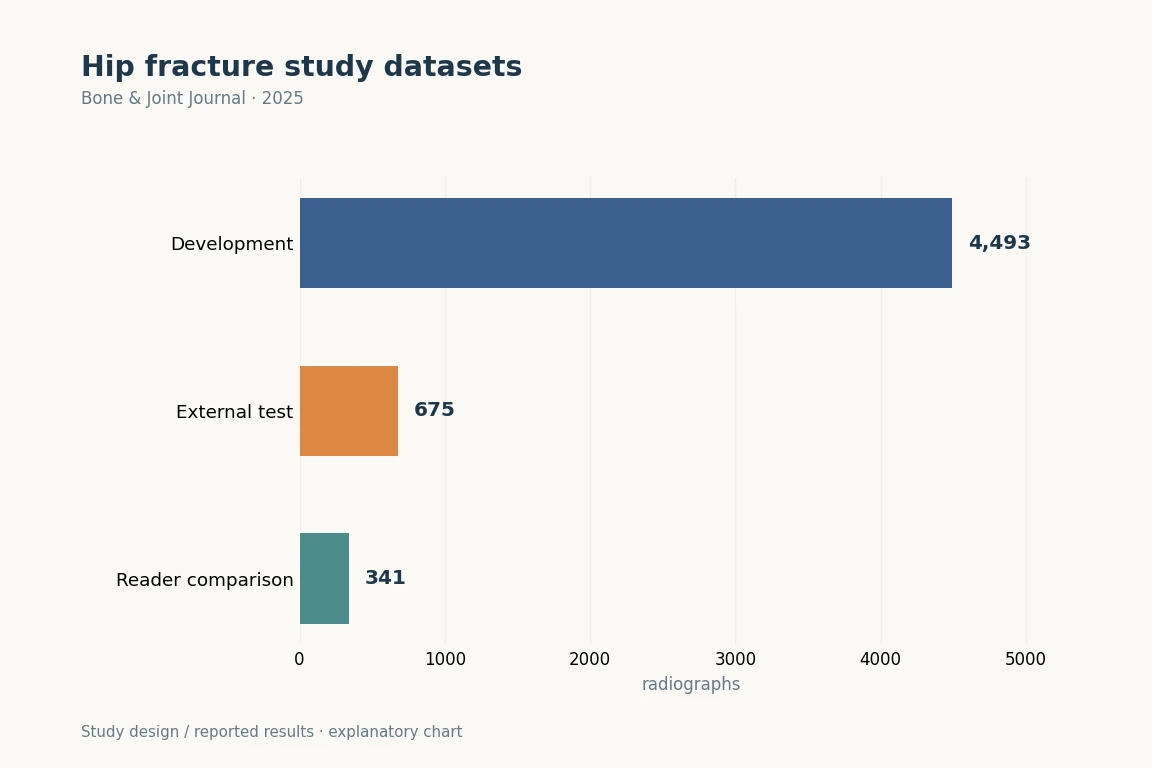
開発4,493件、外部675件、読影比較341件を分けて示します。341件は外部資料の一部なので加算しません。Table IIIの0.83–0.89は医師3人の平均列であり、評価主体の説明に不一致があるためAI単独の感度として表示しません。
Bone & Joint Journal (2025). DOI: 10.1302/0301-620X.107B2.BJJ-2024-0791.R1 · Original explanatory chart based on reported data
研究で問うこと
対象と方法
主な結果
診療・手術で考える点
解釈の限界
簡単に説明しましょう
どの診療上の問いにつながりますか?
診断と骨折型分類を支援するモデルです。手術の選択による効果を評価した研究ではありません。
Keywords・キーワード
- Hip Fractures
- Deep Learning
- Retrospective Studies
- Sensitivity and Specificity
- Neural Networks, Computer
- Radiography
- Aged, 80 and over
- AI
Abstract・原文の抄録
Zhiqian Zheng, Byeong Y Ryu, Sung E Kim, Dae S Song, Seong H Kim, Jung-Wee Park, Du H Ro. Deep learning for automated hip fracture detection and classification : achieving superior accuracy. The bone & joint journal. 2025;107-B(2):213-220. doi:10.1302/0301-620X.107B2.BJJ-2024-0791.R1.
AIMS
The aim of this study was to develop and evaluate a deep learning-based model for classification of hip fractures to enhance diagnostic accuracy.
METHODS
A retrospective study used 5,168 hip anteroposterior radiographs, with 4,493 radiographs from two institutes (internal dataset) for training and 675 radiographs from another institute for validation. A convolutional neural network (CNN)-based classification model was trained on four types of hip fractures (Displaced, Valgus-impacted, Stable, and Unstable), using DAMO-YOLO for data processing and augmentation. The model's accuracy, sensitivity, specificity, Intersection over Union (IoU), and Dice coefficient were evaluated. Orthopaedic surgeons' diagnoses served as the reference standard, with comparisons made before and after artificial intelligence assistance.
RESULTS
The accuracy, sensitivity, specificity, IoU, and Dice coefficients of the model for the four fracture categories in the internal dataset were as follows: Displaced (1.0, 0.79, 1.0, 0.70, 0.82), Valgus-impacted (1.0, 0.80, 1.0, 0.70, 0.82), Stable (0.99, 0.95, 0.99, 0.83, 0.89), and Unstable (1.0, 0.98, 0.99, 0.86, 0.92), respectively. For the external validation dataset, the sensitivity and specificity were as follows: Displaced (0.83, 0.94), Valgus-impacted (0.89, 0.90), Stable (0.88, 0.95), and Unstable (0.85, 0.99), respectively. The overall means (Micro AVG and Macro AVG) for the external dataset were Micro AVG (0.83 (SD 0.05), 0.96 (SD 0.01)) and Macro AVG (0.69 (SD 0.02), 0.95 (SD 0.02)), respectively.
CONCLUSION
Compared to human diagnosis alone, our study demonstrates that the developed model significantly improves the accuracy of detecting and classifying hip fractures. Our model has shown great potential in assisting clinicians with the accurate diagnosis and classification of hip fractures.
オリジナル紙だ
Deep learning for automated hip fracture detection and classification: achieving superior accuracy
Zhiqian Zheng, Byeong Y Ryu, Sung E Kim, Dae S Song, Seong H Kim, Jung-Wee Park, Du H Ro
Bone & Joint Journal · 2025