2025 · Bone & Joint Journal
고관절 골절 분류 딥러닝: 외부 검증과 판독 보조 평가
두 기관 영상 4,493장으로 개발하고 외부 기관의 675장으로 검증했습니다.
연구 수치로 읽는 결과
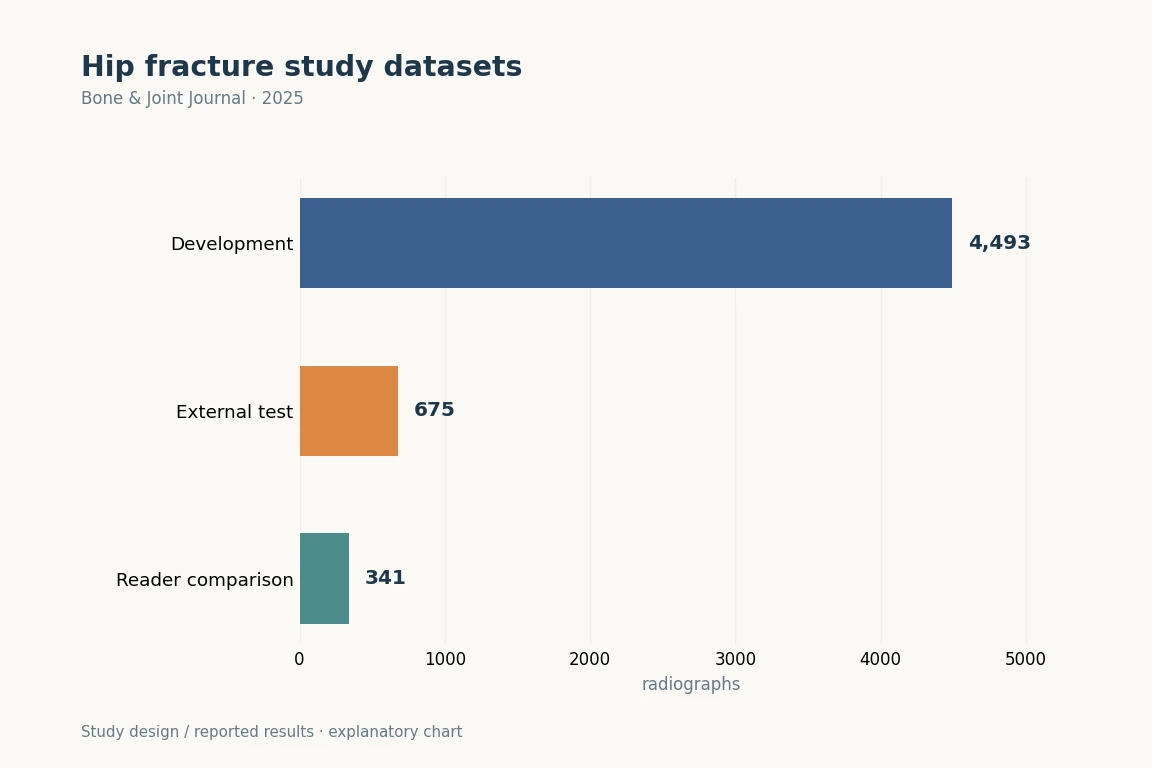 그림 크게 보기
개발 4,493장, 외부 675장, 판독 비교 341장을 구분한 도표입니다. 341장은 외부 자료의 일부로 세 막대를 합산하지 않습니다. Table III의 0.83–0.89는 세 의사의 평균 열 값으로, 평가 주체 설명의 불일치 때문에 AI 단독 민감도로 표시하지 않습니다.
Bone & Joint Journal (2025). DOI: 10.1302/0301-620X.107B2.BJJ-2024-0791.R1 · Original explanatory chart based on reported data
연구에서 묻는 질문
대상과 방법
주요 결과
진료와 수술에서 읽을 지점
해석의 제한
짧게 정리하면
어떤 진료 질문과 연결되나요?
진단과 골절 유형 분류를 보조하는 모델입니다. 수술 선택의 효과를 평가한 연구는 아닙니다.
Keywords · 주제어
- Hip Fractures
- Deep Learning
- Retrospective Studies
- Sensitivity and Specificity
- Neural Networks, Computer
- Radiography
- Aged, 80 and over
- AI
Abstract · 원문 초록
Zhiqian Zheng, Byeong Y Ryu, Sung E Kim, Dae S Song, Seong H Kim, Jung-Wee Park, Du H Ro. Deep learning for automated hip fracture detection and classification : achieving superior accuracy. The bone & joint journal. 2025;107-B(2):213-220. doi:10.1302/0301-620X.107B2.BJJ-2024-0791.R1.
AIMS
The aim of this study was to develop and evaluate a deep learning-based model for classification of hip fractures to enhance diagnostic accuracy.
METHODS
A retrospective study used 5,168 hip anteroposterior radiographs, with 4,493 radiographs from two institutes (internal dataset) for training and 675 radiographs from another institute for validation. A convolutional neural network (CNN)-based classification model was trained on four types of hip fractures (Displaced, Valgus-impacted, Stable, and Unstable), using DAMO-YOLO for data processing and augmentation. The model's accuracy, sensitivity, specificity, Intersection over Union (IoU), and Dice coefficient were evaluated. Orthopaedic surgeons' diagnoses served as the reference standard, with comparisons made before and after artificial intelligence assistance.
RESULTS
The accuracy, sensitivity, specificity, IoU, and Dice coefficients of the model for the four fracture categories in the internal dataset were as follows: Displaced (1.0, 0.79, 1.0, 0.70, 0.82), Valgus-impacted (1.0, 0.80, 1.0, 0.70, 0.82), Stable (0.99, 0.95, 0.99, 0.83, 0.89), and Unstable (1.0, 0.98, 0.99, 0.86, 0.92), respectively. For the external validation dataset, the sensitivity and specificity were as follows: Displaced (0.83, 0.94), Valgus-impacted (0.89, 0.90), Stable (0.88, 0.95), and Unstable (0.85, 0.99), respectively. The overall means (Micro AVG and Macro AVG) for the external dataset were Micro AVG (0.83 (SD 0.05), 0.96 (SD 0.01)) and Macro AVG (0.69 (SD 0.02), 0.95 (SD 0.02)), respectively.
CONCLUSION
Compared to human diagnosis alone, our study demonstrates that the developed model significantly improves the accuracy of detecting and classifying hip fractures. Our model has shown great potential in assisting clinicians with the accurate diagnosis and classification of hip fractures.
원래 논문
Deep learning for automated hip fracture detection and classification: achieving superior accuracy
Zhiqian Zheng, Byeong Y Ryu, Sung E Kim, Dae S Song, Seong H Kim, Jung-Wee Park, Du H Ro
Bone & Joint Journal · 2025