2026 · The Bone & Joint Journal
Does Joint-line Obliquity Explain OA Onset Better Than CPAK Type?
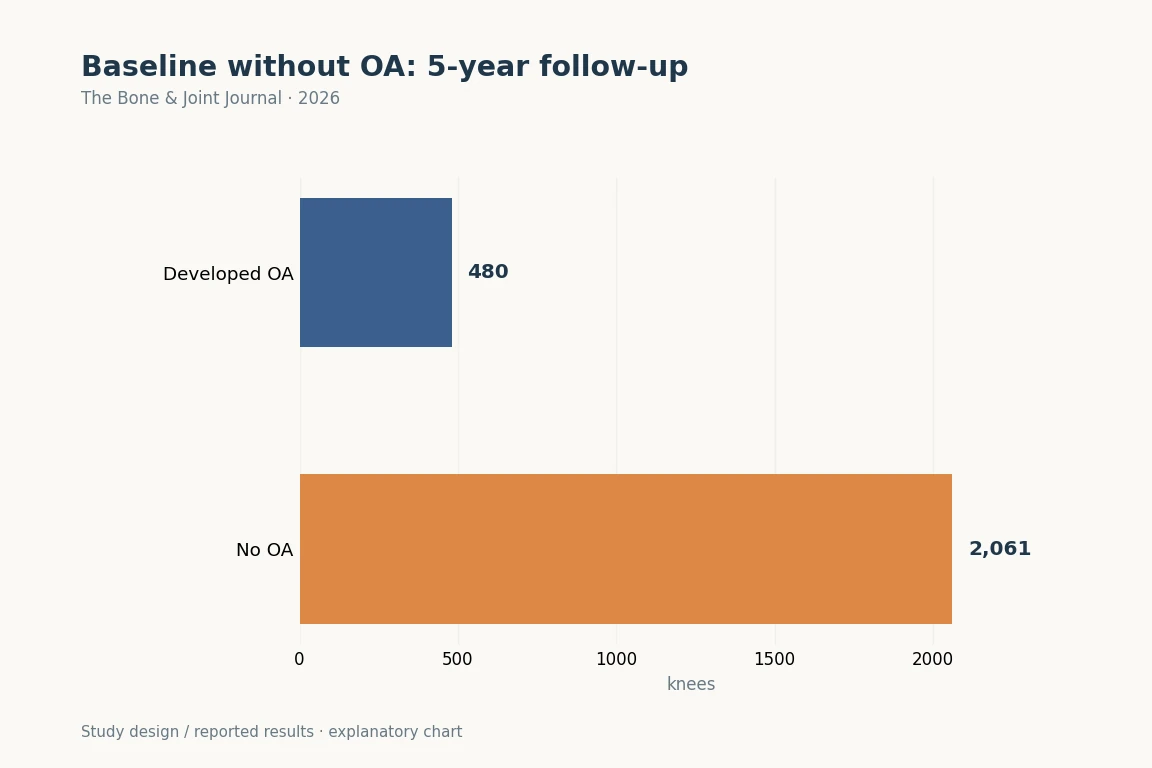
Over 5 years, 480 knees (18.9%) developed KL ≥2. CPAK type itself was not significantly associated with onset.
Results explained with study numbers
 Enlarge Figure
Among 2,541 knees without baseline OA, 480 developed OA over five years. The study examined continuous JLO measures and OA onset, beyond categorical alignment types.
The Bone & Joint Journal (2026). DOI: 10.1302/0301-620X.108B7.BJJ-2025-0687.R2 · Original explanatory chart based on reported data
The research question
Participants and Methods
Main Findings
Implications for clinical and surgical practice
Limitations
Let's put it briefly.
Which clinical question does this address?
Continuous measures of aHKA=MPTA−LDFA and JLO=MPTA+LDFA should be retained. The findings suggest possible refinement of classification boundaries, but do not validate preventive osteotomy or TKA alignment targets.
Keywords
- Osteoarthritis, Knee
- Knee Joint
- Bone Malalignment
- Alignment
- CPAK
- Osteoarthritis
- MOST
Abstract · Original text
Ji-Sahn Kim, Samuel J MacDessi, Do Weon Lee, Du Hyun Ro. Coronal alignment parameters of the knee predict osteoarthritis development : a Coronal Plane Alignment of the Knee classification-based analysis using the Multicenter Osteoarthritis Study data. The bone & joint journal. 2026;108-B(7):889-897. doi:10.1302/0301-620X.108B7.BJJ-2025-0687.R2.
AIMS
Mechanical varus or valgus alignment measures have been demonstrated to be closely related to knee osteoarthritis (KOA) development, but few attempts have been made to correlate the Coronal Plane Alignment of the Knee (CPAK) classification and disease development. This study hypothesized that certain CPAK types or deviations in CPAK parameters might enhance the risk of KOA development.
METHODS
KOA was defined as a Kellgren-Lawrence grade of 2 or higher. Data from 2,541 knees without KOA at baseline from the Multicenter Osteoarthritis Study (MOST) over five years of follow-up were examined. Differences in baseline CPAK types and parameters were analyzed between knees that developed KOA and those that did not. The association of CPAK type, arithmetic hip-knee-ankle angle (aHKA), and joint line obliquity (JLO) with the risk of disease development and joint line convergence angle (JLCA) changes were assessed.
RESULTS
Knees that developed KOA (480 knees; 18.9%) had significantly lower JLO (p = 0.022) and aHKA (p = 0.008) values than those that did not (2,061 knees; 81.1%). JLO was significantly associated with KOA development (odds ratio 1.048 (95% CI 1.001 to 1.098)). For knees with JLO values under the cut-off value of 171.6°, the risk of KOA development was 1.36 times higher than for those with values over the cut-off value (95% CI 1.053 to 1.770). aHKA showed a significant negative correlation with JLCA change (regression coefficient -0.139 (95% CI -0.241 to -0.036); p = 0.008). However, CPAK type itself showed no significant correlation with KOA development.
CONCLUSION
CPAK parameters, rather than types, were significantly associated with KOA development. Importantly, significant obliquity to the constitutional joint line might be as impactful as lower limb alignment. By potentially adjusting cut-off values, CPAK classification might be applied for predicting KOA development and investigating alignment-related aspects of KOA pathophysiology.
The original paper.
Coronal alignment parameters of the knee predict osteoarthritis development: A Coronal Plane Alignment of the Knee classification-based analysis using the Multicenter Osteoarthritis Study data
J-S. Kim, S. J. MacDessi, D. W. Lee, D. H. Ro
The Bone & Joint Journal · 2026