2026 · The Bone & Joint Journal
CPAK 유형보다 관절선의 기울기가 관절염 발생을 설명할까?
5년 동안 480무릎(18.9%)에서 KL ≥2가 발생했습니다. CPAK 유형 자체와 발생의 유의한 연관성은 없었습니다.
연구 수치로 읽는 결과
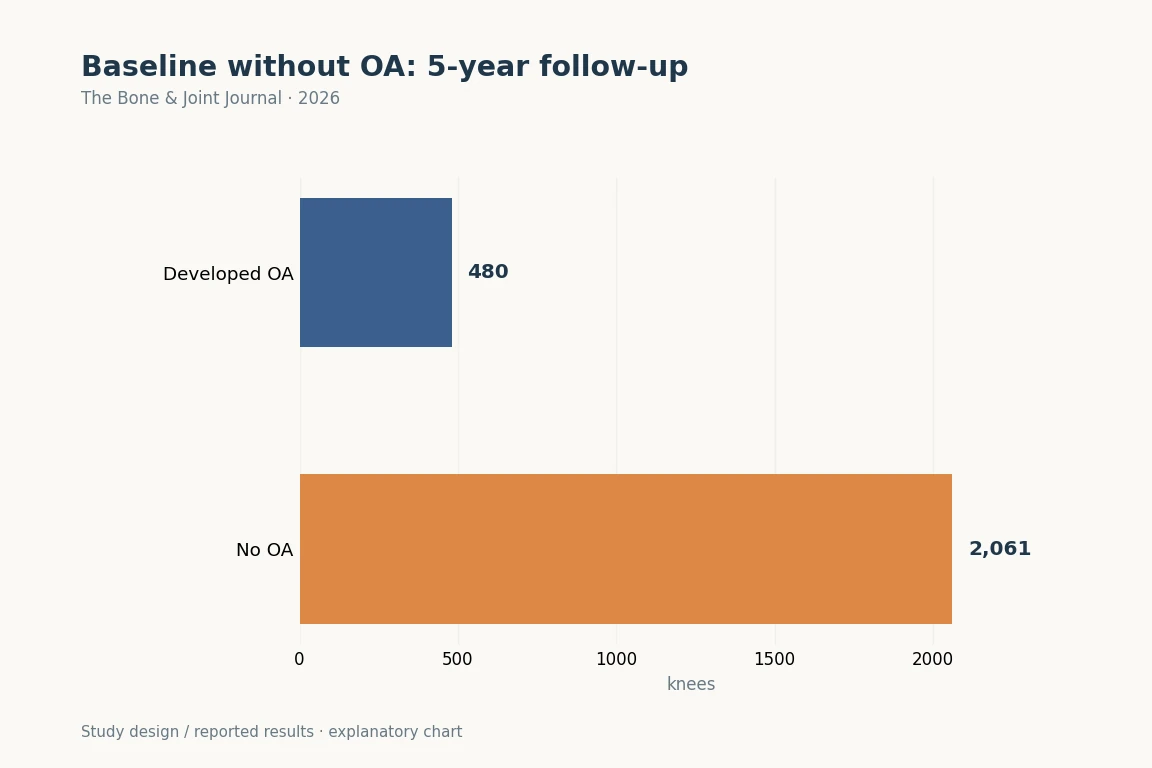 그림 크게 보기
시작 시 관절염이 없던 2,541무릎을 5년 추적해 480무릎에서 관절염이 발생했습니다. 유형 자체보다 연속적인 JLO 지표와 발생의 연관성을 살폈습니다.
The Bone & Joint Journal (2026). DOI: 10.1302/0301-620X.108B7.BJJ-2025-0687.R2 · Original explanatory chart based on reported data
연구에서 묻는 질문
대상과 방법
주요 결과
진료와 수술에서 읽을 지점
해석의 제한
짧게 정리하면
어떤 진료 질문과 연결되나요?
aHKA=MPTA−LDFA, JLO=MPTA+LDFA의 연속형 정보를 남겨야 합니다. 분류 경계를 조절할 가능성을 제시하지만 preventive osteotomy나 TKA 정렬 목표를 검증한 연구는 아닙니다.
Keywords · 주제어
- Osteoarthritis, Knee
- Knee Joint
- Bone Malalignment
- Alignment
- CPAK
- Osteoarthritis
- MOST
Abstract · 원문 초록
Ji-Sahn Kim, Samuel J MacDessi, Do Weon Lee, Du Hyun Ro. Coronal alignment parameters of the knee predict osteoarthritis development : a Coronal Plane Alignment of the Knee classification-based analysis using the Multicenter Osteoarthritis Study data. The bone & joint journal. 2026;108-B(7):889-897. doi:10.1302/0301-620X.108B7.BJJ-2025-0687.R2.
AIMS
Mechanical varus or valgus alignment measures have been demonstrated to be closely related to knee osteoarthritis (KOA) development, but few attempts have been made to correlate the Coronal Plane Alignment of the Knee (CPAK) classification and disease development. This study hypothesized that certain CPAK types or deviations in CPAK parameters might enhance the risk of KOA development.
METHODS
KOA was defined as a Kellgren-Lawrence grade of 2 or higher. Data from 2,541 knees without KOA at baseline from the Multicenter Osteoarthritis Study (MOST) over five years of follow-up were examined. Differences in baseline CPAK types and parameters were analyzed between knees that developed KOA and those that did not. The association of CPAK type, arithmetic hip-knee-ankle angle (aHKA), and joint line obliquity (JLO) with the risk of disease development and joint line convergence angle (JLCA) changes were assessed.
RESULTS
Knees that developed KOA (480 knees; 18.9%) had significantly lower JLO (p = 0.022) and aHKA (p = 0.008) values than those that did not (2,061 knees; 81.1%). JLO was significantly associated with KOA development (odds ratio 1.048 (95% CI 1.001 to 1.098)). For knees with JLO values under the cut-off value of 171.6°, the risk of KOA development was 1.36 times higher than for those with values over the cut-off value (95% CI 1.053 to 1.770). aHKA showed a significant negative correlation with JLCA change (regression coefficient -0.139 (95% CI -0.241 to -0.036); p = 0.008). However, CPAK type itself showed no significant correlation with KOA development.
CONCLUSION
CPAK parameters, rather than types, were significantly associated with KOA development. Importantly, significant obliquity to the constitutional joint line might be as impactful as lower limb alignment. By potentially adjusting cut-off values, CPAK classification might be applied for predicting KOA development and investigating alignment-related aspects of KOA pathophysiology.
원래 논문
Coronal alignment parameters of the knee predict osteoarthritis development: A Coronal Plane Alignment of the Knee classification-based analysis using the Multicenter Osteoarthritis Study data
J-S. Kim, S. J. MacDessi, D. W. Lee, D. H. Ro
The Bone & Joint Journal · 2026