2026 · The Bone & Joint Journal
CPAK分類より関節線の傾きが、関節症の発症を説明するか?
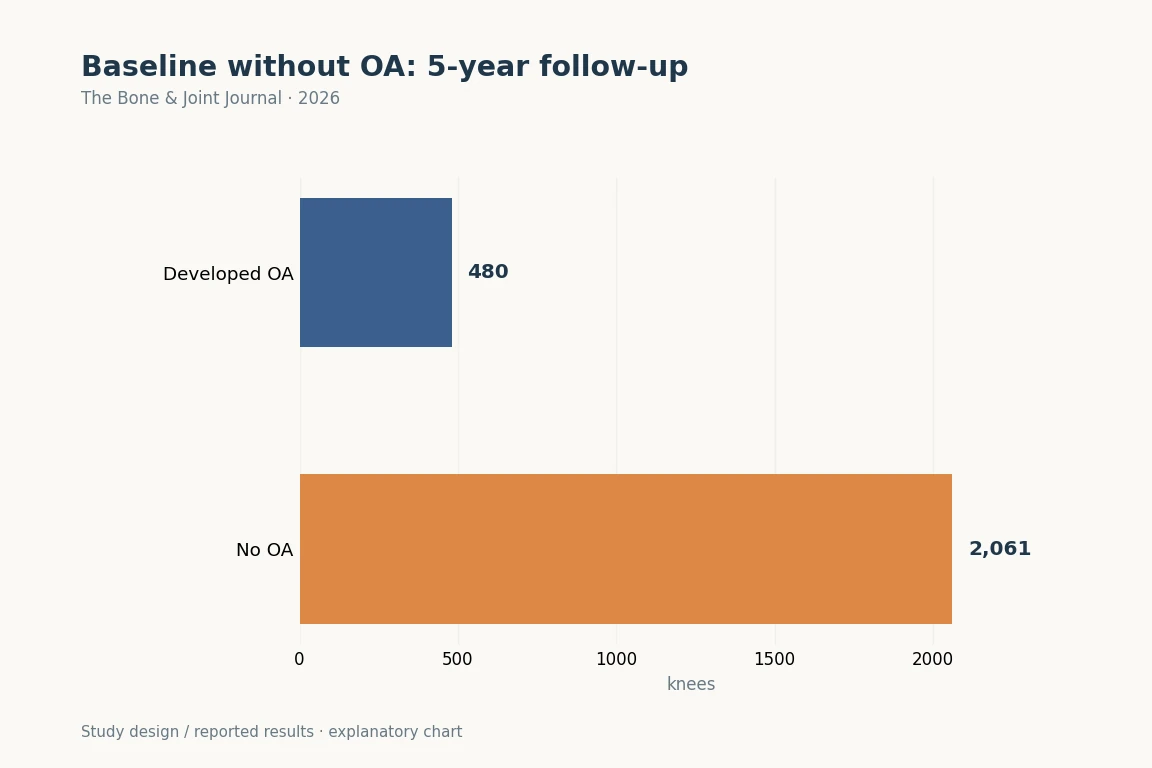
5年間で480膝(18.9%)がKL ≥2となりました。CPAK分類自体と発症に有意な関連はありませんでした。
研究の数値から読む結果
 図を拡大する
開始時に関節症のなかった2,541膝を5年間追跡し、480膝で発症しました。型の分類よりも連続的なJLO指標と発症との関連を調べました。
The Bone & Joint Journal (2026). DOI: 10.1302/0301-620X.108B7.BJJ-2025-0687.R2 · Original explanatory chart based on reported data
研究で問うこと
対象と方法
主な結果
診療・手術で考える点
解釈の限界
簡単に説明しましょう
どの診療上の問いにつながりますか?
aHKA=MPTA−LDFA、JLO=MPTA+LDFAの連続値を残す必要があります。分類境界を調整する可能性は示しますが、予防的骨切り術やTKAのアライメント目標を検証した研究ではありません。
Keywords・キーワード
- Osteoarthritis, Knee
- Knee Joint
- Bone Malalignment
- Alignment
- CPAK
- Osteoarthritis
- MOST
Abstract・原文の抄録
Ji-Sahn Kim, Samuel J MacDessi, Do Weon Lee, Du Hyun Ro. Coronal alignment parameters of the knee predict osteoarthritis development : a Coronal Plane Alignment of the Knee classification-based analysis using the Multicenter Osteoarthritis Study data. The bone & joint journal. 2026;108-B(7):889-897. doi:10.1302/0301-620X.108B7.BJJ-2025-0687.R2.
AIMS
Mechanical varus or valgus alignment measures have been demonstrated to be closely related to knee osteoarthritis (KOA) development, but few attempts have been made to correlate the Coronal Plane Alignment of the Knee (CPAK) classification and disease development. This study hypothesized that certain CPAK types or deviations in CPAK parameters might enhance the risk of KOA development.
METHODS
KOA was defined as a Kellgren-Lawrence grade of 2 or higher. Data from 2,541 knees without KOA at baseline from the Multicenter Osteoarthritis Study (MOST) over five years of follow-up were examined. Differences in baseline CPAK types and parameters were analyzed between knees that developed KOA and those that did not. The association of CPAK type, arithmetic hip-knee-ankle angle (aHKA), and joint line obliquity (JLO) with the risk of disease development and joint line convergence angle (JLCA) changes were assessed.
RESULTS
Knees that developed KOA (480 knees; 18.9%) had significantly lower JLO (p = 0.022) and aHKA (p = 0.008) values than those that did not (2,061 knees; 81.1%). JLO was significantly associated with KOA development (odds ratio 1.048 (95% CI 1.001 to 1.098)). For knees with JLO values under the cut-off value of 171.6°, the risk of KOA development was 1.36 times higher than for those with values over the cut-off value (95% CI 1.053 to 1.770). aHKA showed a significant negative correlation with JLCA change (regression coefficient -0.139 (95% CI -0.241 to -0.036); p = 0.008). However, CPAK type itself showed no significant correlation with KOA development.
CONCLUSION
CPAK parameters, rather than types, were significantly associated with KOA development. Importantly, significant obliquity to the constitutional joint line might be as impactful as lower limb alignment. By potentially adjusting cut-off values, CPAK classification might be applied for predicting KOA development and investigating alignment-related aspects of KOA pathophysiology.
オリジナル紙だ
Coronal alignment parameters of the knee predict osteoarthritis development: A Coronal Plane Alignment of the Knee classification-based analysis using the Multicenter Osteoarthritis Study data
J-S. Kim, S. J. MacDessi, D. W. Lee, D. H. Ro
The Bone & Joint Journal · 2026