After a knee twists during exercise, rest may make walking tolerable—but that does not show the ligament has recovered. Giving way may remain during turning or landing. With ACL injury, pain relief and regained stability are different; swelling alone cannot determine readiness to return.
Explanation of the video
And we explained it together in the video.
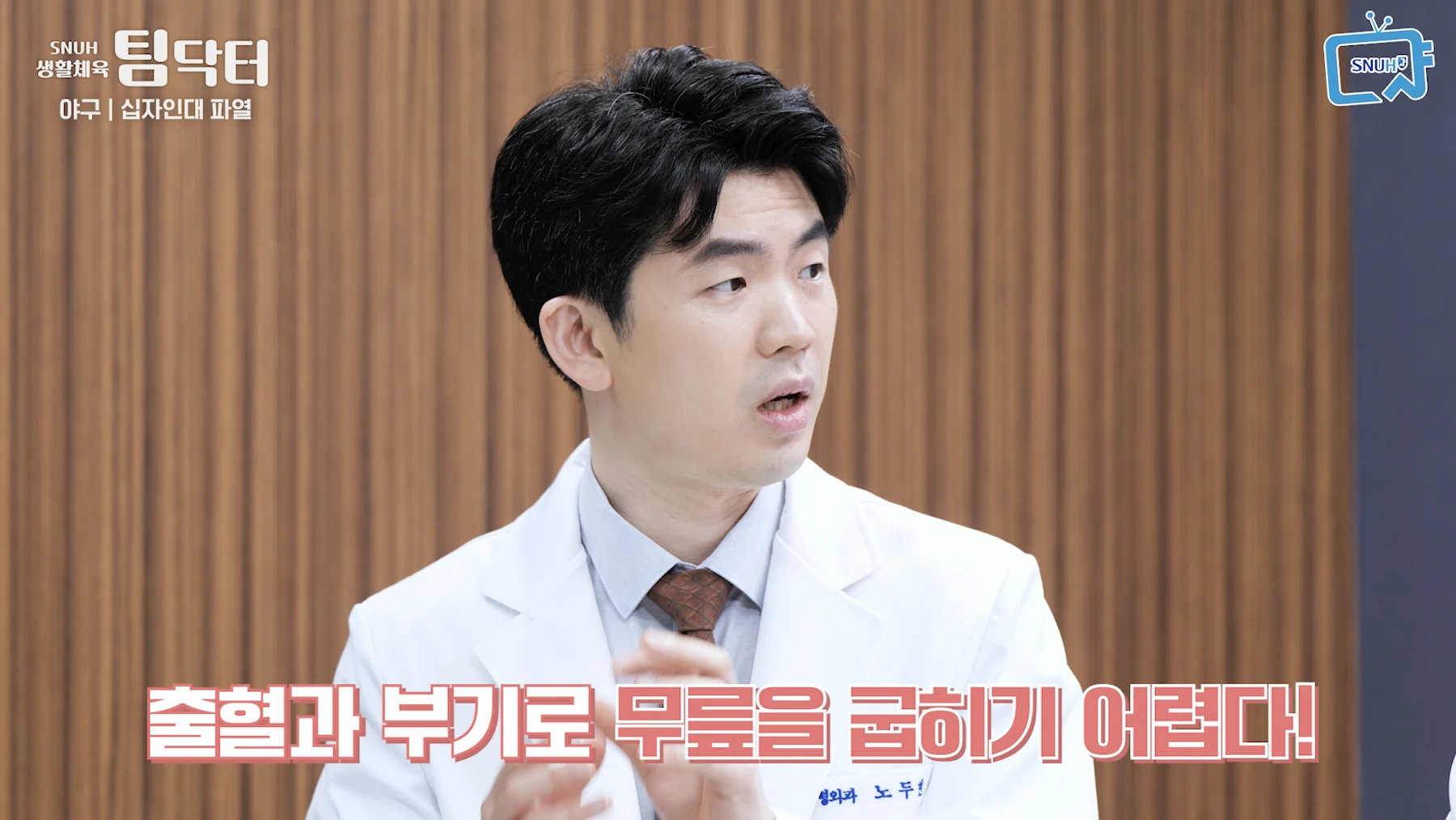
Swelling and movement immediately after injury
If you swell quickly after being injured and it's hard to move knee, check the damaged lining together with the associated damage. I'm losing weight, but it doesn't set me back.
Video frame · Seoul National University Hospital · SNUH team physician
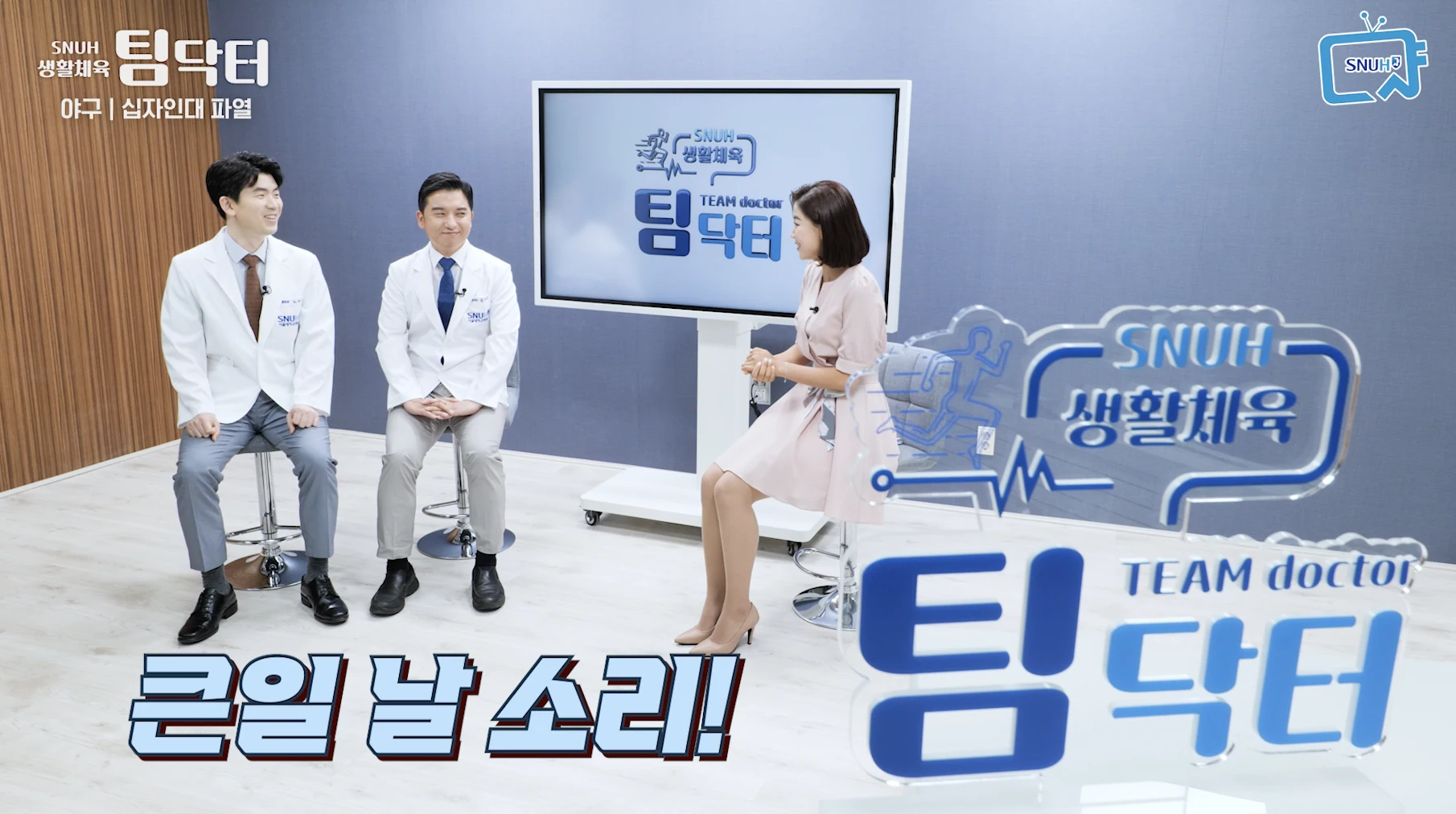
Can I exercise if I get swollen?
A cruciate-ligament explanation video featuring Professors Du Hyun Ro and Ji Hyeong Kim. Return to activity requires assessment of motion, strength and stability during turning and landing.
Video frame · Seoul National University Hospital · SNUH team physician
What does the anterior cruciate ligament do?
The ACL connects the femur and tibia inside the knee, limiting excessive forward movement of the tibia and helping rotational stability. Sudden turns in football or landings in basketball can injure it when rotation and load combine. No collision does not rule out injury. Describing the actual movement is more useful than simply saying you twisted the knee slightly.
Can swelling and a pop alone tell us the diagnosis?
A pop and rapid swelling are clues, but not hearing a pop does not establish an intact ligament. Clinicians ask about the injury, swelling onset and giving way, and compare knees. X-rays assess fractures and ligament-attachment bone injuries; MRI assesses ligaments, menisci and cartilage. One image is not a whole-knee evaluation.
Why check the meniscus too?
The same injury can damage ligaments and menisci. Meniscal damage affects load distribution and planning; repeated giving way may stress other tissue. Treating a cruciate ligament requires considering meniscal status, locking/catching and cartilage damage. Do not keep exercising through an inability to fully straighten, assuming swelling alone.
Does every tear need surgery?
The word “tear” alone does not decide surgery. Consider instability, associated injuries, growth plates, and desired activities. Pivoting sport and level walking have different demands. Some people manage with suitable rehabilitation; recurrent instability may lead to reconstruction. If an injury requires surgery, prolonged delay in assessment may be unhelpful. Ask why surgery is recommended for you and the risks of waiting.
Is the ligament fully restored immediately after reconstruction?
Ligament reconstruction usually uses tendon tissue fixed to bone. Finishing fixation does not make it function immediately like the original ligament. Motion, strength, balance and control recover in stages. Return to sport requires more than counting days: assess extension, strength, movement and any feeling of instability.
What should I tell the doctor at the next visit?
Record the injury movement, swelling at the time, and when the knee now gives way. Describe stairs, turns, and running as well as the fact that you can walk. Explain your desired activity and return timing. Confirm rehabilitation goals, movements to avoid, and reassessment criteria. Less pain alone is not a reason to rapidly increase intensity; first check readiness to move confidently.
Nine months is an important checkpoint for returning to pivoting sports
For sports such as football and basketball, which involve jumping and rapid changes of direction, 9 months after surgery is an important checkpoint. A study followed 106 sports participants after ACL reconstruction for 2 years. Among those who returned before 9 months, each additional month before return was associated with an approximately 51% lower rate of knee reinjury.
Decisions about return should consider both time and recovery. Assess thigh strength, single-leg hopping and landing, swelling, and instability, then return gradually with your rehabilitation clinician and surgical team. If function has not recovered sufficiently, wait longer even after 9 months.
Starting with rehabilitation and choosing reconstruction later is also an option
After an ACL tear, rehabilitation begins by reducing swelling, restoring movement, and improving strength and balance. In the KANON study of 121 young, active adults, 30 of the 59 participants who began with rehabilitation and the option of later surgery—about 51%—underwent reconstruction within 5 years.
At 5 years, average patient-reported scores did not differ significantly between the early-reconstruction strategy and rehabilitation with surgery if needed. However, the need for surgery varies with the sport you want to return to, repeated episodes of the knee giving way, and associated injuries such as a meniscal tear. If you wish to continue pivoting sports or experience repeated instability in daily life, discuss reconstruction actively with your surgical team.